
Trump said allies will join Hormuz blockade, no nation stepped forward
 5 Min Read
As of Monday morning, no nation has volunteered to join Trump's blockade effort, with key allies instead calling for de-escalation and a return to negotiations.
-
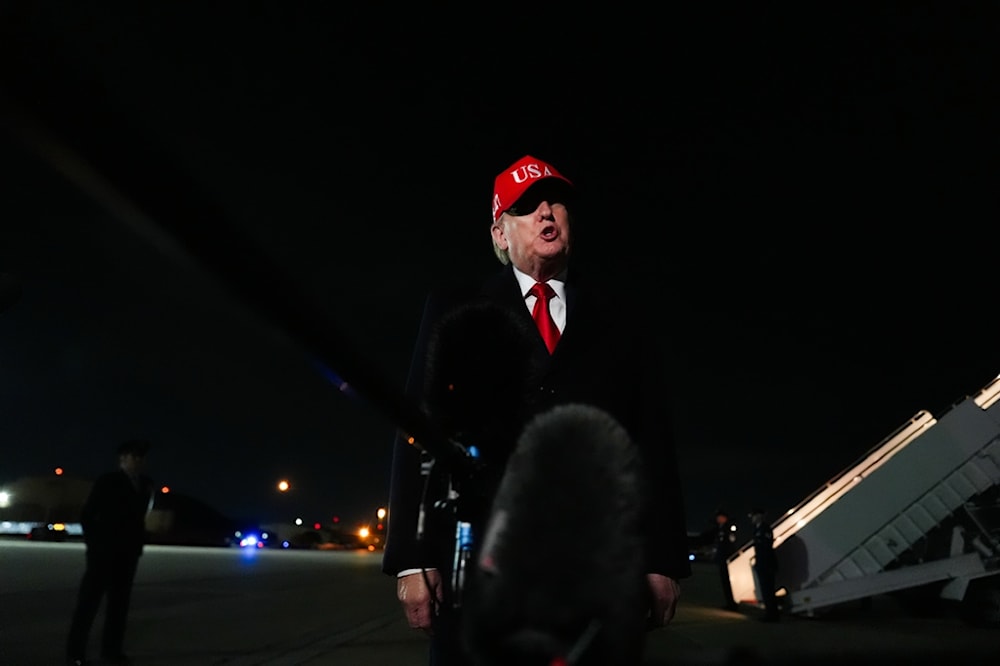
US President Donald Trump speaks with reporters after disembarking Air Force One, Sunday, April 12, 2026, at Joint Base Andrews, Md. (AP)
US President Donald Trump's weekend announcement of a comprehensive US naval blockade targeting Iranian ports marked yet another abrupt shift in his fluctuating approach to pressuring Tehran and reopening the Strait of Hormuz to commercial shipping, The New York Times reported.
The US Navy is set to begin blocking access to Iranian ports starting Monday and will intercept any vessels making transit payments to Iran, Trump said. He suggested that other militaries would join the American effort.
"We think that numerous countries are going to be helping us with this also," Trump told Fox News on Sunday.
However, by early Monday, no volunteers had emerged.
Key allies reject blockade participation
British Prime Minister Keir Starmer said his country would not support the blockade and went as far as saying he would not allow dragging his country into Trump's war on Iran. Australian Prime Minister Anthony Albanese stated that his government had not received any request to assist and instead urged the de-escalation of the crisis.
Spain's defense minister, Margarita Robles, dismissed the proposed blockade in a television interview on Monday.
"It makes no sense," she said. "Since this war started, nothing makes sense. This is another episode in the downward spiral the world has been dragged into."
Read More: UK refuses to join Trump's Strait blockade, Australia says not asked
War continues to disrupt global economy
The US-Israeli war on Iran, now entering its seventh week, has disrupted international trade, destabilized energy markets, and inflicted economic hardship on countries worldwide, harming both American allies and adversaries alike.
Trump's sudden blockade announcement on Sunday did little to improve the increasingly bleak global outlook. Oil prices climbed on Monday while stock markets declined, indicating that investors do not believe the blockade will quickly resolve the economic damage caused by the war.
The blockade appears to represent Trump's latest attempt to pressure Tehran into negotiations after direct talks between US and Iranian officials in Pakistan over the weekend failed to produce a breakthrough.
Experts question blockade effectiveness
Some analysts have expressed doubt about whether the tactic will succeed. Ahmet Kasim Han, a professor of international relations at TED University in Ankara, suggested that Trump may be overestimating the effectiveness of economic pressure in changing Iran's position.
"Iran is already hurting, and they have shown that they are willing to take more than a couple of hits," Han said.
Han added that Trump's credibility was undermined by his announcement that other countries would help enforce the blockade without naming which ones. "This habit of saying that people are on board with him while not naming them diminishes his credibility, and that does not work well for US standing internationally," he said.
Read more: 'Iran resilient, far from collapse': Israeli media
Most governments call for return to talks
Many governments did not issue immediate direct responses to Trump's blockade announcement. Among those that did, the majority instead called for a return to diplomatic negotiations.
Starmer told BBC Radio 5 that getting the Strait fully open was vital, which is where all British efforts had been focused.
Albanese of Australia, who was preparing for a diplomatic tour across Asia to secure fuel and fertilizer supplies, called the lack of progress in weekend talks between Iran and the United States disappointing. He said his government wanted to see the escalation and a resumption of negotiations.
In Beijing, Chinese Foreign Ministry spokesman Guo Jiakun called for a ceasefire and urged all parties to exercise restraint. "China is willing to continue to play a positive and constructive role," he said. China is a major importer of fuel that transits through the Strait of Hormuz.
CENTCOM to implement blockade of Iranian maritime traffic
Amid these developments, the United States has moved forward with elements of Trump’s proposed plan.
The US will begin enforcing a maritime blockade on all traffic entering and exiting Iranian ports starting April 13 at 10 am ET (5:00 pm al-Quds Time), according to a statement by US Central Command (CENTCOM).
The measure comes in accordance with a presidential proclamation and will apply to vessels of all nationalities operating in Iranian waters.
CENTCOM said the blockade will be implemented impartially, targeting all ships entering or departing Iranian ports and coastal areas, including those located along the Gulf and the Gulf of Oman.
Despite the sweeping restrictions, the command emphasized that freedom of navigation will remain unaffected in one of the region’s most critical waterways.
Vessels transiting the Strait of Hormuz en route to or from non-Iranian ports will not be impeded, CENTCOM stated, underscoring that international shipping lanes will remain open.
Read more: Iran warns US over Strait of Hormuz blockade as implementation nears


