
Iran warns US over Strait of Hormuz blockade as implementation nears
 4 Min Read
Iranian officials warn the US over Strait of Hormuz tensions, rejecting naval blockade claims and stressing readiness amid rising regional escalation.
-
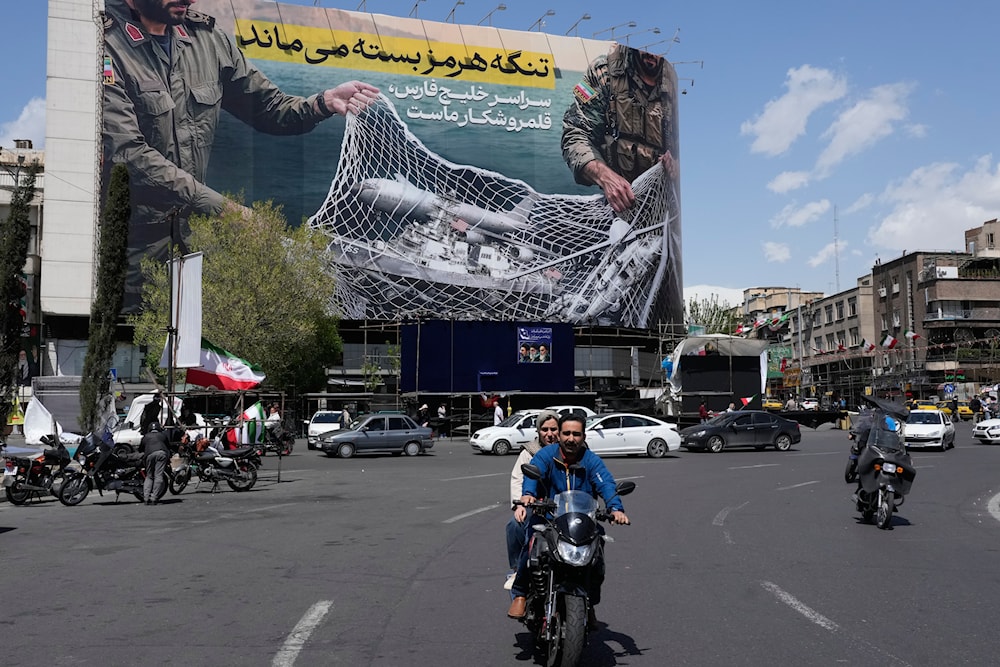
Vehicles and motorcycles move past an anti-US billboard depicting the American aircraft caught in the Iranian armed forces' fishing net at the Islamic Revolution square in downtown Tehran, Iran, April 5, 2026 (AP)
The Axis of Resistance maintains a strong and active presence across the region and remains on high alert, Brigadier General Esmail Qaani stated on Sunday.
Brig. Gen. Qaani, commander of the Quds Force of Iran’s Islamic Revolution Guard Corps, stated that "the unified resistance front enjoys a strong and effective presence throughout the region, and it is in a state of readiness awaiting the enemies of humanity."
Qaani added: "America and the Zionist entity must remember how they fled empty-handed from heroic Yemen, from Bab al-Mandeb, and the Red Sea," stressing, "and now as well, they will leave the region without achieving any accomplishment."
For his part, Ebrahim Rezaei, spokesperson for the Iranian Parliament’s National Security and Foreign Policy Committee, said that "Trump has no choice but to accept defeat," asserting that "the Iranian people are not defeated, and this gambler will lose again."
Trump's blockade more deception than reality
Rezaei further explained that "Trump’s talk of initiating a naval blockade on Iran is more deception than reality," warning that "if Trump implements his blockade on the Strait of Hormuz, it will be considered an act of war, and we will respond to it."
He also noted that the recent US measure related to the Strait of Hormuz "will lead to further complications in the current situation he is struggling with and will increase market instability."
Meanwhile, Deputy Speaker of the Iranian Parliament Hamid Reza Haji Babaei stated that "with the presence of the Strait of Hormuz, no country can impose sanctions on Iran," adding: "the Strait of Hormuz and the masses in the streets are our nuclear bomb."
These statements come in response to claims by US President Donald Trump that a naval blockade would be imposed on vessels attempting to enter or exit the Strait of Hormuz.
Trump threatens, Iran remains steadfast
US President Donald Trump announced on April 12 that Washington would impose a naval blockade on the Strait of Hormuz, warning that any retaliatory action would result in Iran being “blown to hell.”
In a post on the Truth Social platform, Trump said talks held in Islamabad had made progress on several issues but ultimately collapsed over Washington’s demand that Tehran halt uranium enrichment, which Iran insists is a sovereign right under international law. “So, there you have it, the meeting went well, most points were agreed to, but the only point that really mattered, NUCLEAR, was not,” he wrote.
Iran has consistently maintained that its nuclear program is intended for peaceful purposes, stressing that uranium enrichment falls within its sovereign rights.
Trump nevertheless portrayed the outcome as justification for immediate escalation, announcing that US naval forces would begin enforcing broad restrictions in one of the world’s most strategic maritime corridors. “Effective immediately, the United States Navy, the Finest in the World, will begin the process of BLOCKADING any and all Ships trying to enter, or leave, the Strait of Hormuz,” he said.
US destroyers' passage through Hormuz foiled
Meanwhile, Iran has asserted that the Strait of Hormuz would not be open to hostile forces. A spokesperson for the Khatam al-Anbiya Central Headquarters said earlier on Sunday that "The authorization for any vessel's transit through this strategic waterway rests solely with the Armed Forces of the Islamic Republic of Iran."
This came after two US destroyers attempted to cross the Strait on April 11 while negotiations were still underway.
A report by Press TV indicated that Iranian forces, including the Navy of the Islamic Revolutionary Guard Corps (IRGC), responded rapidly to the presence of the US vessels.
According to the report, cruise missile systems locked onto the destroyers as they approached the entrance to the Persian Gulf, while drones were deployed overhead. The vessels were subsequently issued a warning, granting them 30 minutes to alter course.
The report added that communication was established through international maritime channels, instructing the US ships to leave the area or face possible targeting. The destroyers later withdrew following the warning.
According to the findings, the US vessels also employed electronic warfare measures during the encounter.
These reportedly included disabling position-reporting systems and attempting to conceal their identity by presenting themselves as commercial vessels. The ships were said to have simulated Omani registration while navigating through the southern Sea of Oman.


