
Trump orders insurance, possible Navy escorts for ships in the Gulf
 4 Min Read
Trump orders political risk insurance for ships in the Gulf and signals possible US Navy escorts as escalation with Iran threaten energy routes.
-
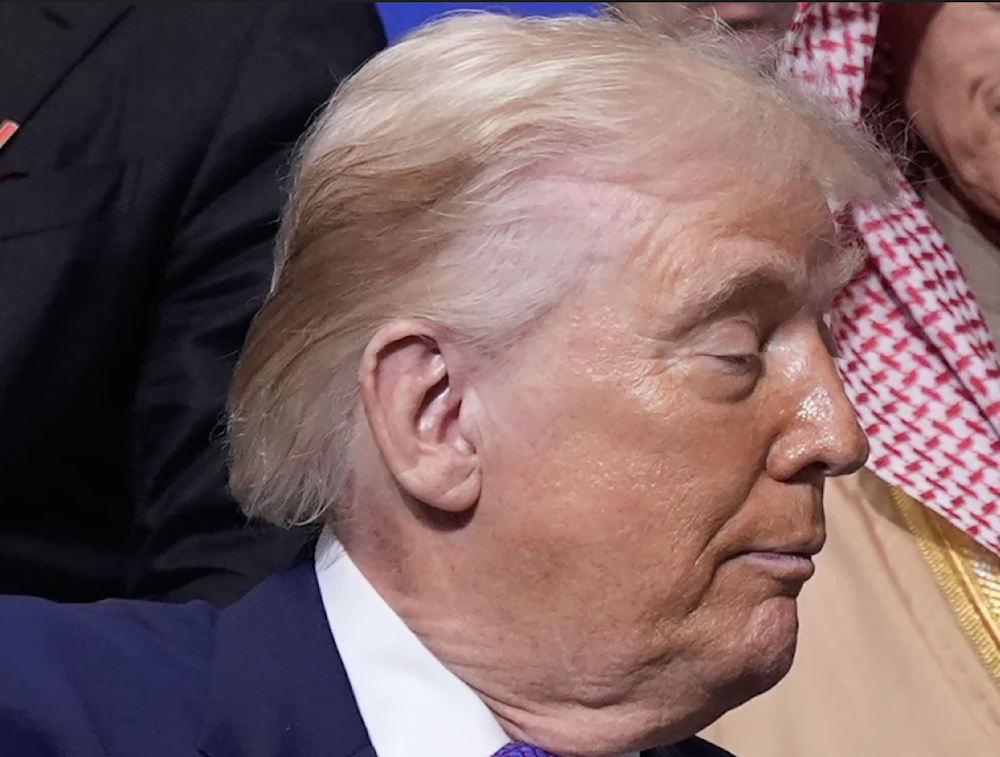
Redness is visible on the neck of US President Donald Trump as he attends a Board of Peace meeting at the U.S. Institute of Peace, on February 19, 2026, in Washington (AP)
US President Donald Trump announced that he has directed the United States Development Finance Corporation (DFC) to provide political risk insurance and financial guarantees for ships traveling through the Persian Gulf, particularly energy shipments.
“Effective IMMEDIATELY, I have ordered the United States Development Finance Corporation (DFC) to provide, at a very reasonable price, political risk insurance and guarantees for the Financial Security of ALL Maritime Trade, especially Energy, traveling through the Gulf. This will be available to all Shipping Lines,” Trump wrote on Truth Social.
The announcement comes after Iran officially closed the Strait of Hormuz, with Brigadier General Ebrahim Jabbari, the Advisor to the Commander of the IRGC, warning on Monday that any ship attempting to pass through will burn.
Jabbari further raised the stakes and said that Iran will prevent the export of oil from the region. "Not one drop of oil will be allowed to leave the region," he said, adding that oil pipelines may also be targeted, estimating a drastic rise in oil prices to "$200 in the coming days."
Oil benchmarks had already been hovering near multi-month highs amid tightening inventories and escalating geopolitical tensions in West Asia, magnifying the market’s sensitivity to any supply threat. Since the aggression was launched against Iran, Brent crude surged, at one point climbing roughly 10–13% to between $80 and $82 per barrel, as investors weighed the risk that sustained hostilities could disrupt flows through the Strait of Hormuz.
Major shipping line suspends upper Gulf bookings
Amid the heightened security environment, German shipping giant Hapag-Lloyd announced on March 2 the immediate suspension of bookings from Africa to the Upper Gulf region until further notice.
The company cited “current operational and security constraints in the Upper Gulf region,” stating that the decision was made to maintain cargo safety, secure equipment placement, and uphold operational standards.
The booking suspension applies to all cargo types moving from several African countries to:
- United Arab Emirates
- Iraq
- Kuwait
- Qatar
- Bahrain
- Eastern Province of Saudi Arabia
Additionally, all cargo moving via Jebel Ali on the MIAX Eastbound (EB) and EA2 Northbound (NB) services is included in the booking stop.
Hapag-Lloyd said its teams are actively monitoring developments and will provide updates as the situation evolves.
The affected African countries include Mauritania, Senegal, Gambia, Guinea, Sierra Leone, Liberia, Ivory Coast, Ghana, Togo, Benin, Nigeria, Cameroon, Gabon, Equatorial Guinea, Congo Brazzaville, DR Congo, Angola, Namibia, South Africa, Kenya, Tanzania, Sudan, and Djibouti.
Strait of Hormuz in focus
The Strait of Hormuz, located between Iran and Oman, remains one of the world’s most critical maritime chokepoints for global oil transit. Any disruption in the narrow waterway can have immediate repercussions on international energy markets.
Trump said the insurance would be offered immediately to all shipping lines at what he described as a “very reasonable price,” aiming to mitigate financial risks linked to operating in a conflict zone.
He also said the US Navy could begin escorting tankers through the Strait of Hormuz if necessary to ensure safe passage.
“No matter what, the United States will ensure the free flow of energy to the world,” Trump said, adding that further measures could follow.
The move signals a potential expansion of US military involvement in securing maritime routes as the war with Iran continues to unfold.


