
Trump’s redacted classified files fail to prove election allegations
 4 Min Read
The US president renews claims about China, election vulnerabilities, and noncitizen voter registration, despite previous US intelligence assessments.
-
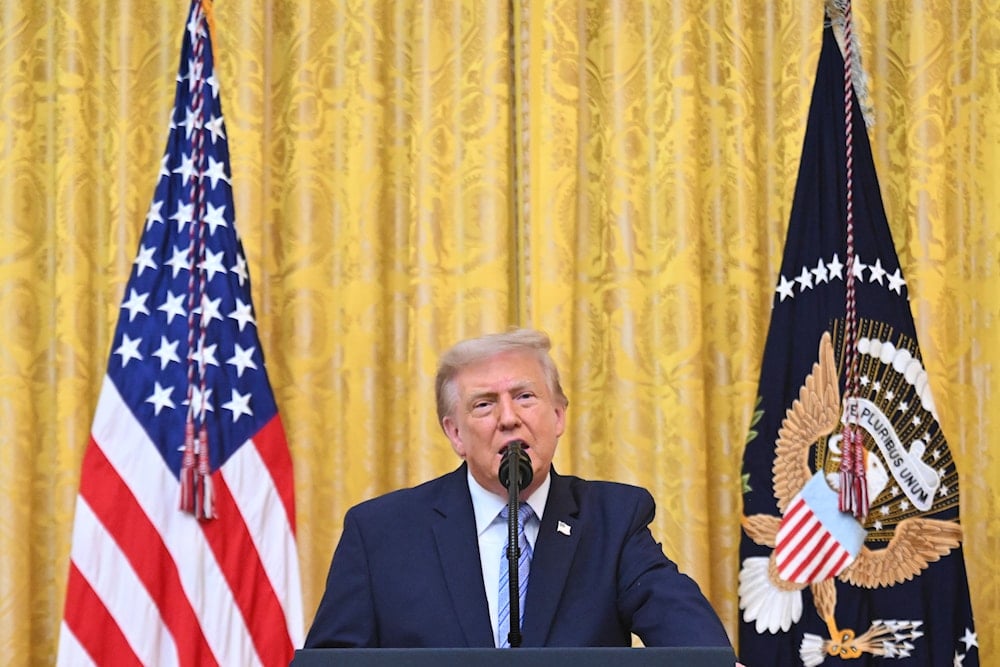
US President Donald Trump speaks in the East Room of the White House, July 16, 2026, in Washington (AP)
US President Donald Trump used a televised address from the East Room of the White House on Thursday to assert that the US election system faces significant vulnerabilities, making claims regarding Chinese interference and noncitizen voter registration that conflict with previous intelligence community assessments.
In an analysis by Sam Levine published by The Guardian, in New York, Trump attempted to give the impression that his administration had uncovered new findings about weaknesses in the electoral system. He claimed that China had illicitly acquired voter information on 220 million Americans and that China had interfered in other ways to undermine his 2020 campaign, adding that intelligence officials had suppressed this information. Trump did not specify the means by which China acquired the data.
The White House released a tranche of formerly classified materials on Thursday in an attempt to undercut previous conclusions. However, the documents were heavily redacted, making it difficult to assess their content. A review of the documents by CNN concluded there was not much new information in them.
Intelligence community findings directly oppose Trump
Trump’s claims about election vulnerabilities were already investigated by intelligence officials, who concluded with high confidence in 2021 that China “did not deploy interference efforts and considered but did not deploy influence efforts intended to change the outcome of the US presidential election.”
A minority view included in that public report by the national intelligence officer for cyber argued, “China took at least some steps to undermine former President Trump’s reelection chances, primarily through social media and official public statements and media.” That dissenting view also concluded, “We have no information suggesting China tried to interfere with election processes.”
At least some of the documents released on Thursday appeared to undercut the idea that China intended to interfere in the 2020 election. Instead of offering smoking-gun evidence, the release appeared to be a return to a classic Trump strategy of flooding the zone with information in an attempt to muddy the waters and make uncertain what was true, according to the review.
Claims on noncitizen voters and future administration action
Trump also claimed that FBI officials had investigated a voter-canvassing operation in Muskegon, Michigan, in which canvassers admitted they had submitted voter-registration applications with fake names. While it is not known why the FBI did not file charges, the incident did not result in illegitimate ballots being cast and was caught by the local clerk. The incident has been trumpeted by Michigan Republicans and the far-right website the Gateway Pundit for years.
Trump said the Department of Homeland Security had identified more than 270,000 noncitizens on the voter rolls in four states, without providing details on how the agency identified those individuals. There are more than 211 million people registered to vote in the United States.
The US Constitution gives no power over elections to the president, instead vesting that authority with the states. Toward the end of his speech, Trump said his administration would be taking more action to try to take control of elections. He stated that the Department of Homeland Security was holding a briefing on Friday to discuss vulnerabilities in state voting systems and would order states to remove noncitizens from the rolls.
The Chinese Embassy in Washington has firmly rejected the allegations, affirming that China "has never and will never" interfere in US presidential elections.
In a statement issued to RIA Novosti on Thursday, an embassy spokesperson reiterated Beijing's long-standing commitment to the principle of non-interference in the internal affairs of other nations.
"China has never and will never interfere in the presidential elections of the US," the spokesperson said, noting that "the US election is an internal matter of the US Its outcome is determined by the votes of the American people."


