Al Mayadeen English

  • Ar
  • Es
  • x
Al Mayadeen English

Slogan

  • News
    • Politics
    • Economy
    • Sports
    • Arts&Culture
    • Health
    • Miscellaneous
    • Technology
    • Environment
  • Articles
    • Opinion
    • Analysis
    • Blog
    • Features
  • Videos
    • NewsFeed
    • Video Features
    • Explainers
    • TV
    • Digital Series
  • Infographs
  • In Pictures
  • • LIVE
News
  • Politics
  • Economy
  • Sports
  • Arts&Culture
  • Health
  • Miscellaneous
  • Technology
  • Environment
Articles
  • Opinion
  • Analysis
  • Blog
  • Features
Videos
  • NewsFeed
  • Video Features
  • Explainers
  • TV
  • Digital Series
Infographs
In Pictures
  • Africa
  • Asia
  • Asia-Pacific
  • Europe
  • Latin America
  • MENA
  • Palestine
  • US & Canada
BREAKING
Military source to Fars: We foiled CENTCOM's scenarios to breach the Strait's control and management system through continuous monitoring and effective strikes
Military source to Fars: Last night witnessed one of the most intense levels of Iranian military confrontation in the heart of the Strait of Hormuz
Military source to Fars: In the past 24 hours, Iran conducted one of its fiercest and most diverse offensive and defensive operations against violating ships and US aircraft
Brigadier General Majid Mousavi, receiving the IRGC Commander-in-Chief: Our combat system today possesses astonishing, effective, terrifying, and destructive equipment
IRGC Aerospace Force Commander: We are fully prepared to carry out the orders of the Supreme Leader and IRGC leadership across all operational theaters
Iran's IRGC Commander Major General Ahmad Vahidi tours new missile city: What the enemy is facing is only the beginning
Al-Moussawi: Sovereignty cannot be restored or safeguarded by undermining the nation's strength or threatening civil peace
Al-Moussawi: Those seeking to put the resistance on trial today are either unaware or deliberately ignoring that they are offending a people's memory, while challenging a cause written in blood
Hezbollah's Ammar al-Moussawi at the 35th Arab National Congress in Beirut: Resistance in Lebanon would not have emerged had it not been for aggression and occupation
Al-Hayya: The Israeli enemy has moved into the implementation phase of its 'Greater Israel' project

Trump's 3 failed options for reopening Strait of Hormuz: The Economist

  • By Al Mayadeen English
  • Source: The Economist
  • 14 Jul 2026 22:22
4 Min Read

The Economist examines why none of Washington's options of further attacks, escalation, or blockade can reopen the Strait of Hormuz as the Iran-US MoU unravels.

Listen
  • x
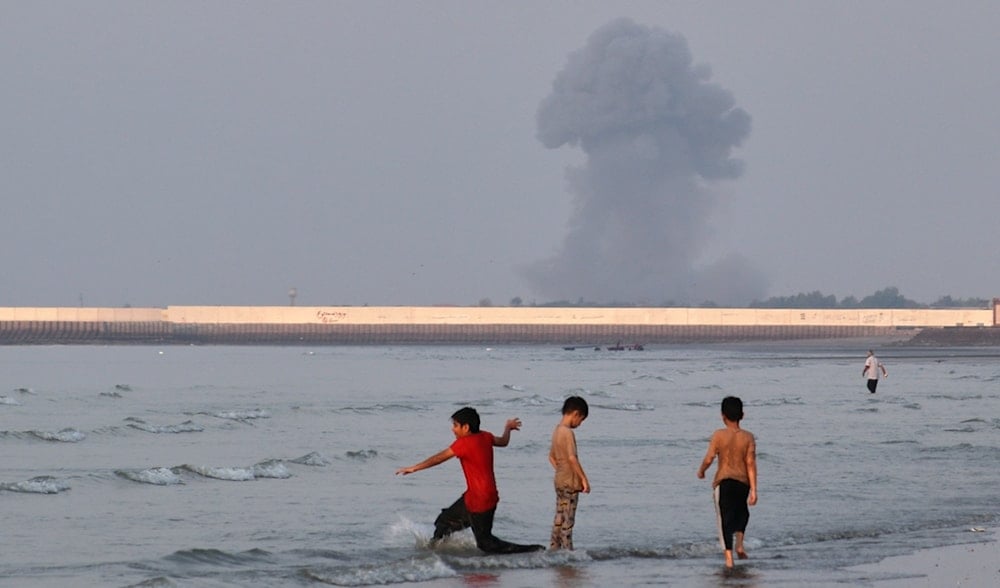
  • Three boys play in the shallow waters of the Strait of Hormuz, as a plume of smoke rises from an explosion in the background, off Bandar Abbas, Iran, Monday, July 13, 2026. (Razieh Poudat/ISNA via AP)
    Three boys play in the shallow waters of the Strait of Hormuz, as a plume of smoke rises from an explosion in the background, off Bandar Abbas, Iran, Monday, July 13, 2026 (ISNA via AP)

The memorandum of understanding that was meant to end the US war on Iran is unraveling, and Washington is left with the same three options it had before the deal existed, none of which reopens the Strait of Hormuz.

The Economist traces the collapse back to the MoU's fifth paragraph, which commits Iran to "make arrangements" for safe passage of commercial vessels.

Washington reads this as an obligation to clear mines, while Tehran reads it as a right to administer traffic through the Strait. Washington has already revoked the sanctions waiver that let Iran sell oil, and Trump has said he will resume the naval blockade.

Option one: Continued limited attacks

The first path available to Washington is simply to keep doing what it has already been doing, attacking Iranian military sites and equipment on a limited basis. The Economist argues that this option has effectively already failed.

More than 300 such attacks over five nights have not shifted Iranian behavior in any meaningful way, and there is little reason to expect a sixth night, or a sixtieth, to succeed where the first fifty did not.

Part of the problem is geographic, as even if the US were able to bomb every coastal launcher Iran possesses, the country could keep firing on shipping from positions further inland, since many of its missiles and drones have ranges well beyond 1,000 kilometers. 

Option two: Escalation

The second option is to escalate well beyond the current tit-for-tat, but The Economist notes that this path carries substantial risk without any assurance of a better outcome.

Attacking Iran's core infrastructure directly would likely draw retaliation against Gulf states caught in the crossfire and could expose Washington to accusations of a war crime.

Deploying ground troops, meanwhile, is regarded as politically untenable in Washington under current conditions, making it a non-starter regardless of its theoretical military logic.

Trump has repeatedly floated occupying Kharg Island, the site of Iran's main oil export terminal, but The Economist points out that this would do nothing to reopen Hormuz itself, since the island sits more than 600 kilometers from the strait.

Option three: Reimposing the blockade

The third option, reinstating the naval blockade, might look like the least disruptive choice, but The Economist argues it simply returns both sides to the standoff that existed before the MoU was signed, a staring contest over which side blinks first under economic pressure.

That earlier standoff is precisely what produced the interim deal now falling apart, which offers little confidence that repeating it would end differently.

There is also no guarantee Iran accepts a renewed blockade without retaliating against Gulf states this time around, and if it does escalate in response, Trump would be left choosing between all-out war and a retreat from his stated goals.

No outside help in sight

Britain and France have offered to help Oman clear mines from the strait, but Germany, Japan, Gulf states and China have all stayed on the sidelines, The Economist observes, leaving Washington with little meaningful outside support to draw on.

Tanker traffic through the strait has collapsed to its lowest level since May, and Brent crude has climbed roughly 20 percent since July 6, trading near $87 a barrel.

The Economist concludes that neither Washington nor Tehran has a military path to what it wants, claiming that the US cannot bomb the strait open, and Iran cannot profit while it stays shut, leaving the fragile MoU as the least bad option either side has left.

  • United States
  • US war on Iran
  • Iran-US Memorandum of Understanding
  • Strait of Hormuz
  • The Economist
  • Iran

Most Read

A view of Iran's nuclear enrichment facility in Natanz, Iran, on April, 9, 2007 (AP)

Iran announces first nuclear fusion reactor, set to operate soon

  • Technology
  • 15 Nov 2026
Yemen’s Armed Forces engage Saudi forces, south of Taiz, Yemen, October 14, 2026. (Yemeni Military Media)

Field sources: YAF secure large areas of Dhubab at Bab al-Mandab

  • Politics
  • 15 Nov 2026
People watch as two cooling towers of the Scholven Power Station are demolished due to Germany's Energy Transition, in Gelsenkirchen, Germany, May 9, 2026. (AP)

Germany drafts law to bring coal power plants amid gas shortage fears

  • Environment
  • 14 Nov 2026
A document that was included in the U.S. Department of Justice release of the Jeffrey Epstein files, photographed Wednesday, Feb. 4, 2026, shows an April 2012 International Driving Permit for Epstein. (AP)

Epstein was strangled, forensic expert says after file review: BBC

  • Miscellaneous
  • 16 Nov 2026

Coverage

All
US Midterm Elections 2026

Read Next

All
Ukrainian President Volodymyr Zelensky gives a press conference in Kiev, Feb. 19, 2025. (AP)
Politics

Zelensky urges Pentagon to unlock stalled patriot missile deliveries

Palestinian inspects his scrapyard where vechiles were scorched during and Israeli settler attack in the West Bank Village of Burqa, east of Ramallah, July 15, 2025. (AP)
Politics

'Israel' plans settler 'mega-city' to split Palestinian land in two

US Senate Majority Leader John Thune heads to the Senate chamber as Republicans debate President Donald Trump’s tax and spending bill in Washington, June 29, 2025. (AP)
Politics

Trump's $350bln Pentagon bid could reopen Medicaid fight

US President Donald Trump watches as War Secretary speaks with reporters at the White House, April 6, 2026, in Washington. (AP)
Politics

Hegseth curbs military ties with Canada, Trump feud deepens: WashPo

Al Mayadeen English

Al Mayadeen is an Arab Independent Media Satellite Channel.

All Rights Reserved

  • x
  • Privacy Policy
  • About Us
  • Contact Us
  • Authors
Android
iOS