
Trump's return to war on Iran 'a dead end': FT
 3 Min Read
The Financial Times says Trump's renewed strikes on Iran risk deepening the political, economic, and diplomatic costs of a prolonged war with no clear path to resolution.
-
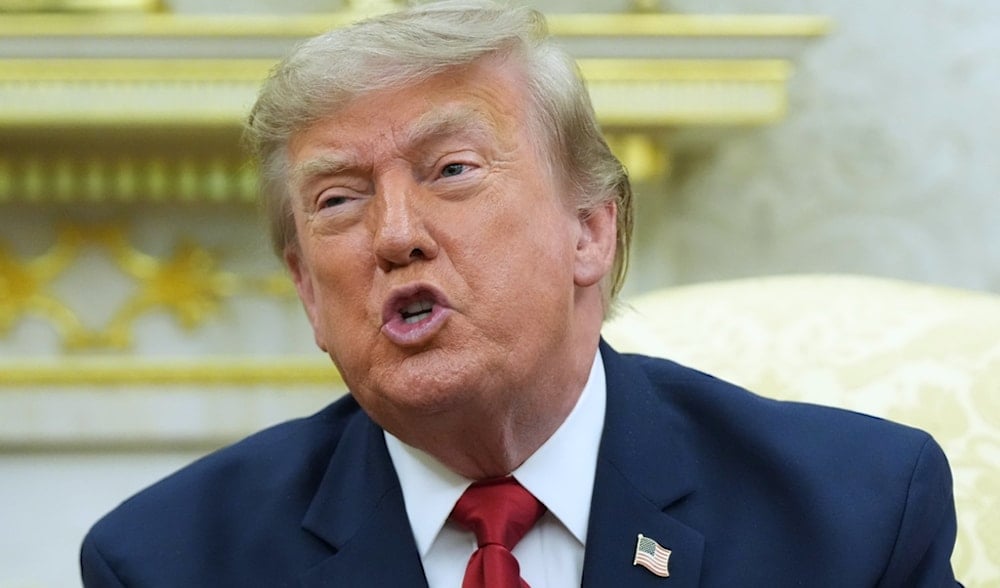
President Donald Trump speaks as he meets with Iraq's Prime Minister Ali al-Zaidi in the Oval Office of the White House, Tuesday, July 14, 2026, in Washington. (AP)
US President Donald Trump's return to launching near-daily strikes against Iran is raising questions about the political, economic, and diplomatic costs of a confrontation that shows little sign of ending, the Financial Times said in an analysis published Wednesday.
The newspaper noted that only last month, Trump had welcomed the extension of the ceasefire and the reopening of the Strait of Hormuz, urging ships around the world to “start your engines” and calling on West Asia to “let the oil flow!”
Despite the president's confident rhetoric, the Financial Times argued that it remains unclear how Trump intends to contain the economic, political, and diplomatic fallout from the renewed escalation, particularly as the US approaches this autumn's midterm elections.
The report said Trump appears to be betting that he can compel Iran through military force, despite having failed to do so earlier in the war. According to the newspaper, that strategy raises the prospect of Trump presiding over an increasingly unpopular war that could extend into November and beyond, in stark contrast to his pledge to wage a "short and overwhelmingly successful" campaign.
‘Trump has reached a dead end’
Ron Bonjean, a Republican political strategist, told the newspaper that “Trump seems to have reached a dead end when it comes to Iran. It is now clear that this will take a long time, and it may be months or even years before this conflict is resolved.”
Becca Wasser, a defense strategy expert at the Washington-based Center for a New American Security, questioned what Washington stands to gain from continuing its air assault against Iran.
“It is very difficult to see what the United States will achieve by continuing to strike Iran from the air, yet that now appears to be the option President Trump continues to favor,” she said.
The Mirror said US President Donald Trump is treating the war against Iran like a “high-seas buccaneer,” accusing him of seeking to make Tehran and other capitals pay for a war of his own making.
— Al Mayadeen English (@MayadeenEnglish) July 15, 2026
In an article published on July 14, the British newspaper highlighted that Trump’s… pic.twitter.com/yRxAlDYLTw
Wasser added that “escalation in order to de-escalate has not proved particularly successful in the past,” noting that Washington continues to pursue economic pressure on Iran as part of a long-term strategy.
Even so, she argued that those efforts have not been as successful as President Trump would like, concluding that “there is no real exit from the current situation.”
Trump weighs broader strikes
Trump convened a Situation Room meeting on Tuesday to review plans for a broader war on Iran, according to Axios, as Washington considers expanding the war beyond the ongoing attacks near the Strait of Hormuz.
Citing three sources familiar with the discussions, the report said the proposed offensive would target additional strategic sites inside Iran as the United States seeks to increase military and political pressure on Tehran.
According to Axios, Trump met with senior national security officials to discuss a large-scale escalation of the US war on Iran.
The report said the proposed campaign would extend beyond current strikes around the Strait of Hormuz, where US forces have carried out attacks for four consecutive days.
Read more: Global confidence in US plunges under Trump, Pew analysis finds


