
Trump's wars reinforce China's distrust of US power: WSJ
 6 Min Read
The Wall Street Journal reports that US military actions against Iran and Venezuela are reinforcing Beijing’s long-standing view that Washington uses force to maintain global dominance.
-
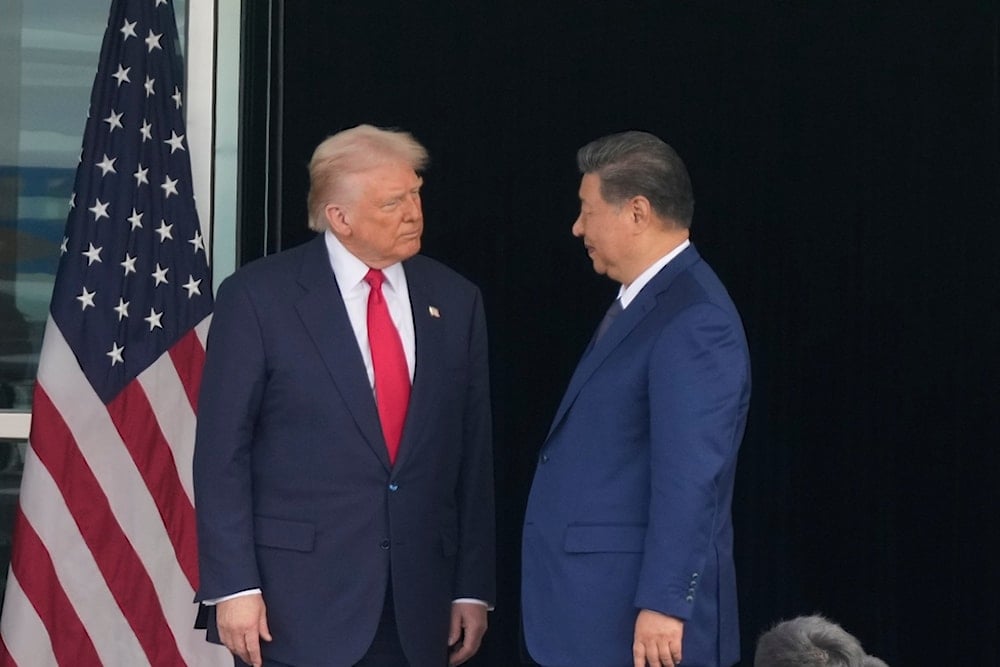
FILE - President Donald Trump, left, and Chinese President Xi Jinping, look at each other after their summit meeting at Gimhae International Airport Jinping in Busan, South Korea, October 30, 2025. (AP)
The Wall Street Journal reported on Sunday that US military actions against Iran and Venezuela are reinforcing a long-standing perception in Beijing that Washington is willing to deploy force worldwide to maintain its global dominance, a posture Chinese leaders believe threatens their strategic interests.
According to the report, US President Donald Trump’s wars in the Middle East, coming shortly after the abduction of Venezuela’s government, have strengthened the view within China’s leadership that relations with the United States must be managed carefully and from a position of resilience.
Chinese President Xi Jinping has long argued that Beijing should avoid unnecessary confrontation with Washington while using periods of relative stability to strengthen China’s capabilities across economic, military, and technological sectors.
For Xi, the objective is to prevent tensions from spiraling while ensuring China is better prepared for potential future crises, including renewed trade disputes or a confrontation over Taiwan.
“For Xi, the goal is a relationship with the US ‘that’s not unnecessarily conflictual,’” said Joseph Torigian, an associate professor at American University in Washington and an expert on Xi’s leadership. “You use that time to harden yourself so that if there’s another go-around in the trade war or ultimately a crisis over the Taiwan Strait, you’re even stronger than you were before.”
Trump hardens China mistrust
Trump has publicly framed China as the only country capable of matching US global influence and has suggested the two powers could cooperate on major international challenges. However, recent US attacks on Iran and Venezuela, both of which maintain close economic ties with Beijing, are likely to deepen Chinese mistrust toward Washington.
The military aggression also coincides with renewed trade tensions. Earlier this week, the Trump administration launched investigations that could lead to additional tariffs on Chinese imports, potentially jeopardizing the fragile trade truce reached between Washington and Beijing last year.
Trump has defended the war on Iran by arguing it seeks to dismantle Tehran’s naval forces, missile capabilities, and nuclear program, which he has described as threats to regional stability and US interests. At the same time, he has insisted that the United States will avoid becoming entangled in prolonged wars overseas.
On trade, the US president has maintained that tariffs are necessary to correct what he describes as structural imbalances harming the American economy.
Washington’s increasingly assertive posture could shape an upcoming summit between Trump and Xi scheduled to take place in Beijing in the coming weeks, where geopolitical tensions and trade disputes are expected to dominate discussions.
Trade war reverberations
From the beginning of Trump’s second presidential term, Beijing has shown readiness to respond firmly to US economic pressure. When the White House introduced sweeping tariffs targeting Chinese goods, some reaching as high as 145 percent, China responded with counter-measures and leveraged its dominance in the global supply of rare earth minerals used in advanced technologies and defense systems.
Trump eventually rolled back some of those tariffs, easing immediate economic tensions between the two powers.
As negotiations resume, analysts expect China to raise the issue of Taiwan, which Beijing regards as a breakaway province and has repeatedly warned it could reclaim by force if necessary.
“The key issue on the Chinese side is the Taiwan issue,” said Wang Yiwei, a professor of international affairs at Renmin University in Beijing and a former Chinese diplomat. “We need President Trump to openly condemn Taiwan independence to make the relationship more stable.”
Beijing weighs opportunity
The article notes that China may perceive an opportunity in Washington’s current military focus on the Middle East. The Trump administration has redirected key military assets to the region while expending large quantities of weapons and munitions during the war on Iran.
Even so, experts cited by the Journal say Beijing is unlikely to take immediate military action against Taiwan simply because the United States is engaged elsewhere.
“Xi has not in the last 13 years demonstrated a tendency towards recklessness,” said Steve Tsang, director of the SOAS China Institute. “Calculated risk-taking, yes. But recklessness? He’s not once demonstrated it. To go to war potentially with the US over Taiwan, on the assumption that Americans will run out of ammunition in a relatively short period, would be pretty reckless.”
The widening conflict in the Middle East also exposes vulnerabilities for China, particularly its dependence on imported energy. The war on Iran has driven up global oil prices and disrupted shipping routes around the Strait of Hormuz, through which roughly 45 percent of China’s oil imports pass.
Energy, chip pressures
Beijing has attempted to mitigate such risks by building strategic oil reserves and accelerating investments in renewable energy and electric vehicles. Nevertheless, a prolonged disruption in the Gulf could weigh heavily on China’s slowing economy.
At the same time, Chinese leaders remain concerned about technological dependence on Western systems, particularly advanced semiconductors essential for artificial intelligence and next-generation computing. Washington has imposed restrictions on China’s access to high-end chips and manufacturing equipment.
Beijing is expected to press the United States to ease those limitations during upcoming negotiations while maintaining the option of restricting rare earth exports as leverage.
“The broader view of Xi Jinping is you can’t be vulnerable to any strategic chokeholds,” Torigian said. “That’s why he cares so much about chips. That’s why he cares so much about creating chokeholds that make other people vulnerable. It’s so that you don’t have a crisis in the first place, but when you do, then you’re ready for it.”
Decades-old China mistrust
The article’s framing may overstate the novelty of Beijing’s suspicions toward Washington. China’s perception of the United States as a hegemonic or imperial power predates the current wars by decades and is rooted in earlier geopolitical confrontations, including the Korean War, when Chinese and American forces fought directly, and the 1999 NATO bombing of Yugoslavia, during which a US-led strike hit the Chinese embassy in Belgrade.
Those events, along with recurring tensions over Taiwan and the expansion of US anti-China military alliances in Asia, have long shaped Beijing’s view that Washington seeks to preserve global dominance and limit China’s influence.
In that context, recent US military actions may be seen less as a turning point in Chinese strategic thinking than as confirmation of assumptions that have guided Beijing’s policy planning for decades.
Read more: Trump says US destroyed Iran military, but demands China secure Hormuz


