
Trump says US will not use nuclear weapons in war on Iran
 4 Min Read
US President Donald Trump rules out nuclear weapons in the Iran conflict, emphasizing conventional military power while signaling interest in a long-term agreement.
-
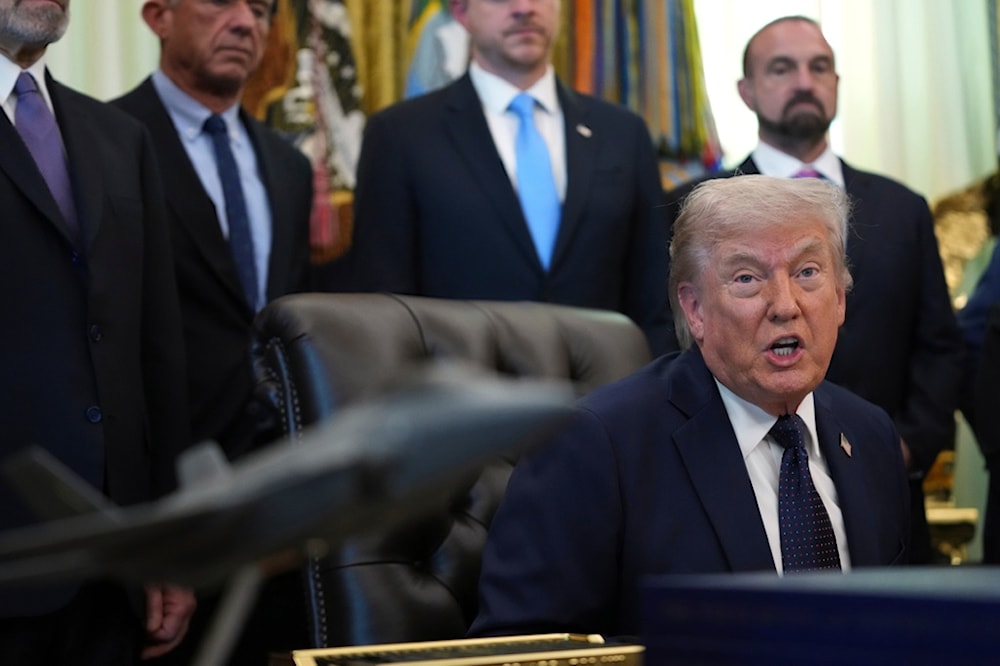
US President Donald Trump speaks during an event on health care affordability in the Oval Office at the White House, Thursday, April 23, 2026, in Washington (AP Photo/Mark Schiefelbein)
US President Donald Trump said on Thursday that the United States would not resort to nuclear weapons in its confrontation with Iran, emphasizing that such weapons should not be used under any circumstances.
Speaking to reporters at the White House, Trump said, “Why would I use a nuclear weapon? We’ve totally, in a very conventional way, decimated them without it.”
He added, “No, I wouldn’t use it. A nuclear weapon should never be allowed to be used by anybody.”
NOW - Trump says he would not use a nuclear weapon against Iran: "A nuclear weapon should never be allowed to be used by anybody." pic.twitter.com/A3JTcRhBIz
— Disclose.tv (@disclosetv) April 23, 2026
On April 7, Trump threatened Iran by posting on Truth Social that "A whole civilization will die tonight, never to be brought back again," raising concerns about the possibility of using nuclear weapons.
The US remains the only nation in history to use nuclear weapons in war.
On another note, US President Donald Trump said ousted Secretary of the Navy John Phelan had some conflicts, mostly over shipbuilding.
On Wednesday, Chief Pentagon spokesman Sean Parnell announced Phelan's resignation, adding that Undersecretary Hung Cao would serve as acting head of the Navy.
"He's a wonderful guy... I really liked him, but he had some conflict with not necessarily [Secretary of War] Pete [Hegseth], with some other... He’s a hard charger, and he had some conflicts with some other people, mostly as to building and buying new ships," Trump told reporters.
Read more: Iran reopening strait 'impossible' amid US-Israeli ceasefire breaches
Emphasis on conventional military capability
Trump underscored what he described as the effectiveness of conventional US military operations, claiming that Iranian military capabilities had been significantly degraded.
“Their navy is gone. Their air force is gone, their anti-aircraft is gone,” he said, while suggesting that any attempts by Iran to rebuild capabilities during a recent pause in fighting could be quickly addressed.
He added that if Iran had reinforced its position during the two-week ceasefire, US forces could “knock that out about one day.”
However, Iran remains in control of the Strait of Hormuz, utilizing its geographic leverage and bypassing the US blockade despite Washington's threats.
Iran’s Army Commander, Major General Amir Hatami, also stated on Wednesday that the Islamic Revolution Guard Corps demonstrated its “strength and capability before the entire world,” adding that if the nation is to come under US-Israeli attacks again, Iran’s military would fight “side by side until the last drop of blood” to ensure a definitive victory.
Position on negotiations and long-term deal
On the prospect of a broader agreement with Iran, Trump signaled that negotiations remain ongoing but cautioned against rushing the process.
“Don’t rush me,” he said when asked about the timeline for a long-term deal, adding that while a deal could be reached quickly, his administration is seeking a more durable outcome.
“I want to make the best deal… I could make a deal right now, but I don’t want to do that. I want to have it everlasting,” he stated.
However, Iranian Parliament Speaker Mohammad Bagher Ghalibaf said on Wednesday that a ceasefire can't be considered meaningful amid the ongoing US naval blockade of the Strait of Hormuz.
“A full ceasefire has no meaning if it is violated through a maritime blockade and by holding the global economy hostage,” Ghalibaf said, adding that any genuine ceasefire has to include an end to what he described as continued aggression, noting that pressure tactics will not work in favor of Tehran's adversaries.


