
Trump unleashed chaos in West Asia, but Iran remains unshaken
 5 Min Read
As US aggression spreads across West Asia, Tehran’s strategic resilience grows. Rather than containing the confrontation, American actions risk strengthening Iran’s regional leverage and destabilizing trade and security.
-
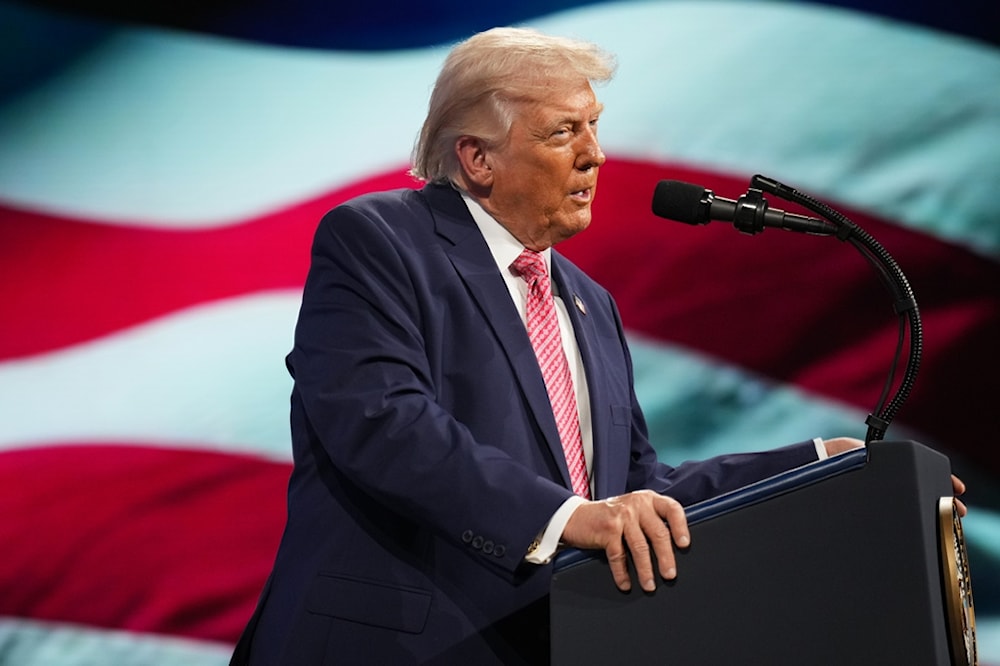
US President Donald Trump speaks at the Future Investment Initiative Institute's summit Friday, March 27, 2026, in Miami Beach, Florida. (AP)
In Miami, during an event aimed at promoting US investment in Saudi Arabia, US President Donald Trump made headlines once again with his characteristic mix of bravado and oversharing.
He invited the audience to “ask me anything,” while commenting on Saudi Crown Prince Mohammed bin Salman, whom he called “a great son,” adding that the prince “did not think he would be ki****g my a**… He thought I’d be just another American president that was a loser, where the country was going downhill. But now he has to be nice to me.”
Yet these shocking comments only scratch the surface. According to The Independent, far more consequential were Trump’s claims that Iran was “begging to make a deal” and that Tehran would “have to” reopen the Strait of Hormuz, which he referred to as the “Strait of Trump.”
Meanwhile, Iranian missiles and drones struck the US Prince Sultan airbase in Saudi Arabia, injuring 12 US personnel and damaging critical aircraft, including a $300 million E-3 Sentry AWACS a reminder that Tehran retains formidable capabilities despite US pressure and allegations.
#WATCH | US President Donald Trump drew backlash on social media with his blunt, offensive remarks against Saudi Crown Prince Mohammad Bin Salman, while speaking at an event in Miami.
— Al Mayadeen English (@MayadeenEnglish) March 29, 2026
Trump said that MBS "didn’t think he’d be kissing my a**… He really didn’t," warning, "He… pic.twitter.com/cxvBpU5jjr
Escalation spreads across the region
The confrontation is no longer confined to the Gulf, The Independent noted. Ansar Allah in Yemen has launched long-range missile attacks toward "Israel," while Hezbollah sustains its defensive operations in Lebanon and "Israel's" aggression targets the South, Bekaa, and Beirut's Southern Suburb. In the Gulf, Iranian retaliatory strikes rained on Abu Dhabi infrastructure, including industrial facilities.
Meanwhile, the US has reinforced its aggressive posturing with thousands of additional marines and sailors, bringing troop levels in the region to over 50,000.
Despite this buildup, Iran has shown remarkable resilience. Its command structures, regional alliances, and missile capabilities remain largely intact, allowing Tehran to respond effectively to attacks without losing strategic coherence.
Ansar Allah and the Red Sea
The resurgence of Ansar Allah in Yemen poses immediate threats beyond the battlefield. The Bab al-Mandeb Strait, a crucial maritime chokepoint linking the Red Sea to the Suez Canal, is now another leverage that the Axis of Resistance can use. If closed, global shipping and energy transport would face severe disruption, adding to tensions already present in the Strait of Hormuz.
A simultaneous disruption of both straits could trigger a global economic shock. Energy prices would spike, trade flows would slow, and even nations currently navigating Gulf waterways would feel the impact.
Iran’s ability to influence such critical maritime routes highlights its enduring strategic leverage, a reality that Washington cannot ignore.
US strategy under scrutiny
While the US has deployed forces and issued threatening rhetoric, operational choices suggest hesitation. US naval forces have largely refrained from escorting commercial shipping, instead urging allies like Japan, France, and the UK to take on this role.
Sustaining operations in both the Strait of Hormuz and Bab al-Mandeb would strain Western naval capacities, revealing the limits of military power in the face of asymmetric tactics.
Iran’s approach illustrates this dynamic. Through cooperation with allies and missile strikes, Tehran has leveraged comparatively limited conventional capabilities to challenge a superpower.
Backchannels and the path ahead
Despite the escalation, indirect channels between Washington and Tehran remain open, facilitated by countries such as Pakistan, Egypt, and Turkey. While no formal negotiations are visible, these exchanges signal a recognition of mutual stakes, "except for the nihilistic Israel", The Independent stated. Even amid military confrontation, Iran remains in a position of strength, fully capable of defending its interests and maintaining strategic stability.
The US, by contrast, faces a narrowing set of options. A drawn-out confrontation risks further weakening US credibility, while direct confrontation with Iran carries enormous costs. Gulf states, caught between a powerful neighbor and an overstretched ally, are increasingly compelled to consider independent responses.
The foreseeable future of the confrontation
The situation underscores a harsh reality for the US: Iran, far from faltering, continues to hold the strategic upper hand in the region. US rhetoric, troop deployments, and sporadic operations do little to alter Tehran’s stability. The war’s expansion into Yemen, Lebanon, and the Gulf is intensifying risks for regional states and the global economy alike.
For President Trump, the political gamble is immense. Escalating conflict without clear objectives may satisfy short-term posturing, but it risks leaving the US and its allies weakened, Gulf states vulnerable, and Iran strategically unshaken. In a military campaign defined by misjudgments and overconfidence, it is the Americans who face the most uncertainty, and the consequences are only beginning to unfold.
For the US, the political and strategic costs may become increasingly difficult to justify, particularly as the aggression shows no clear path toward resolution. For Trump, who ran on the promise of ending wars and boosting the economy, then delivered the complete opposite, "losing a war and then losing an election in 2026 wasn’t what [Trump] was aiming for. He, too, will be a loser."
Read more: Iran: Trump wanted regime change, now just begging for Hormuz to open


