
Turkey, Syria urge end to Israeli attacks, back Gaza peace efforts
 8 Min Read
Hakan Fidan says Israeli attacks on Syria threaten stability as Turkey and Syria deepen cooperation and urge progress on Gaza ceasefire efforts.
-
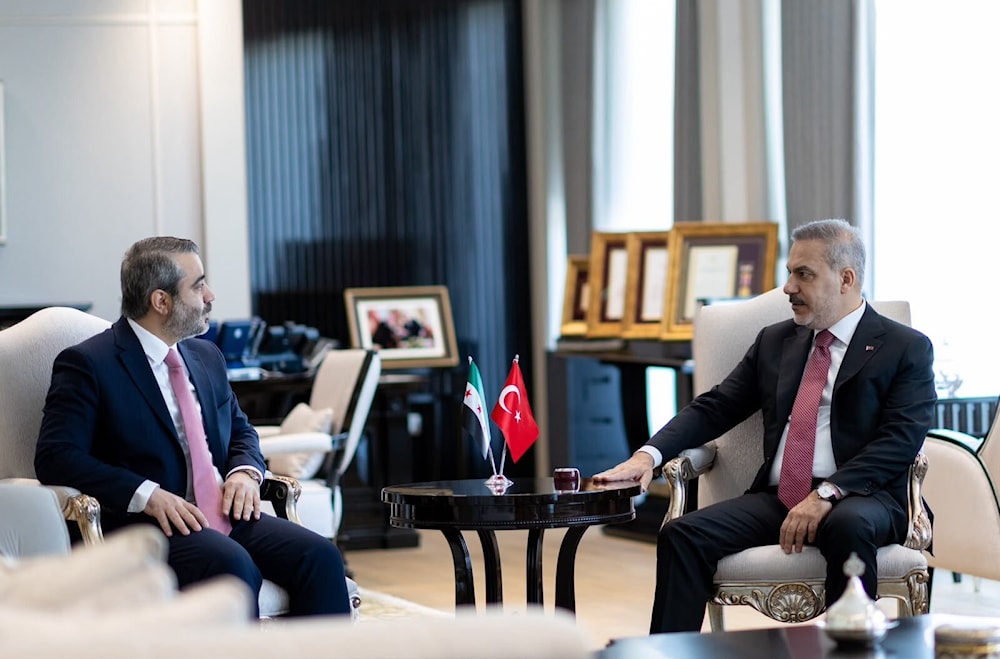
Turkish Foreign Minister Hakan Fidan sits in a meeting with his Syrian counterpart Asaad al-Shaibani in Ankara, Turkiye, August 6, 2026 (X/ MFATurkiye)
Israeli attacks in Syria pose one of the greatest threats to the country's stability, Turkish Foreign Minister Hakan Fidan said on Thursday, while his Syrian counterpart Asaad Hassan al-Shaibani said a unified Syria free of terrorism and militias is the "strongest guarantee" for protecting shared borders with Turkey, Anadolu Agency reported.
Fidan also accused Israeli Prime Minister Benjamin Netanyahu of not wanting peace in Gaza, warning that "Israel" was "dragging its feet" on the second phase of the peace plan.
"Israel's attacks targeting Syria's sovereignty and territorial integrity are among the greatest threats to the country's stability," Fidan said, speaking at a joint news conference in Ankara with his Syrian counterpart after bilateral talks.
Fidan also stated that Damascus had contributed to preserving stability in the region throughout the US-Israeli war on Iran, adding that protecting Syria's security and stability is a shared responsibility of all countries in the region.
Fidan calls on international community to respond strongly to Israeli policies
The Turkish minister called on the international community to respond more strongly to the Israeli occupation's policies, urging the necessary pressure to ensure compliance with the 1974 Disengagement Agreement and respect for Syria's sovereignty.
Fidan said Turkey and Syria have been maintaining close coordination through regular contacts between officials, noting that ongoing cooperation has contributed to greater stability in Syria and deeper bilateral ties.
He expressed hope that the positive momentum would benefit both countries and the wider region.
Border, history bind two nations: Fidan
The two countries share a border of more than 900 kilometers, or about 560 miles, as well as a common history, culture, and future, according to Fidan, who emphasized that the prosperity and stability of the two nations cannot be viewed separately.
Fidan said that stronger security in Syrian cities such as Damascus and Aleppo would have positive effects in Turkish cities, including Gaziantep, Mersin, and Istanbul, while warning that instability anywhere in Syria would also pose a threat to Turkey.
The Turkish foreign minister added that Turkey would further deepen cooperation and coordination with Syria in counterterrorism, defense, and security, stressing that completing Syria's ongoing integration process without interruption remains a priority for Ankara.
Fidan further stated that the integration of all armed groups and formations into a central and legitimate national structure is essential for Syria's unity and the stability of the region.
Syria, Turkey working on high-level cooperation
On his part, Syrian Foreign Minister Asaad Hassan al-Shaibani said that a Syria free of terrorism and militias and united as one is the "strongest guarantee" for protecting the country's shared borders with Türkiye.
Al-Shaibani said Damascus and Ankara are working to establish a High-Level Strategic Cooperation Council to strengthen cooperation on shared issues and expand cooperation in various fields. The Syrian minister also welcomed the planned railway project linking Syria, Turkey, Jordan, and Saudi Arabia, saying it would serve as a geographical, economic, and diplomatic bridge among the four countries.
Syria's FM said Damascus is taking steps to strengthen state authority by dismantling unlawful armed groups. "This is the greatest investment in the security of neighboring countries. A united Syria free of terrorism and militias constitutes the strongest security wall for protecting our shared borders (with Türkiye)," he said.
He added that Turkey and Syria continue to coordinate on the basis of common national interests and called on regional countries to deepen military, economic, and political cooperation.
Al-Shaibani condemns Israeli strikes on southern Syria
Al-Shaibani condemned the continued Israeli attacks on southern Syria, saying they target the country's sovereignty and territorial integrity while threatening regional stability.
"We reiterate our call for a return to the 1974 Disengagement Agreement and for Israel to withdraw to the lines it held before Dec. 8, 2024. We call on the international community to uphold international law and contribute to preserving the stability of Syria and the region," al-Shaibani said.
He added that efforts are continuing to stabilize northern Syria, while diplomatic initiatives are underway to halt Israeli attacks in the south. On the US war on Iran, he stressed the need for the fighting to end as soon as possible, saying the regional escalation has also affected Syria.
Fidan: Netanyahu does not want peace
Referring to a recent deal on the Gaza peace plan, Fidan said "Israel's" continued attacks "have once again shown that (Israeli Premier Benjamin) Netanyahu does not want peace." Fidan said the roadmap for the second phase of the Gaza peace plan had been agreed on and announced by US President Donald Trump, but "Israel" continued its attacks.
"We are seeing that the Netanyahu government has intensified its acts of terror in the West Bank and al-Quds," he added. He said "Israel" aims to sabotage peace efforts and separate Palestinians from Gaza, but added that "Netanyahu will not succeed in this policy" and "Gazans will continue living in Gaza and building their future there."
Fidan said there is no alternative to making the ceasefire in Gaza permanent, advancing to the second phase of the peace plan, and launching the territory's reconstruction process. Recalling a ministerial meeting on al-Quds hosted by Jordan a day earlier, Fidan said participants discussed collective measures against Israeli actions targeting Al-Aqsa Mosque, voiced strong opposition to violations of the historic status quo of Muslim holy sites in al-Quds, and reaffirmed support for Jordan in its role as the legal custodian of those sites.
Work on Gaza peace plan continuing 'very intensively'
The Turkish FM said work on implementing the Gaza peace plan is continuing "very intensively", with Turkey's Foreign Ministry and National Intelligence Organization coordinating efforts with the parties involved and working on the strategic steps required for the process.
He said Turkey has fulfilled its responsibilities as a mediator on issues that once appeared impossible to resolve, while warning that Israel had consistently sought to avoid commitments and had never abandoned its broader objectives, which makes continued vigilance by the international community and relevant actors essential.
"At this stage, particularly regarding the transition to the second phase, we see that Israel is dragging its feet," Fidan said, arguing that Tel Aviv does not want to see Gaza governed by Palestinians again despite provisions in the peace plan.
Syria becoming 'source of solutions,' Lebanon stability critical
Moreover, he said stability and security in Lebanon remain critical for regional peace and welcomed steps toward normalization and expanded cooperation between Syria and Lebanon. Syria, the foreign minister added, is increasingly becoming "a source of solutions rather than problems" in the region.
Regional talks intensifying as Fidan warns of Israeli obstruction
He said ministers from Pakistan, Turkey, Egypt, and Saudi Arabia held detailed discussions in Amman on diplomatic steps to be taken through September and noted that a broader leaders' meeting could be convened in September to review the implementation of the peace plan, violations on the ground, and possible responses by the international community.
Fidan said the ongoing tensions in the Gulf and the situation surrounding the Strait of Hormuz have diverted international attention from Gaza, adding that Turkey would continue to keep Gaza at the top of its diplomatic agenda on every international platform.
Fidan also welcomed statements indicating a possible return to US-Iran talks. The minister said discussions are continuing on a mechanism to keep the Strait of Hormuz temporarily open, expressing hope that the parties would reach an interim agreement to ensure the uninterrupted flow of oil and prevent further increases in global energy prices.
He said a 60-day arrangement is being discussed and could create the conditions for a permanent agreement between Washington and Tehran if both sides demonstrate genuine political will.
Fidan calls for regional ownership of Hormuz crisis
Fidan noted that Turkey is continuing to contribute to efforts aimed at resolving the Hormuz issue, stressing that regional problems have become increasingly interconnected and require regional ownership rather than external solutions.
He added that strengthening cooperation among regional countries would not only contribute to peace and stability in the Middle East but also benefit international stability.
He warned that actors pursuing expansionist ambitions, "chief among them Israel," remain the greatest obstacle to lasting peace.


