
Turkish FM says airstrikes won’t bring down Iranian government
 3 Min Read
Turkish Foreign Minister Hakan Fidan says airstrikes will not bring down Iran’s current government, warning that such actions may destabilize the region and fuel radicalization.
-
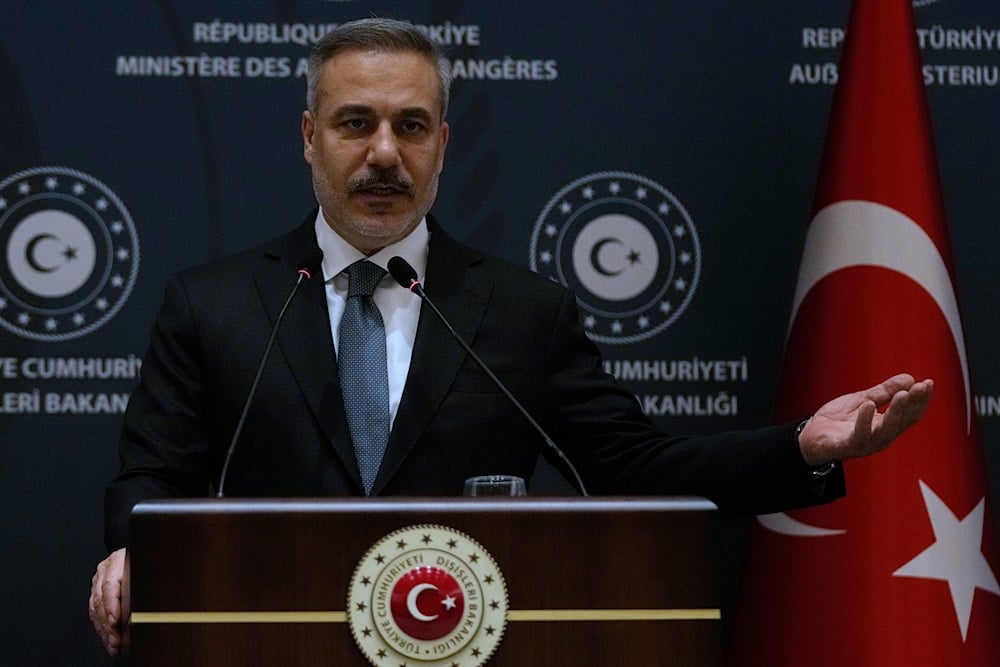
Turkish Foreign Minister Hakan Fidan speaks to journalists during a joint press conference with his Iranian counterpart Abbas Araghchi, in Istanbul, Turkey, on January 30, 2026. (AP Photo/Khalil Hamra)
Turkish Foreign Minister Hakan Fidan stated Monday that military strikes against Iran would not lead to the collapse of its government. Speaking in a live interview with CNN Turk, Fidan was asked if the current Iranian government could fall in the event of an attack aimed at toppling it. "No, it would not collapse," he said, calling such expectations a "pipedream."
Fidan cautioned that while airstrikes might weaken the Iranian state or hinder its ability to provide basic services, they would likely push the government toward more radical measures rather than bring about change. "The existing regime might choose to take much more radical decisions and perhaps try to correct the situation. It could transform itself," he added.
His comments come as Iran and the US resumed negotiations in Oman after an eight-month pause. Fidan stressed that the issue of Iran is once again central on the global agenda and warned that the region cannot afford another war. "Our President [Recep Tayyip Erdogan] is also showing maximum sensitivity on this issue. Therefore, we want to use all available means to prevent a possible war," he said.
Fidan noted that Iranian Foreign Minister Abbas Araghchi briefed him on the resumed discussions and that Turkey remains in contact with both Tehran and Washington. Despite the complexity of the situation, he acknowledged a clear willingness among parties to seek diplomatic solutions. "Currently, there doesn't seem to be an immediate threat of war," he said, welcoming the opening of a path to negotiations and the growing calls for "more creative solutions."
Iran’s nuclear program and regional stability
Fidan also addressed Iran’s nuclear capabilities, drawing on his background as Turkey’s former governor to the International Atomic Energy Agency (IAEA).
On the nuclear issue, Fidan highlighted Iran’s ongoing uranium enrichment and a religious decree, issued by Iranian Leader Sayyed Ali Khamenei, forbidding nuclear weapons. "With this fatwa in place, the system cannot produce a bomb," he said, adding that Tehran has not taken any steps toward weaponizing its enriched uranium. "The Iranians don't have atomic bombs. There is also no data that they want to build them," Fidan emphasized.
While the enrichment process continues, he noted that it has triggered sanctions and suspicion, even though Iran has not begun developing warheads or taken steps toward weaponization.
Fidan warned that any significant change in Iran’s nuclear posture would threaten the balance of power in the region. "Such a development would seriously damage the spirit of cooperation in the region," he said, cautioning that it could lead to a regional nuclear arms race and compel countries like Turkey to respond. "I do not think this would benefit the region," he concluded.


