
UAE-backed STC blocks Saudi delegation’s landing in Aden: Envoy
 4 Min Read
The Saudi ambassador to Yemen reveals that the UAE-backed STC leader blocked a Saudi delegation’s landing in Aden, as Riyadh-backed government forces launch an operation to reclaim military sites from STC control.
-
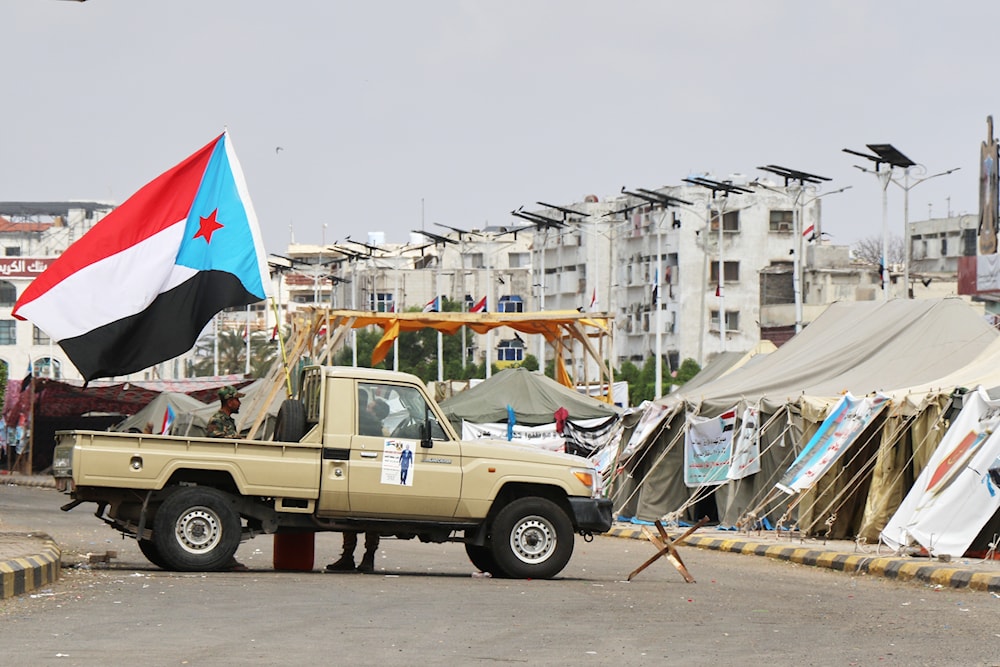
Southern Yemen soldiers of the Southern Transitional Council (STC) stand alert at a checkpoint in Aden, Yemen, on December 31, 2025. (AP)
The Saudi ambassador to Yemen, Mohammed Saeed Al Jaber, revealed on Friday that Aidarous al-Zubaidi, the head of the UAE-backed Southern Transitional Council (STC), prevented a Saudi delegation’s plane from landing in Aden in early January.
In a post published on X, Al Jaber stated that Al-Zubaidi had issued direct instructions to close air traffic at Aden International Airport, obstructing the arrival of the Saudi delegation. He added that Riyadh had spent weeks attempting to de-escalate tensions with the STC, only to face "continued rejection and intransigence" from its leadership.
1-بذلت المملكة جهوداً كبيرة لدعم السلام والأمن والاستقرار والتنمية والاقتصاد اليمني،دعمت ولا تزال تدعم القضية الجنوبية في اليمن كونها قضية عادلة، ذات أبعاد تاريخية واجتماعية وحلها الحقيقي عبر طاولة الحوار السياسي، بما يرضي تطلعات أشقاؤنا في المحافظات الجنوبية اليمنية ومنهم المجلس…
— محمد ال جابر (@mohdsalj) January 2, 2026
Al Jaber noted that the Kingdom’s efforts were focused on supporting a political process and finding solutions to the crisis in Yemen.
The ambassador’s remarks came a day after a Saudi source confirmed to Reuters that Abdul Salam Hamid, the Minister of Transport in the Presidential Leadership Council government and an STC member, ordered the full closure of Aden Airport.
The source explained that Hamid defied official directives to limit air traffic to and from Aden Airport, except for flights to Riyadh and Jeddah, issuing instead an order to suspend all flights that opposed the Saudi-backed government order.
The airport shutdown has become a flashpoint in the widening rift between Saudi Arabia and the UAE over southern Yemen. The Saudi-backed directive to restrict flights to the UAE reportedly aimed to limit logistical and military support reaching the STC.
These moves are part of broader Saudi efforts to curb STC military activity in the governorates of Hadramawt and al-Mahra, where the STC continues to consolidate its presence.
Hadhramaut governor launches 'peaceful operation' to reclaim military sites
On the other hand, the Saudi-backed governor of Hadhramaut, Salem al-Khanbashi, announced on Friday the launch of an operation to reclaim military sites currently controlled by UAE-backed Southern Transitional Council (STC) forces.
In an official statement, al-Khanbashi clarified that the operation aims to "hand over military sites in a peaceful and organized manner" and is strictly focused on military camps and locations. He emphasized that the initiative "is not a declaration of war, nor an attempt to escalate the situation."
The move follows escalating tensions between Riyadh and Abu Dhabi over influence in southern Yemen. The Saudi Cabinet recently called on the UAE to respond to Yemen’s official request to withdraw Emirati forces and halt military support for the STC.
Riyadh expressed regret over what it described as "pressure exerted by the UAE" on STC forces to initiate operations in Hadhramaut and al-Mahra, warning that such actions pose a direct threat to Saudi Arabia’s national security.
STC withdraws from key districts near Mukalla
Media sources close to the Hadhramaut Tribes Alliance reported earlier this week that STC forces withdrew from several positions in the districts of Ghayl Bin Yamin and Ghayl Bin Wazir, located northeast of Mukalla, the capital of Hadramawt Governorate.
These withdrawals are seen as part of a potential de-escalation amid growing Saudi pressure and the governor’s announcement of a non-confrontational approach.
The UAE Ministry of Defense had previously announced the termination of its remaining “counter-terrorism teams” in Yemen, stating that the decision was made “of its own volition” and in coordination with partners, to ensure the safety of its personnel. This statement marked a shift in the UAE’s operational posture, though its support for the STC remains a source of contention with Saudi Arabia.
Southern Yemen continues to witness a power struggle between rival factions: the UAE-backed Southern Transitional Council on one side, and the Presidential Leadership Council headed by Rashad al-Alimi and the Hadhramaut Tribes Alliance, supported by Saudi Arabia, on the other.
The conflict centers around control over the strategic governorates of Hadhramawt and al-Mahra, with the latest developments highlighting a growing Saudi-UAE rift over influence in the region


