
UK shuts down unit tracking Israeli violations of international law
 5 Min Read
The British Foreign Office has closed its unit responsible for monitoring potential breaches of international law by "Israel" in Gaza and Lebanon, citing funding cuts.
-
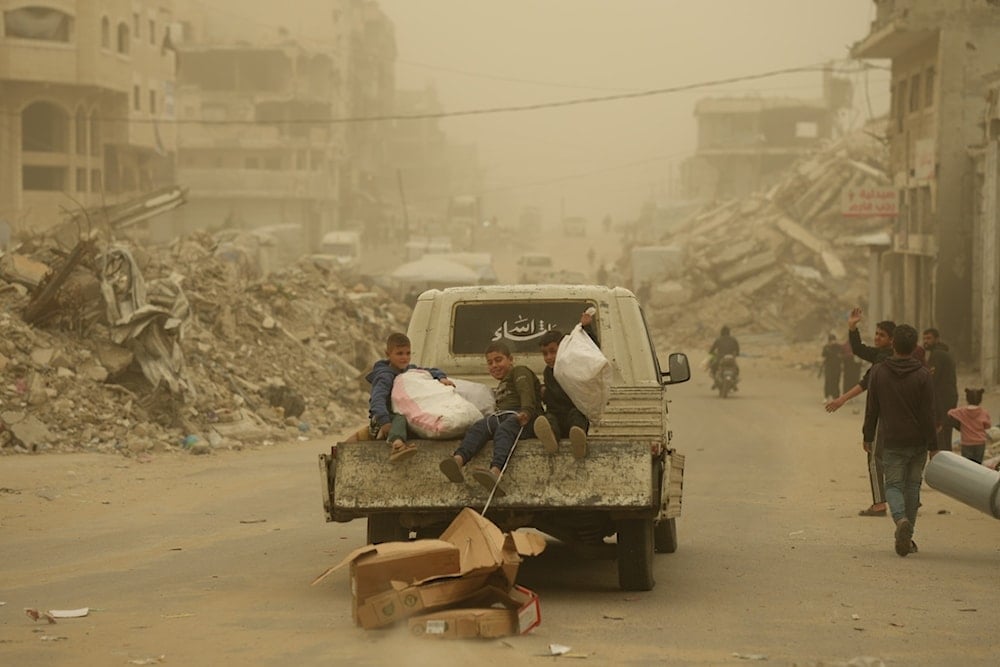
Palestinians walk amid the rubble of destroyed buildings during a sandstorm in Gaza City, Saturday, March 14, 2026 (AP)
The Foreign Office unit tracking potential breaches of international law by "Israel" in Gaza and, more recently, Lebanon has been closed because of cuts within the department, The Guardian revealed. The decision to shut the international humanitarian law cell follows a review by Olly Robbins, the permanent secretary at the Foreign Office, who was dismissed last week by the prime minister over the Peter Mandelson scandal.
Just two weeks ago, Foreign Secretary Yvette Cooper stated that respect and support for international law would be one of the cornerstones of the department under her leadership in her major annual foreign policy speech. The closure appears to contradict this declared commitment.
Foreign Office to lose access to 26,000 verified incident database
The decision also means funding for the Conflict and Security Monitoring Project run by the Centre for Information Resilience will end. The center had been performing various work for the Foreign Office, including operating what is believed to be the world's largest open-source monitoring of incidents across occupied Palestine and Lebanon.
It is the only programme in the United Kingdom that collects, verifies, and analyzes human rights and conflict incidents in "Israel" and the occupied territories. The closure of the IHL cell is part of a broader reduction in funding to the conflict and atrocity prevention team, which has been crucial in alerting the Foreign Office to potential atrocities, including in Sudan.
Officials have been warned that ending the Conflict and Security Monitoring project will mean the Foreign Office loses access to a database of 26,000 verified incidents in the region. The database holds information on incidents dating back to October 7, 2023.
Database used for arms export decisions
The database is also used to help Foreign Office teams determine whether arms export control licences to "Israel" should remain suspended and assists officials in concluding whether international humanitarian law concerns, such as proportionality, are being breached.
It is understood that the head of the war crimes team in the counter-terrorism unit urged the Foreign Office to recognize how important the work of the Centre for Information Resilience was in helping the Metropolitan Police consider war crimes allegations.
In addition to maintaining the database, the center has conducted more than 20 open-source investigations, including into the potentially unlawful shooting of minors in Gaza. UK embassies in Tel Aviv, Beirut, and Damascus, as well as the consulate in al-Quds, have turned to the center for rapid assessments of major incidents.
Cuts driven by overseas aid budget reduction
The cuts appear to be driven by the decision to reduce the overseas aid budget to 0.3 percent of gross national income, despite maintaining the target to reach 0.7 percent when resources allow. Robbins was also pushing through a restructuring at the head office that led to the closure of several teams, including the IHL cell.
In her Mansion House speech, Cooper said, "It might be tempting to think that international law and the role of international frameworks are out of date, and that in championing them, we somehow cherish rules over national interests. Well, I reject that view."
"The role that rules-based frameworks play is vital, and respect for the rule of law is a core British value that supports our national interest," she added.
Human rights groups condemn closure
Yasmine Ahmed, the UK director of Human Rights Watch, said it was damning that the government was choosing to cut the unit at a time when there were "continued significant violations of international law and atrocity crimes being committed across the world."
"It makes me question the extent to which this government is complying with its obligations under the arms export criteria and its obligations under the arms trade treaty, as well as obligations that it's meant to be discharging under the genocide convention," she said.
Katie Fallon, the advocacy manager at Campaign Against Arms Trade, said closing the IHL cell would protect ministers and senior Foreign Office officials "who know that they have been manipulating the data on potential violations of IHL, beyond any logical interpretation, to obscure unimaginable violations and crimes."
"The timing of this closure is notable," she said. "As Olly Robbins explained to a parliamentary committee this week, the civil service is under pressure to give the government the answers that they want. Nowhere is this more clear than on ensuring arms sales to 'allies' continue, despite the risks of war crimes."
Read more: UK direct participant in war on Iran: Russian ambassador to UK


