
US, Turkey, Egypt and Qatar reaffirm support for Trump's Gaza plan
 4 Min Read
The US, Turkey, Egypt, and Qatar reaffirmed their backing for Donald Trump's 20-point Gaza peace plan and agreed to continue joint consultations on advancing its second phase.
-
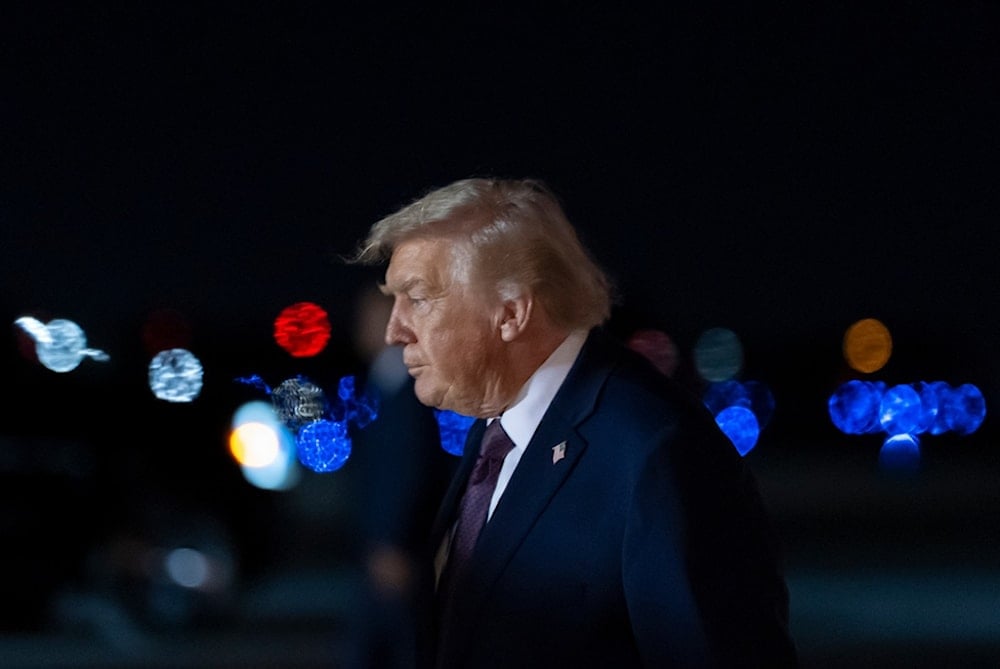
President Donald Trump arrives on Air Force One at Palm Beach International Airport, Saturday, Dec. 20, 2025, in West Palm Beach, Fla., US (AP Photo/Alex Brandon)
The United States brought together officials from Turkey, Egypt, and Qatar in Miami on Saturday, where the four governments jointly reaffirmed their backing for President Donald Trump’s Gaza initiative. The meeting comes amid preparations for the next phase of the US-designed framework, which was endorsed last month in a controversial UN Security Council resolution that effectively authorizes an external transitional administration for Gaza.
US special presidential envoy Steve Witkoff released a joint message following the talks, stating: "We reaffirm our full commitment to the entirety of the President's 20-point peace plan and call on all parties to uphold their obligations, exercise restraint, and cooperate with monitoring arrangements. Further consultations will continue in the coming weeks to advance the implementation of phase two."
We, the representatives of the United States of America, the Arab Republic of Egypt, the State of Qatar, and the Republic of Türkiye, met yesterday in Miami to review the implementation of the first phase of the Gaza ceasefire and to advance preparations for the second phase.…
— Special Envoy Steve Witkoff (@SEPeaceMissions) December 20, 2025
What the Plan Sets Out to Do
Washington’s 20-point proposal lays out a phased framework centered on a ceasefire, a security overhaul, and an internationally managed reconstruction program. It calls for an end to combat, the release of Israeli captives, a large-scale prisoner exchange, and full humanitarian access.
One of its most consequential components is the deployment of the so-called International Stabilisation Force, commanded by a US general and staffed by allied militaries, tasked with enforcing Gaza’s demilitarization, dismantling Hamas’s remaining military infrastructure, and controlling strategic corridors. This security regime forms the backbone of the plan’s two-year “transitional governance period” as outlined in UN Security Council Resolution 2803.
The plan also introduces a non-elected technocratic authority supervised by a foreign-led “Board of Peace”, a body Trump has said he intends to chair personally and whose members are expected to be announced early next year. Diplomatic sources say the board will hold sweeping authority over Gaza’s political, administrative, and economic affairs, effectively functioning as the territory’s highest governing structure during the transition.
Earlier drafts of the proposal reportedly included controversial figures such as former UK prime minister Tony Blair, whose involvement sparked regional backlash due to his role in the invasion of Iraq. Though Blair’s name was later dropped, the underlying framework, external leadership determining Gaza’s governance, remains intact.
Reconstruction and investment flows would be tightly controlled by foreign donors, with assistance conditioned on compliance with the plan’s security benchmarks. Despite references to “aspirations” for a political horizon, the proposal offers no binding commitments toward sovereignty or statehood, leaving Gaza’s long-term status undefined.
Why It Faces Strong Opposition
The plan has drawn significant criticism from Palestinian factions, civil society groups, legal scholars, and regional analysts, who argue that it effectively revives the logic of the old mandate and trusteeship systems once imposed by European powers. Observers have noted its resemblance to the British Mandate framework that governed Palestine from 1920 to 1948 and to more recent international interventions in Kosovo, East Timor, and post-2003 Iraq.
Critics argue that the combination of external governance, enforced demilitarization, and conditional reconstruction places Gaza under foreign guardianship, not on a path toward liberation or self-rule. By excluding Palestinian political actors from decision-making while empowering foreign capitals, they say the plan undermines any credible path to self-determination and risks entrenching long-term dependency.
Resistance movements have already rejected the proposal, warning that Palestinians will not accept any foreign figure, envoy, or “peace administrator” imposed from outside. Human rights experts caution that without sovereignty, accountability, or a meaningful political settlement, the so-called transition could become a permanent arrangement, leaving Gaza administered by foreign technocrats while its people remain sidelined.
Read more: Trump says Gaza 'Board of Peace' to be revealed early next year


