
US escalates regime change efforts in Cuba after Maduro abduction: WSJ
 2 Min Read
After abducting Nicolas Maduro in Venezuela, the US now targets Cuba with intensified pressure, insider recruitment, and economic isolation to force regime change.
-
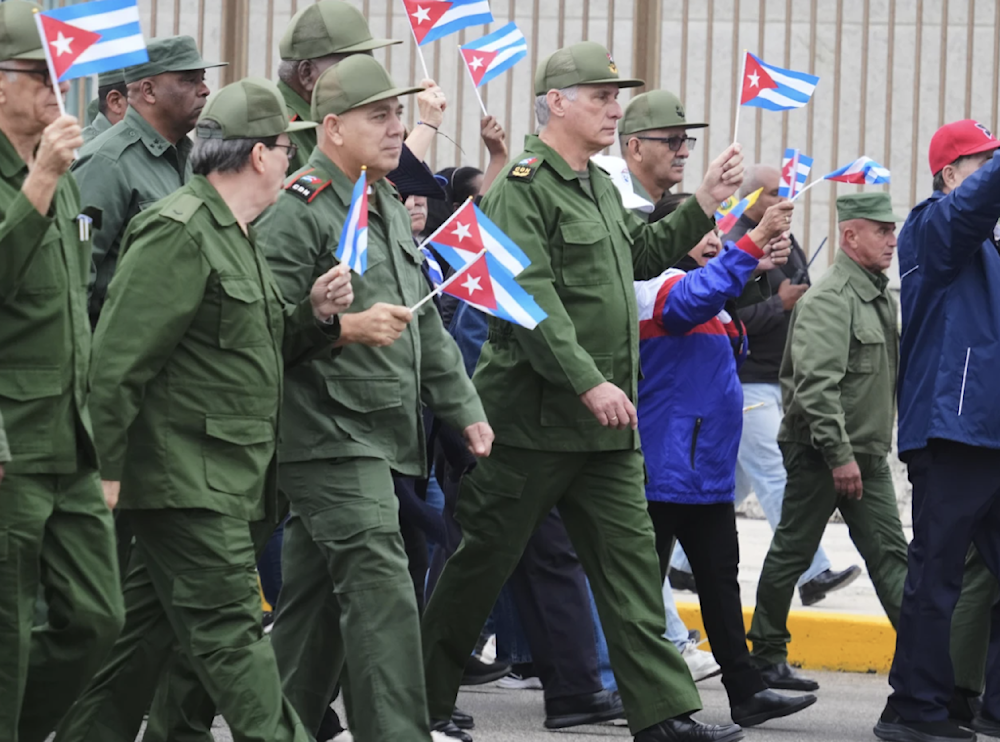
Cuban President Miguel Diaz-Canel marches during a rally to protest the killing of Cuban officers during the US operation in Venezuela that abducted Venezuelan President Nicolas Maduro on January 16, 2026. (AP)
Emboldened by its military operation in Venezuela, the Trump administration is now seeking to engineer regime change in Cuba by the end of 2026, targeting insiders within the Cuban government who may be willing to collaborate, according to a report by The Wall Street Journal.
Citing unnamed US officials, the WSJ report says that Washington believes Cuba’s economy is on the verge of collapse, due to long-standing shortages, power outages, and the loss of subsidized oil from Venezuela.
The kidnapping of Venezuelan President Nicolás Maduro, which resulted in the deaths of dozens of Cuban citizens, has reportedly emboldened US policymakers to pursue a similar operation in Havana.
“I strongly suggest they make a deal. BEFORE IT IS TOO LATE,” Trump threatened in a January 11 post, announcing a halt to oil and financial support for Cuba.
Militarized strategy, economic pressure
Although no official military action has been announced, the US sees the Venezuela operation as a model, and Trump’s inner circle reportedly views the overthrow of Cuba’s government as a top priority.
Senior US officials are pressuring Cuba through sanctions, targeting its overseas medical missions, and threatening oil cut-offs, with intelligence assessments predicting that Cuba could run out of fuel within weeks. The goal is to paralyze the economy and trigger internal collapse or elite defection.
“Cuba’s rulers are incompetent Marxists… they have destroyed their country,” a White House official claimed, in a statement that echoes the long-standing US hostility toward Cuban sovereignty.
Propaganda and psychological operations
The push is accompanied by a wave of AI-generated propaganda, promoted by Trump allies, portraying a “post-Communist” Cuba filled with US symbols, mass migration from Miami, and celebratory images of Trump and Secretary of State Marco Rubio in Havana.
Analysts, however, warn that the Cuban state is more centralized and less penetrable than Venezuela. Cuba’s leadership has firmly rejected Washington’s approach.
“There is no surrender or capitulation possible nor any kind of understanding based on coercion or intimidation,” Cuban President Miguel Díaz-Canel declared, vowing resistance following the deaths of Cuban personnel in Caracas.


