
From Latin America to Eurasia, nations condemn US attacks on Venezuela
 15 Min Read
Countries across Latin America, Europe, Asia, and beyond condemn the US aggression on Venezuela as a violation of international law, urging restraint, dialogue, and respect for sovereignty.
-
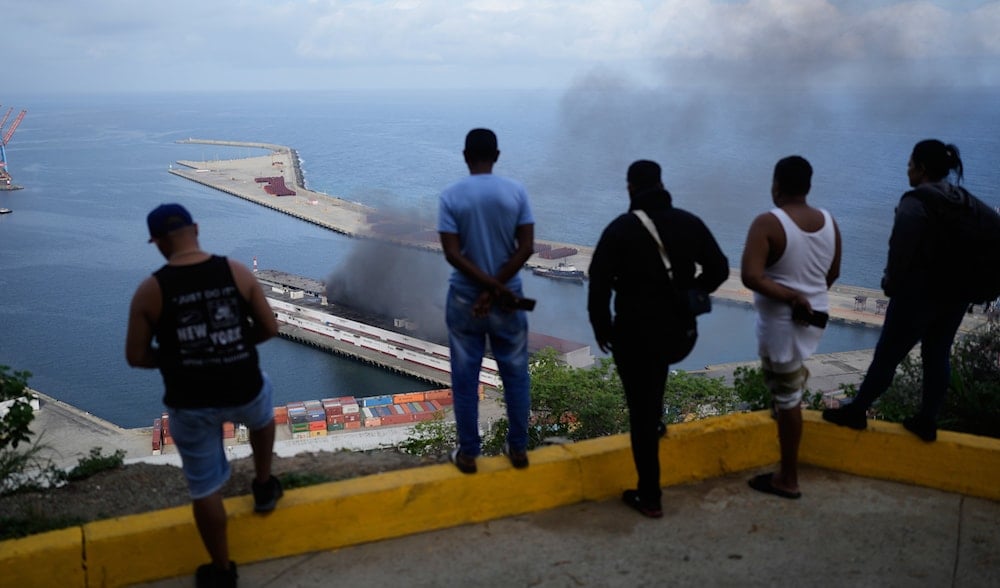
Men watch smoke rising from a dock following US strikes on La Guaira port, Venezuela, Saturday, Jan 3, 2026 (AP)
International condemnation continued to mount on Saturday following the United States' military aggression on Venezuela and kidnapping of President Nicolas Maduro and his wife, with governments across Latin America, West Asia, Europe, and Eurasia denouncing the operation as a grave violation of international law and Venezuelan sovereignty.
Iran
Iran was among the first to condemn the aggression, as the Iranian Foreign Ministry slammed the attack as a flagrant breach of Venezuela's sovereignty and territorial integrity, stressing that the use of force against an independent UN member state violates the fundamental principles of the UN Charter and international law.
Tehran warned that such actions undermine international peace and security and threaten the global order, reaffirming Venezuela's inherent right to defend its sovereignty and the Venezuelan people's right to self-determination.
Araghchi holds phone call with Venezuelan FM
Later, Iranian Foreign Minister Abbas Araghchi held a phone call with Venezuelan Foreign Minister Ivan Gil Pinto to discuss the US aggression on Venezuela.
During the conversation, Araghchi strongly condemned the US military action in Venezuela and the reported kidnapping of the country’s legitimate president, NicolAs Maduro, and his wife, describing the operation as a “blatant example of state terrorism and a flagrant violation of the national sovereignty and popular will of the Venezuelan people.” He reaffirmed the Islamic Republic of Iran’s support for the Venezuelan people and their elected government.
Venezuelan Foreign Minister Gil Pinto expressed his appreciation for Iran’s principled stance and solidarity, emphasizing that the Venezuelan people and government remain determined to defend their national sovereignty and their right to self-determination in the face of aggressive and unlawful US policies.
Russia
Russia also rejected Washington's justifications for the operation. The deputy speaker of Russia's Federation Council said Venezuela posed no threat to the United States and described the measures taken against it as unjustified.
In a separate statement, the Russian Foreign Ministry said that "Moscow expresses deep concern" and condemned the "US armed aggression against Venezuela," urging all parties to prevent further escalation and focus on dialogue as the only viable path out of the crisis.
Later, the Russian Foreign Ministry released a statement, saying that Russian Foreign Minister Sergey Lavrov conveyed "firm solidarity with the Venezuelan people in the face of armed aggression" in a phone call with Venezuelan Vice President Delcy Rodriguez.
"The parties spoke in favour of preventing further escalation and finding a way out of the situation through dialogue," the Ministry said.
It also dismissed as "fake" reports claiming that Rodriguez is currently in Russia, TASS reported.
Meanwhile, the Russian Foreign Ministry also called on the US to release the legally elected president of Venezuela and his wife.
Separately, Russian Security Council Deputy Chairman Dmitry Medvedev described the US aggression as a blatant violation of a sovereign state's rights and an example of aggressive militarism. He argued that such operations highlight the need for all states to strengthen their armed forces to the maximum and prevent outside interference in their internal affairs.
Medvedev criticized the assault as a shining example of Pax Americana, suggesting that it recalled past instances of foreign intervention under the guise of security, and asserting that only a strong nuclear arsenal can provide reliable protection for a nation's sovereignty and security.
With sarcasm, he noted that the operation could be viewed as yet another brilliant step toward the Nobel Peace Prize for Trump. He also questioned why similar action had not been taken elsewhere if the intent were truly consistent and humanitarian.
Türkiye
Türkiye on Saturday urged restraint following US strikes on Venezuelan territory and reports of the capture of President Nicolas Maduro, emphasizing that it places importance on stability in Venezuela and on the peace and well-being of the Venezuelan people.
In a statement issued by the Foreign Ministry, Ankara warned against escalation, saying, “In order to prevent the current situation from leading to adverse consequences for regional and international security, we call on all parties to act with restraint.”
The Ministry said Türkiye is “closely” following recent developments in Venezuela and expressed its willingness to contribute to resolving the crisis within the framework of international law.
It added, “In this process, our Embassy in Caracas continues uninterrupted communication and necessary coordination with our citizens in the country.”
China
China’s Foreign Ministry condemned the US action in Venezuela, saying it violated international law. In a statement, the Ministry said, “China is deeply shocked and strongly condemns the use of force by the US against a sovereign country and the use of force against the president of a country.”
It added, “China firmly opposes such hegemonic behaviour by the US, which seriously violates international law, violates Venezuela's sovereignty, and threatens peace and security in Latin America and the Caribbean."
The Ministry, furthermore, urged the US "to abide by international law and the purposes and principles of the UN Charter and stop violating the sovereignty and security of other countries.”
United Nations
UN Secretary-General Antonio Guterres expressed deep alarm over US actions in Venezuela, warning they set “a dangerous precedent,” his spokesperson said in a statement on Saturday. The development adds to growing international concern over the implications of the escalation for global norms and stability.
The Secretary-General “continues to emphasize the importance of full respect, by all of international law, including the UN Charter,” adding that he is “deeply concerned that the rules of international law have not been respected,” UN spokesperson Stéphane Dujarric stated.
Latin American solidarity
Cuba
In Cuba, President Miguel Díaz-Canel issued a sharply worded statement on social media, describing the US operation as a "criminal attack" against Venezuela and labeling it "state terrorism" not only against the Venezuelan people but also against Latin America as a whole, which he referred to as "Our America."
He stressed that the Zone of Peace declared for the region was being "brutally assaulted" and called for an urgent international response. The Cuban leader concluded his message with the revolutionary slogan: "Homeland or Death, We Shall Overcome." Cuban Foreign Minister Bruno Rodríguez reinforced this position, denouncing the strikes as cowardly and unlawful, and reiterating that Venezuela posed no threat to Washington.
#Cuba denuncia y demanda URGENTE reacción de la comunidad internacional contra criminal ataque de E.U a #Venezuela. Nuestra #ZonaDePaz está siendo brutalmente asaltada. Terrorismo de Estado contra el bravo pueblo venezolano y contra Nuestra América.
— Miguel Díaz-Canel Bermúdez (@DiazCanelB) January 3, 2026
Patria o Muerte ¡Venceremos!
The Cuban president also warned that the threat posed by the recent US attack extends beyond Venezuela, describing it as a danger to all of humanity. He said Havana strongly condemns what he called an “imperialist attack” on Venezuela and called for urgent international action to halt it.
In his remarks, Díaz-Canel stressed that Cuba rejects and does not recognize the Monroe Doctrine “whether imposed by kings or outdated empires,” arguing that the current escalation reflects long-standing hegemonic policies rejected by the peoples of Latin America. He described the US operation as an act of “state terrorism", saying it could only be compared, in criminal terms, to "Israel’s" actions in the Gaza Strip.
The Cuban president also said the United States has “no moral or legal authority” to arrest or forcibly remove Venezuelan President Nicolas Maduro from his country, holding Washington fully responsible before the international community for Maduro’s physical safety.
Díaz-Canel concluded by saying that this moment “is not a time for neutrality,” but rather a time to take decisive positions against what he described as fascism and imperial brutality, urging countries to assume their political and moral responsibilities toward Venezuela.
Colombia
Colombia, despite political differences with Caracas and its non-recognition of Venezuela's 2024 presidential election, also rejected the US action. President Gustavo Petro warned that unilateral military intervention risks destabilizing the region and said Bogotá would push for an emergency meeting of the UN Security Council while preparing for possible humanitarian repercussions along the shared border.
Brazil
Brazil joined the wave of Latin American countries denouncing the US strikes. President Luiz Inacio Lula da Silva condemned the bombings and the kidnapping of President Maduro, calling it "an unacceptable line."
He warned that violating international law in such a manner paves the way for global instability and undermines multilateralism. Lula described the assault as reminiscent of the darkest moments of foreign interference in Latin American history and urged the international community to "respond vigorously" through the United Nations.
Os bombardeios em território venezuelano e a captura do seu presidente ultrapassam uma linha inaceitável. Esses atos representam uma afronta gravíssima à soberania da Venezuela e mais um precedente extremamente perigoso para toda a comunidade internacional.
— Lula (@LulaOficial) January 3, 2026
Atacar países, em…
Mexico
President Claudia Sheinbaum spearheaded Mexico's response by condemning the US military strikes on Venezuela, emphasizing the need to uphold international law. She shared a clause from the UN Charter that prohibits the use of force against the sovereignty or political independence of any state.
El Artículo 2, párrafo 4 de la Carta de las Naciones Unidas dice textualmente:
— Claudia Sheinbaum Pardo (@Claudiashein) January 3, 2026
“Los Miembros de la Organización, en sus relaciones internacionales, se abstendrán de recurrir a la amenaza o al uso de la fuerza contra la integridad territorial o la independencia política de…
The Foreign Ministry echoed the condemnation, calling the strikes a unilateral action that seriously threatens regional stability. It reaffirmed that military force is not a legitimate means of resolving international disputes and reiterated Mexico’s commitment to peaceful dialogue, negotiation, and support for mediation efforts.
Chile
Chile's President Gabriel Boric voiced concern over the US' military actions in Venezuela, calling for a peaceful resolution to the crisis and reaffirming the country's adherence to international legal principles, including non-intervention, territorial integrity, and the prohibition of the use of force.
Trinidad and Tobago
Similarly, Trinidad and Tobago's Prime Minister Kamla Persad-Bissessar distanced the island nation from the operation, emphasizing that it was not a participant in the strikes. The country reaffirmed its commitment to peaceful relations with the Venezuelan people and stressed the importance of non-interference.
Earlier this morning, Saturday 3rd January 2026, the United States commenced military operations within the territory of Venezuela.
— Kamla Persad-Bissessar (@PM_Kamla) January 3, 2026
Trinidad and Tobago is NOT a participant in any of these ongoing military operations.
Trinidad and Tobago continues to maintain peaceful relations…
Uruguay
Uruguay expressed serious concern over the events unfolding in Venezuela. The Foreign Ministry reiterated its historical opposition to foreign military intervention and reaffirmed the principle that no state may use force to infringe on another’s sovereignty. It called for full respect for international law and the purposes of the UN Charter.
Nicaragua, Bolivia
Nicaragua and Bolivia condemned the attack through the Bolivarian Alliance for the Peoples of Our America (ALBA), which issued a collective statement describing the strikes as an assault on regional sovereignty and a dangerous precedent for military intervention in Latin America.
The Caribbean Community (CARICOM) similarly emphasized the primacy of international law and rejected the use of force.
European responses
European reactions to the US assault on Venezuela were swift and varied, emphasizing concern over the use of force and the need to uphold international law.
European Union
The European Union stated that it was closely monitoring the situation, with EU High Representative for Foreign Affairs Kaja Kallas noting that while the bloc does not recognize the legitimacy of Maduro's presidency, it insists on the importance of restraint and adherence to the UN Charter.
The EU also reiterated its longstanding support for a peaceful transition.
I am following the situation in Venezuela with great concern. The European Union calls for de-escalation and a resolution in full respect of international law and the principles enshrined in the Charter of the United Nations.
— António Costa (@eucopresident) January 3, 2026
The European Union will continue to support a…
European Council
European Council President António Costa has called for de-escalation in Venezuela and a resolution that fully respects international law and “the principles enshrined in the Charter of the United Nations."
In a post on X, he stressed that the European Union “will continue to support a peaceful, democratic, and inclusive solution in Venezuela.”
I am following the situation in Venezuela with great concern. The European Union calls for de-escalation and a resolution in full respect of international law and the principles enshrined in the Charter of the United Nations.
— António Costa (@eucopresident) January 3, 2026
The European Union will continue to support a…
Costa also highlighted that the EU supports the efforts of the High Representative of the Union for Foreign Affairs and Security Policy, Kaja Kallas, “in coordination with the Member States, to ensure the safety of European citizens in the country.”
Germany
Germany expressed serious concern, with its Foreign Ministry confirming close coordination with the embassy in Caracas and the activation of its crisis response team. Prominent MP Roderich Kiesewetter criticized the US action, warning that it undermines the post-World War II rules-based order and erodes global trust in Washington.
France
Meanwhile, French Foreign Minister Jean-Noel Barrot condemned the US military operation that led to the abduction of Venezuelan President Nicolas Maduro, saying it violated international law.
En confisquant le pouvoir au peuple vénézuélien, en le privant de ses libertés fondamentales, Nicolás Maduro a porté une atteinte grave à sa dignité et à son droit à l'auto-détermination. La France s'est engagée avec constance, notamment par ses actions de médiation, en faveur du…
— Jean-Noël Barrot (@jnbarrot) January 3, 2026
“The military operation that led to the capture of Nicolas Maduro violates the principle of not resorting to force, that underpins international law. France reiterates that no lasting political solution can be imposed from the outside and that only sovereign people themselves can decide their future,” he wrote on X.
He emphasized that France has consistently supported respect for Venezuela’s sovereignty, including through mediation efforts, and that “the voice of the Venezuelan people must prevail.”
Barrot further warned that repeated violations of the principle of non-use of force by nations holding permanent seats on the UN Security Council “will have serious consequences for world security, which will spare no one.” He concluded by reaffirming France’s commitment to the UN Charter, stating that it “must continue to guide the international actions of states, always and everywhere.”
Melenchon: Macron, wake up!
Meanwhile, French left-wing leader Jean-Luc Mélenchon has sharply criticized President Emmanuel Macron’s stance on Venezuela, urging Paris to condemn what he described as an attack on Venezuela.
In a post on X, Mélenchon questioned whether the French president was fully aware of the situation, calling on the French Republic to take a clear position against military action targeting Venezuela. “There is no such thing as a good invasion, only bad ones,” he wrote.
Mélenchon stressed that France’s voice on the international stage must remain non-aligned and consistent with the principles of international law, warning against what he sees as selective or politically motivated positions in times of international crisis.
Spain
Spain echoed calls for de-escalation and reiterated its commitment to international law, offering to act as a mediator in efforts to reach a negotiated resolution to the crisis.
The @SpainMFA is closely monitoring the situation in Venezuela, in coordination with our partners in the European Union and the countries of the region.
— Spain MFA (@SpainMFA) January 3, 2026
🔗 https://t.co/aJh6GKQiyF pic.twitter.com/ODb5HwUm7e
United Kingdom
The United Kingdom distanced itself from the US operation, with Prime Minister Keir Starmer stating that Britain had no involvement in the strikes and would seek further clarification through direct communication with President Trump and allied leaders, reaffirming the UK's commitment to upholding international law.
Italy
Italy also voiced concern, focusing primarily on the welfare of its large expatriate community in Venezuela. Prime Minister Giorgia Meloni said the government was in close contact with the Foreign Ministry and actively monitoring developments to ensure the safety of Italian nationals, particularly those with dual citizenship.
Belarus
Meanwhile, in Eastern Europe, Belarus strongly denounced the US military operation in Venezuela, labeling it a threat to international peace and a violation of Venezuelan sovereignty. The Foreign Ministry reiterated its support for the government in Caracas and emphasized the right of the Venezuelan people to determine their own political future free from external interference.
The Netherlands
Christine Teunissen, a lawmaker from the Party for the Animals, called on the Netherlands to impose sanctions against the United States.
She described the strikes as an illegal attack targeting vulnerable populations and likened the action to the US invasion of Iraq. Teunissen emphasized the need for the Netherlands to defend international law and protect the interests of regional communities, including those in Curaçao, Aruba, and Bonaire.
VS voert illegale aanval uit en raakt mensen in een al extreem kwetsbare situatie
— Christine Teunissen (@Ct_teunissen) January 3, 2026
Net als de invasie Irak regelrecht tegen het internationaal recht in
NL moet dit keihard veroordelen, pal staan voor bescherming mensen op Curaçao, Aruba & Bonaire en sancties instellen tegen VS…
Indonesia
Alternatively, Indonesia, while monitoring the situation for the safety of its nationals, also called for restraint and peaceful resolution. The Indonesian Foreign Ministry stressed the importance of de-escalation, protection of civilians, and adherence to international law and the UN Charter.
South Africa
On the other hand, South Africa has called for an urgent United Nations Security Council session in response to the unilateral US military action in Venezuela, the country’s Department of International Relations said. In a statement, it said, “South Africa calls on the UN Security Council, the body mandated to maintain international peace and security, to urgently convene to address this situation.”
The statement added that “South Africa views these actions as a manifest violation of the Charter of the United Nations, which mandates that all Member States refrain from the threat or use of force against the territorial integrity or political independence of any state.”
Tunisia
Tunisian Workers’ Party
The Secretary-General of the Tunisian Workers' Party, Hammam Hammami, vehemently condemned the US attack on Venezuela as "thuggery and state terrorism" that is clearly "targeting the peoples of the world."
He called for urgent global action against US actions, saying, "There is no alternative but to confront such dangers by turning our region into a hell beneath the feet of American imperialism."


