
Cuba faces aggression with innovation, resistance: Diaz-Canel
 3 Min Read
Cuba's president outlines measures to tackle the country's economic crisis amid US blockade, emphasizing innovation, BRICS membership, and social justice.
-
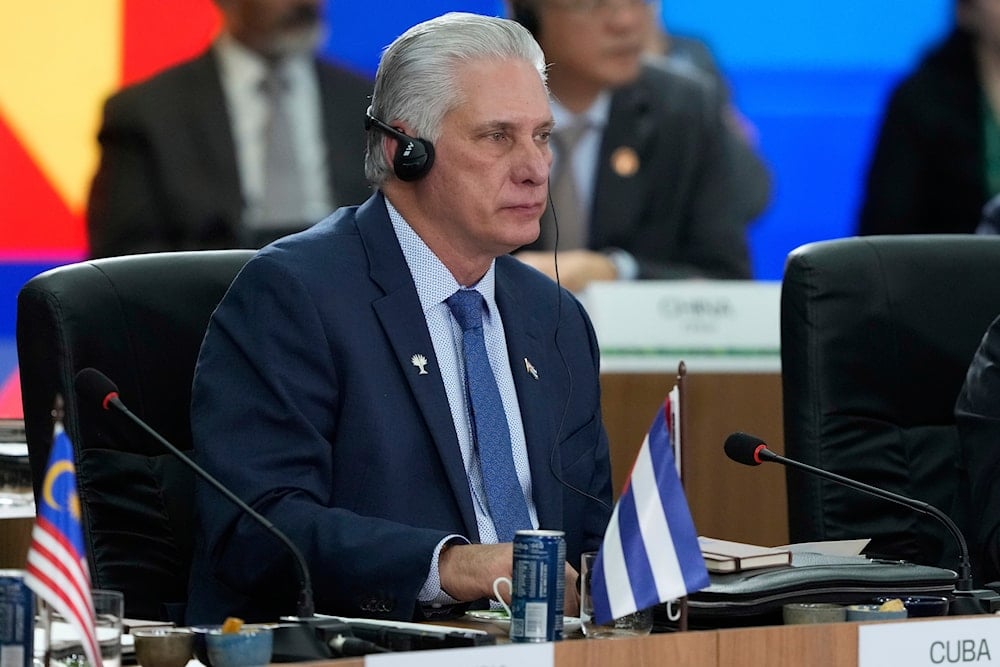
Cuba's President Miguel Diaz-Canel attends the 17th annual BRICS summit in Rio de Janeiro, Sunday, July 6, 2025. (AP)
Cuban President Miguel Diaz-Canel addressed the National Assembly on Thursday, emphasizing the approval of the Economic Plan, the State Budget, and the Science, Technology, and Innovation Law.
During his speech, Diaz-Canel acknowledged the complex crisis facing Cuba, intensified by the US blockade and a volatile international context that threatens multilateralism, international law, and global peace.
He highlighted the economic aggression Cuba faces, including the escalation of the blockade, the country’s designation as a "state sponsor of terrorism," and disruptions to international trade and financial transactions.
The president noted that 2025 had presented significant challenges but underscored growing international support against the embargo and Cuba’s recent inclusion in the BRICS group, which strengthened its role in the global South.
US 'peace through strength' facade for imperialism
Diaz-Canel criticized the US “peace through strength” doctrine, asserting that it aims to impose imperialist domination, seize natural resources, and threaten Venezuela through acts of war and maritime piracy.
Reaffirming Cuba’s resilience, Diaz-Canel said the nation is guided by three principles: unity, continuity, and creative resistance. He stressed the importance of discipline, innovation, and active popular participation across all sectors to navigate the ongoing crisis.
The president called for macroeconomic stabilization, correction of distortions, and productive growth, emphasizing the importance of accountability and taking concrete measures to ensure social justice and economic sustainability. He also highlighted the role of science and innovation as drivers of development, advocating for closer integration between universities, businesses, and local communities to create practical solutions in areas such as production, energy, health, and daily life.
Díaz-Canel concluded by stressing the need to translate laws and plans into tangible results and proposed declaring 2026 the Year of Fidel Castro’s Centennial, encouraging all efforts to reflect the late leader’s spirit of solidarity and commitment to social justice.
Decades of economic war
The United States first began imposing economic measures on Cuba in October 1960, placing restrictions on trade following the Cuban Revolution and nationalization of US properties. These measures expanded into a formal embargo under President John F. Kennedy, with Proclamation 3447 issued on February 3, 1962, and taking full effect on February 7, 1962, banning most trade between the two countries.
Over the decades, the embargo has been tightened and modified by successive US administrations, including the Helms‑Burton Act of 1996, which codified and strengthened the restrictions, and later executive actions that targeted financial and travel links with Cuba.
The embargo remains in place today and continues to restrict Cuba’s ability to import key goods and access international financial systems, contributing to economic hardship on the island. Each year, since 1992, the United Nations General Assembly has overwhelmingly voted for resolutions calling for an end to the embargo, most recently on October 29, 2025, affirming global opposition.
Cuba and many international observers argue that the embargo has failed to achieve its political aims and instead has deep economic and social impacts on the Cuban people, while only the US Congress holds the authority to repeal it.


