
US allies fear Washington moving head-on towards defeat against Iran
 7 Min Read
The US war on Iran enters its sixth month as allies question Washington’s strategy, military readiness, and credibility amid ongoing tensions over the Strait of Hormuz.
-
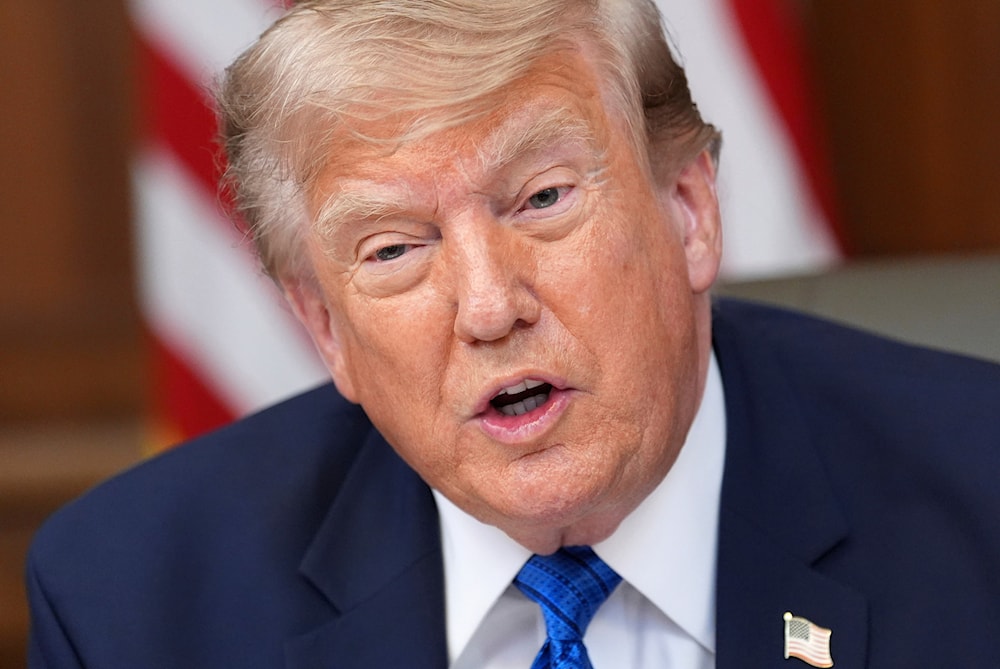
President Donald Trump speaks during a cabinet meeting on July 31, 2026, at Camp David, the presidential retreat, near Thurmont, Md. (AP)
US President Donald Trump's war on Iran, now in its sixth month, appears to be heading toward a strategic defeat, according to concerns raised by Washington's allies.
The inability of the United States to translate military superiority into a sustainably changed Iran has revealed a vulnerability that Russia and China are expected to welcome, analysts and officials have told The New York Times (NYT).
Trump's goals remain unmet, and the US military is running short on key armaments needed for global reach. Iran remains seemingly resolute under a more hardline government, its nuclear and ballistic missile programs are degraded but not destroyed, and the Strait of Hormuz is effectively under Iranian control. The war has left both the United States and "Israel" in weaker positions, with each side blaming the other for the current situation.
Iranian missiles and drones continue to restrict traffic through the strait, damage the economic infrastructure of allied energy production, and threaten American bases across West Asia, according to The New York Times. These attacks have killed and injured US service members. With Trump's aims shifting, Washington is losing credibility both militarily and diplomatically, analysts said, and its conduct in the war underscores the impression that the United States is an unpredictable instrument of global disorder.
Robin Niblett, a former director of Chatham House, a think tank in London, told The New York Times that the war may evolve but that the result so far has been "a strategic loss and an embarrassment."
He added: "For US allies and those who rely on the US for security, this is confirmation that you can't trust the United States." Even if Iran collapses, he said, "people won't forget that their security and their future were dragged into question by an unpredictable and wavering US foreign policy".
Allies hedge as US credibility erodes
European allies remember Trump's vow to seize Greenland from a NATO ally and his threats to leave the alliance unless other allies met his spending goals, The New York Times reported. Allies in West Asia see their own security undermined by this war, even if they remain too committed to Washington to abandon partnerships with the United States.
However, they are already hedging, seeking to repair ties with Iran and improve relations with Europe, China and Russia, said Ali Vaez, the Iran project director at the International Crisis Group.
Niblett said many countries disliked the global order as it was, but there was one. "Now America has confirmed itself as a force of disorder, and everyone is drawing lessons from it, and trying to be less dependent," he told NYT. "No one wants to be subject to a whipsaw foreign policy that doesn't know its limits, and that is a strategic defeat."
Vaez cited other recent developments as evidence that the United States has lost credibility as a guarantor of allies' security, including Trump's abrupt change of demands last week after announcing a landmark nuclear agreement with Saudi Arabia.
"The Saudis do a nuclear deal with Trump that he walks back in 24 hours," Vaez said. "This is the crisis of credibility of the US. Neither its military prowess nor its diplomatic promises can be trusted".
US runs short of munitions as war drags on
World War II left the United States stronger at home and with more influence abroad, but since then Washington's military record has been mixed, The New York Times (NYT) reported. Enemies more willing to suffer the pain and expense of war, as in Vietnam, Iraq and Afghanistan, have outlasted the United States. This war on Iran may turn out similarly, with Washington finding a sufficient reason to cut its losses and go home.
Aaron David Miller, a former American negotiator and now a senior fellow at the Carnegie Endowment for International Peace, told NYT that the war "has undermined US deterrence and credibility, antagonized America's allies and delighted its adversaries." He added: "And if the Strait of Hormuz falls under Iran's leverage and control, it will constitute nothing less than a strategic defeat".
A severe shortage in crucial air-defense munitions like Patriot missiles is having a secondary effect in Ukraine and showing Russia and China, as well as NATO, that the United States will be less capable for years at least to both resupply its allies and fight a lengthy war, according to NYT. The war has also badly damaged the vital alliance between the United States and "Israel", said François Heisbourg, a French security analyst.
US officials, including Vice President JD Vance, have suggested that Prime Minister Benjamin Netanyahu of Israel was overly optimistic while convincing Trump that the war would be quick and decisive. Added to already negative views of "Israel" and Jews more generally stemming from the long conflict with Hamas in Gaza, which some call genocide, this war has increased "antisemitism" in the United States and beyond, some polls show.
Strait of Hormuz talks and Iranian distrust
The most important negotiation now, Heisbourg and Vaez agreed, is between Iran and Oman over control of the Strait of Hormuz, which both countries border. Iran wants sole control over the strait's northern route and shared control over the southern route, which would give it an effective veto over traffic, Vaez said. While Oman, which Iran is convinced is influenced by Saudi Arabia and the United States, argues for a voluntary fee for passage, Iran is demanding a compulsory one.
"This may be the end of the law of the sea as we've known it," said Heisbourg. Freedom of the seas has been a vital American interest from its founding, he noted, but it is now at risk. Even if there is agreement on the strait, Iranian officials believe there is no guarantee Trump will accept it, analysts said.
Iran insists on final deal based on Trump's previous behaviour
The Iranians remember that Trump tore up the 2015 nuclear deal and attacked Iran twice during more recent nuclear negotiations. They are insisting on a final deal on the strait before any new memorandum of understanding can be negotiated with Washington, Vaez said, and they also want a pullback of US offensive military assets.
"The Iranian calculus is simple," he said, clarifying that "they need the leverage the strait provides them to extract concessions from the US and get a guarantee that an attack on Iran can't happen again."
Their position may be strengthened by the decision of their Yemeni ally, Ansar Allah, to blockade the Bab el-Mandeb strait that Saudi oil exports pass through on their way to Asia, The New York Times reported.
But even decision makers in Iran who favor further talks with the United States are losing confidence that Trump will be able to keep to any deal over the Strait of Hormuz or anything else, argued Esfandyar Batmanghelidj of the Bourse & Bazaar Foundation, a research institution focused on economic diplomacy.
Outlook for Diplomacy and Escalation
"Iranian leaders have become intensely pessimistic about what diplomacy with the Trump administration can achieve," Batmanghelidj told The New York Times. He noted that many of them view Trump as erratic and have a hard time seeing how they could reach a deal with the United States when it has undercut its own allies.
Washington has started a war it does not seem to know how to win or end, while Iran is mistrustful that any deal reached will be implemented, The New York Times stated, noting that the coming weeks are likely to see a continuing cycle of ad hoc truces and escalation, Vaez said, a new form of forever war.


