
Trump’s war on Iran reveals the return of forever US wars: Intercept
 8 Min Read
Donald Trump campaigned against endless wars, but Tom Engelhardt and Nick Turse argue that his war on Iran marks another chapter in Washington’s cycle of military intervention and West Asia confrontations.
-
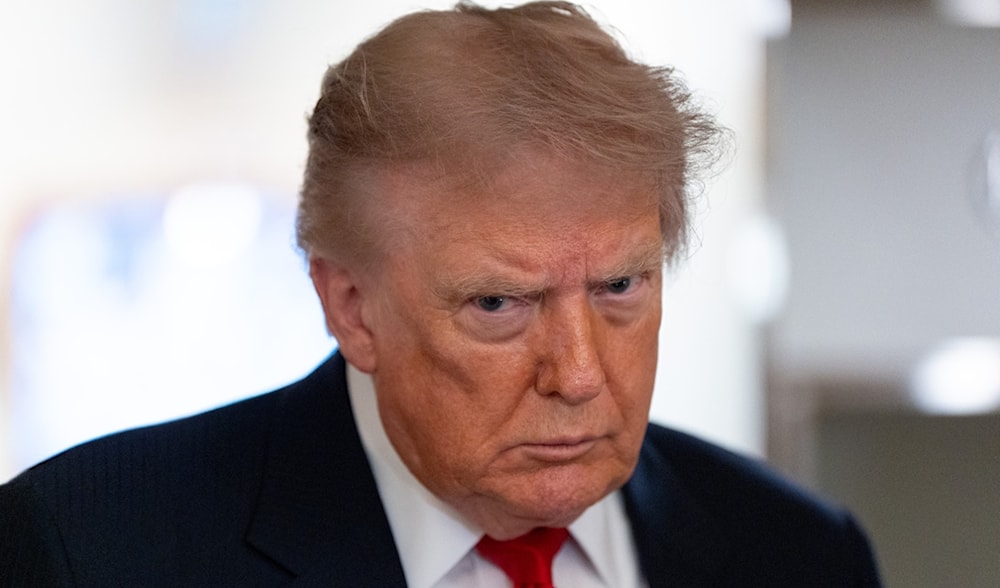
President Donald Trump speaks with reporters while on Air Force One en route to Oakland County International Airport, Monday, July 27, 2026, in Waterford Township, Mich. (AP)
In their analysis for The Intercept, Tom Engelhardt and Nick Turse examine the contradiction between US President Donald Trump’s campaign promises to avoid endless wars and his administration’s escalating military involvement in West Asia. The authors argue that a president who returned to the White House portraying himself as a peacemaker has instead dragged the United States deeper into another destructive confrontation with Iran.
Trump campaigned in 2024 on a promise to keep the United States out of foreign wars, declaring: “Under Trump, we will have no more wars.” He repeatedly criticized previous US military interventions, particularly the 2003 invasion of Iraq, saying during a Republican presidential debate in 2016: “We should have never been in Iraq. We have destabilized the Middle East.”
Yet despite those promises, the United States joined Saudi Arabia in attacks on Iran-backed militias in Iraq, marking another escalation in Washington’s long history of military intervention in West Asia.
US Central Command announced that “U.S. and Saudi fighter aircraft struck multiple terrorist logistics and weapons sites across eastern Iraq in a strong response to over 30 IRGC-directed aerial drone attacks in the last 72 hours,” referring to Iran’s Islamic Revolution Guard Corps and the latest escalation in aggression against Tehran.
Engelhardt and Turse argue that Trump’s latest military campaign exposes the gap between his political image as an opponent of “forever wars” and the reality of his presidency. The authors examine Washington’s recurring attraction to destructive wars in West Asia, questioning why Trump, who once promised to end endless military engagements, became involved in another prolonged confrontation.
Trump’s anti-war promises collapse into another US war
The authors argue that Trump’s approach reflects a pattern that has shaped decades of US foreign policy: presidents entering office promising restraint before becoming involved in new military campaigns.
Trump himself dismissed claims that he had campaigned on avoiding future wars, telling NBC News’ “Meet the Press”: “I didn’t promise anything.”
Engelhardt and Turse argue that, on that point, Trump has remained consistent. They cite an Intercept analysis showing that the United States has been involved in more than 20 military interventions, armed confrontations, and wars during Trump’s years in the White House.
Speaking to Al Mayadeen on Wednesday, Professor Mohammad Marandi said that Washington operates as an empire without red lines rather than a rational diplomatic actor.
— Al Mayadeen English (@MayadeenEnglish) July 30, 2026
Reflecting on past ceasefires and broken agreements, Marandi emphasizes that Iran and the Axis of Resistance… pic.twitter.com/YCBPNtjTb6
The authors frame the issue as being about more than strategic interests, arguing that US wars are often shaped by the ambitions and personalities of the presidents who launch them.
“There’s no I in war. But there is in Iran. And in Iraq, too,” they write, describing US military campaigns as being driven not only by claims of national security but also by the political calculations and personal ambitions of those in power.
“Or to put it another way: It’s the presidential psyche, stupid,” they add.
From Iraq to Iran: the continuation of America’s forever wars
Engelhardt and Turse trace the roots of the current confrontation back to the George W. Bush administration and Washington’s decision to invade Iraq in 2003.
In 2002, Bush warned that Iraq, Iran, and the Democratic People’s Republic of Korea represented a major threat, declaring that “states like these, and their terrorist allies, constitute an axis of evil, arming to threaten the peace of the world.”
The authors note that while the Democratic People’s Republic of Korea developed a nuclear arsenal that helped secure its survival, Iraq and Iran faced dramatically different consequences despite not producing nuclear weapons.
The United States invaded Iraq in March 2003, and Bush later declared that “major combat operations in Iraq … ended” during his infamous “mission accomplished” moment. But, as Engelhardt and Turse argue, the war never truly ended.
An insurgency continued, US bases came under attack, and fears grew of a civil war between Iraq’s Sunni minority and Shiite majority. What began as a military campaign became a lasting occupation and another example of what the authors describe as a “forever war.”
Trump entered office promising to end that cycle, telling voters: “I will not send you to fight and die in stupid foreign wars that never end.” Yet, his presidency has instead produced another chapter in Washington’s long history of military intervention.
Trump’s victory claims fail as the war on Iran continues
As the war on Iran continued, Trump repeatedly attempted to downplay the scale of the military assault and redefine the confrontation as a limited operation.
Engelhardt and Turse compare this approach to previous US declarations of victory that failed to match reality, particularly Bush’s “mission accomplished” announcement in Iraq.
Trump initially predicted that the war would last only weeks, claiming in March that it would end within “four to five weeks.” He later declared victory, saying at a rally: “Let me tell you, we’ve won. You know, you never like to say too early you won. We won.” However, the war continued, and Washington's violations resumed despite Iran's adherence to the provisions of the memorandum of understanding.
The authors highlight a series of shifting statements from Trump, including claims that the United States was close to completing its objectives and that the fighting could end quickly. They argue that the repeated announcements of success followed a familiar pattern in US military history: declaring victory before the consequences of war have actually ended.
As the campaign dragged on, Trump moved away from describing it as a full-scale war and began calling it a “skirmish.” “I call it a skirmish. This is, with this skirmish we have with the Islamic Republic of Iran,” Trump said on July 22.
For Engelhardt and Turse, the changing terminology reflects an attempt to minimize the scale and consequences of a war that has continued despite repeated claims that it was nearing its end.
Trump’s war rhetoric escalates as civilians bear the cost
While Trump has portrayed the war on Iran as limited, the authors argue that his threats reveal a willingness to expand the campaign.
Trump warned that any Iranian attack on ships in the Strait of Hormuz would trigger US strikes against civilian infrastructure, stating: “Any time the Islamic Republic of Iran shoots at a ship in the Strait of Hormuz, whether it be by missile, rocket, drone, or any other device or weapon, the United States will bomb and destroy one bridge or power plant.”
Engelhardt and Turse argue that such threats demonstrate the widening gap between Trump’s efforts to portray the campaign as a minor operation and the potentially devastating consequences of continued escalation.
They also criticize the approach of Secretary of War Pete Hegseth, arguing that his rhetoric reflects the administration’s increasingly aggressive military posture.
Americans grow tired of another endless war
Despite the administration’s continued military approach, Engelhardt and Turse argue that public support for the war on Iran is declining.
A recent Washington Post poll found that only 29 percent of Americans approved of Trump’s handling of the war on Iran. A Fox News survey also found that 56 percent opposed US military action against Iran, including 40 percent who said they “strongly” opposed it.
A CBS News/YouGov poll found that 67 percent of respondents believed the United States should end the war on Iran immediately, with younger Americans showing the strongest opposition.
The authors argue that the growing opposition reflects broader exhaustion with Washington’s decades-long cycle of military interventions.
Even among Trump’s supporters, enthusiasm for the war has declined. A Politico poll found support among his base had dropped by 13 percent over two months, while nearly one in five MAGA voters believed the United States should end the war.
Trump’s war of choice faces resistance at home
Engelhardt and Turse argue that Trump’s approach to the war on Iran is ultimately tied to his personal image and political identity.
“His war in the ME is wrapped up in his egocentric narcissism and his me, me, me world,” they write.
The authors argue that under Trump, the phrase “wars of choice” has taken on a new meaning, becoming “wars of Donald’s choice.”
However, they emphasize that Trump is not the only actor capable of making decisions. Iran has continued resisting US pressure, while the American public has also shown growing opposition to another prolonged military campaign.
“If Trump keeps on fighting in Iran, he may sooner or later also find himself in a distinct ‘skirmish’ with the American people,” the authors conclude.
For Engelhardt and Turse, the war on Iran represents not a break from past US policy but another continuation of America’s long cycle of intervention in West Asia, where promises of restraint have repeatedly given way to new wars.
US President Donald Trump’s approval rating has fallen to 34%, matching the lowest level recorded during his political career, as a new CNN poll found growing public frustration over his priorities, the economy, and his handling of the war on Iran.
— Al Mayadeen English (@MayadeenEnglish) July 29, 2026
The survey found that 73% of… pic.twitter.com/8IbXCrUmGQ


