
US support for Iran war falls to one-third, Reuters/Ipsos poll finds
 5 Min Read
Only one-third of Americans support the US war on Iran, while 69% say US President Donald Trump has failed to clearly explain the goals of military involvement.
-
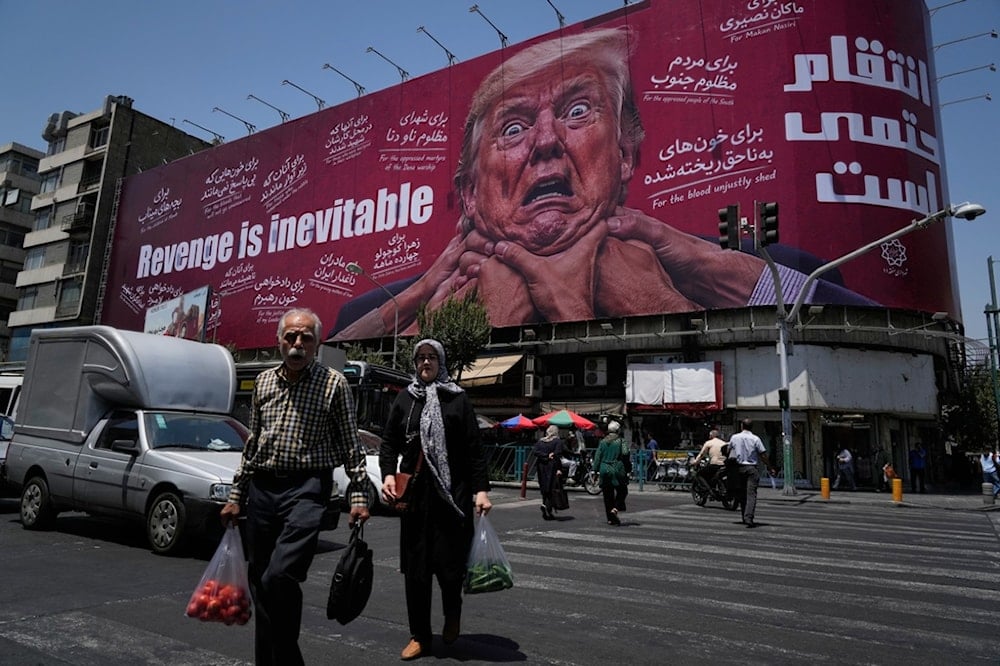
Pedestrians walk past a billboard depicting US President Donald Trump being grabbed by the neck alongside the message 'Revenge is inevitable' in English and Farsi, in Tehran, Iran on July 27, 2026. (AP Photo/Vahid Salemi)
Support for the US war on Iran has fallen to its lowest level in a Reuters/Ipsos poll since the early stages of the five-month-old war, with only one in three Americans backing the military aggression and a majority saying President Donald Trump has not clearly outlined its objectives.
The nationwide poll, conducted from Friday through Sunday, also found that Trump's approval rating rose three percentage points from last month to 37%, after reaching the lowest level of his presidency in the previous survey.
Trump has presented several objectives for the war, including eliminating Iran's ballistic missile capabilities and preventing Tehran from developing a nuclear weapon. However, 69% of respondents, including four in 10 Republicans, said Trump had not "clearly explained the goals of US military involvement in Iran."
White House spokesperson Olivia Wales said the president would not base his decisions on "fluid opinion polls" and reiterated his commitment to preventing Iran from acquiring a nuclear weapon.
"What matters most to the American people is having a commander in chief who takes bold action to keep them safe," Wales said.
War support remains below 40% as costs mount
Public backing for the war has remained below 40% since the United States and "Israel" launched strikes on February 28, according to the poll. The level of support contrasts with the early stages of other major US wars in recent decades.
Around 70% of Americans supported the Iraq War during its initial months in 2003, while approximately 90% backed the Afghanistan War in its early days, according to Gallup polling. Both wars ultimately lasted for years.
The low level of public support for the Iran war is emerging as a political challenge for Trump and his Republican Party ahead of November's midterm elections, when the president's allies will seek to retain narrow majorities in Congress.
Alex Womack, a retired turbine repair specialist from Stockbridge, Georgia, said he was uncertain about the reasons behind the war and had become less supportive of Trump because of it.
"It's not clear why we started a war with them. I have no idea," said Womack, who served in the US Marine Corps during the 1991 Gulf War and later became a Republican partly because he supported then-President George H.W. Bush's handling of that war.
"I don’t think he’s doing very well, personally," Womack said.
Eighteen US soldiers have died in the war so far, while thousands of people have been killed in Iran and Lebanon, where Israeli occupation forces have been attacking since the start of the US-Israeli joint attack on Iran.
The war has also contributed to a sharp rise in gasoline prices in the United States, adding financial pressure on households. Average gasoline prices have climbed to slightly above $4 per gallon nationwide, compared with approximately $3 per gallon before the war began on February 28.
Alex Conant, a Republican political strategist who served as a White House spokesman during the presidency of George W. Bush, said the economic impact could create additional difficulties for the Republican Party.
"This puts pressure on the party in a myriad of ways, all of them bad," Conant said. "The White House officials have been saying since January that they need to win economic arguments. It’s hard to win the economic arguments when you’re clearly focused on foreign policy.”
Independent voters lean toward Democrats
The poll also indicated potential challenges for Republicans among independent voters ahead of the midterm elections.
Among registered independent voters surveyed, 36% said they favored the Democratic congressional candidate in their district, compared with 20% who preferred the Republican candidate. Independents also gave Democrats an advantage over Republicans on economic policy, according to the poll.
Trump campaigned in 2024 on a promise to avoid prolonged foreign wars and initially predicted that the war on Iran would last between four and five weeks. He has also rejected comparisons between this war and previous US wars, including the Vietnam War, which lasted two decades and resulted in the deaths of more than 58,000 US service members.
Rhyan Anderson, an independent voter from Fairburn, Georgia, who supported Trump in 2024, said the president should prioritize domestic issues instead of focusing on assisting "Israel" or other allies.
"My biggest thing is just focus on the people who are actually in the country," said Anderson, who works two security and data collection jobs and voted for Democrat Joe Biden in 2020. "I know we have allies and things like that, but there’s a lot of people here that really need help."
Support for military strikes remains limited
The Reuters/Ipsos survey began asking respondents in mid-March whether they supported or opposed US military attacks on Iran. At that point, 37% said they supported the war.
That figure was higher than the 27% recorded on the day the war began. The initial survey also allowed respondents to select "unsure," with 29% choosing that option.
The latest Reuters/Ipsos poll was conducted online across the United States and collected responses from 1,246 adults. It has a margin of error of approximately three percentage points in either direction.
Read more: Trump’s war on Iran leaves Washington trapped as costs mount


