
US and EU push $800bn Ukraine recovery plan amid war
 5 Min Read
The US and EU are seeking up to $800bn in public and private funds to rebuild Ukraine, but the long-term plan hinges on a ceasefire.
-
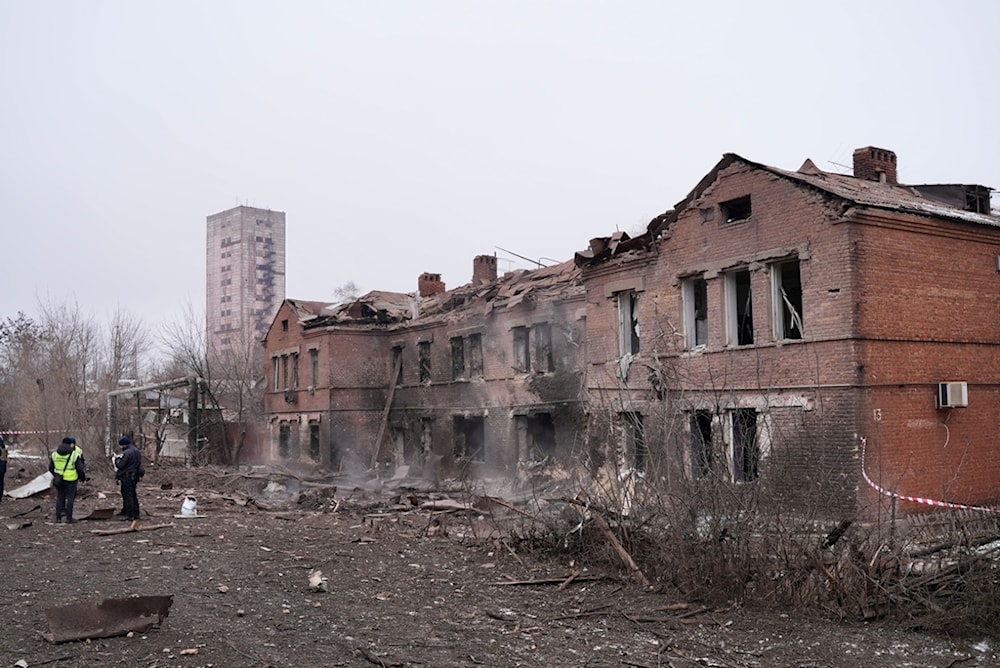
A building damaged by a Russian strike in Kryvyi Rih, Ukraine, Thursday, January 22, 2026 (AP)
The United States and the European Union are seeking to mobilize up to $800 billion in public and private funding to support Ukraine’s long-term reconstruction once the ongoing war comes to a close, according to a document obtained by Politico.
The 18-page document outlines a 10-year recovery strategy paired with a fast-tracked pathway toward EU membership, and was circulated by the European Commission to EU capitals ahead of a leaders’ summit held Thursday, EU officials and diplomats said.
The plan envisions a transition from emergency wartime assistance to self-sustaining economic growth, but its viability depends on a ceasefire that remains out of reach, leaving the proposed prosperity framework vulnerable as fighting continues.
According to the document, the funding strategy would run through 2040 and includes an initial 100-day operational phase to launch reconstruction efforts, though attracting private investment will remain difficult as long as the conflict persists.
Investments unlikely if war persists
BlackRock, which is advising on the reconstruction effort in a pro-bono role, warned that large-scale investment is unlikely while Ukraine remains an active war zone. Speaking at the World Economic Forum, BlackRock vice chairman Philipp Hildebrand said fiduciary constraints make it nearly impossible for pension funds to invest under current conditions.
The prosperity framework forms part of a broader 20-point peace blueprint that the United States is attempting to broker between Kiev and Moscow. The plan explicitly assumes that security guarantees are already in place and does not address military arrangements, focusing instead on economic recovery and institutional reform.
A three-way meeting involving Ukraine, Russia and the United States is set to take place in Abu Dhabi as the war approaches its fourth year, with Washington expected to play a central role in shaping Ukraine’s post-war economy.
Rather than positioning the US solely as a donor, the document casts Washington as a strategic economic partner and anchor for private investment, highlighting its role in mobilizing capital and expertise. Larry Fink has participated in discussions with Ukrainian officials alongside Jared Kushner and US special envoy Steve Witkoff.
Hundreds of billions to go to Kiev
Over the next decade, the EU, the US and international financial institutions, including the International Monetary Fund and the World Bank, aim to mobilize around $500 billion in combined public and private capital.
The European Commission plans to allocate an additional €100 billion in budget support and investment guarantees from 2028 as part of the bloc’s next seven-year budget cycle, a move expected to unlock more than €200 billion in additional investment.
While Washington has reduced military and humanitarian aid during the war, the document signals readiness to invest heavily in Ukraine’s post-conflict economy, particularly in critical minerals, infrastructure, energy, and technology, though investors remain wary as long as drones and missiles continue to strike.
Ongoing discussions to end war
Negotiators from Russia, Ukraine, and the United States are meeting in Abu Dhabi for a second day of talks on a ceasefire plan promoted by US President Donald Trump, as diplomacy accelerates to end nearly four years of war in Ukraine.
The UAE Foreign Ministry said the discussions, scheduled to last two days, are “part of ongoing efforts to promote dialogue and identify political solutions to the crisis.”
The Abu Dhabi talks mark the first face-to-face engagement between Russian and Ukrainian negotiators since talks in Istanbul last summer, which produced only limited agreements on prisoner exchanges. This time, the focus is on a broader settlement framework advanced by the Trump administration.
The center of discussions
Ukraine’s chief negotiator, Rustem Umerov, said the discussions centered on “the parameters for ending Russia’s war and the further logic of the negotiation process.”
Central to the discussions is a 20-point peace framework that proposes a demilitarized zone in contested areas of Donetsk, international oversight, and use of frozen Russian assets to fund reconstruction.
Moscow is reportedly willing to commit $1 billion from frozen US-based assets to Trump's so-called "Board of Peace" initiative, which Putin says is focused on Gaza and the Palestinian struggle, but may also be used in rebuilding Ukraine.
An initial US ceasefire draft drew sharp criticism in Ukraine and Western Europe for appearing to align too closely with Russia’s position. Later revisions triggered pushback from Moscow after raising the possibility of deploying European peacekeepers.
Trump met with Zelensky on Thursday at the World Economic Forum in Davos, while US envoy Steve Witkoff later held talks with Russian President Vladimir Putin in the Kremlin. Putin also met Witkoff alongside Trump’s son-in-law, Jared Kushner.


