
EU unveils Ukraine war reparations panel at The Hague
 5 Min Read
The EU has launched an International Claims Commission to seek reparations for Ukraine, possibly using frozen Russian assets and an EU-backed reparations loan.
-
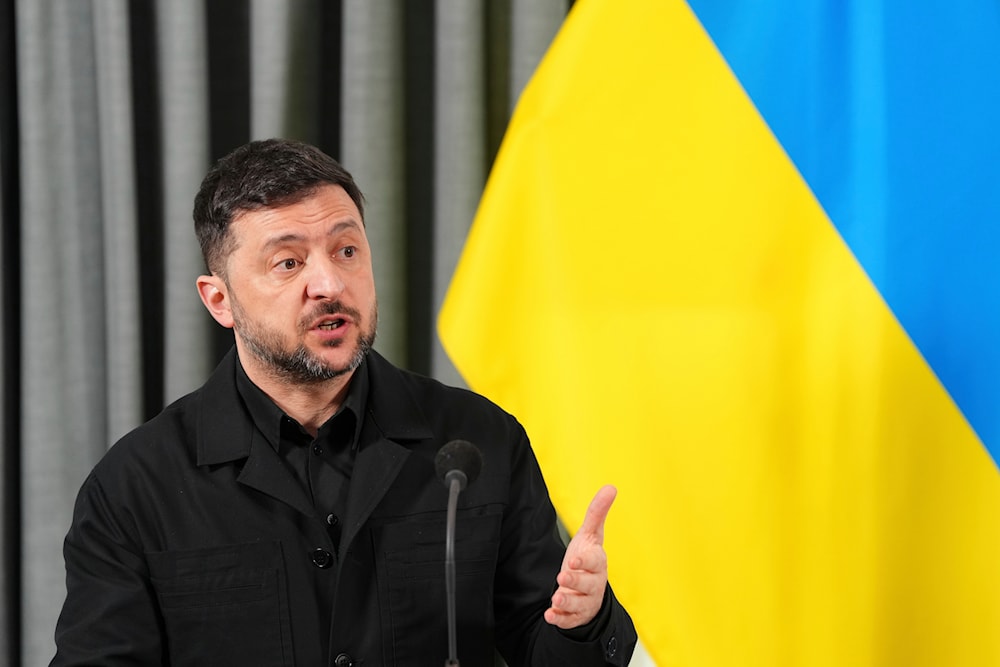
Ukraine's President Volodymyr Zelensky attends a news conference after meeting Dutch Prime Minister Dick Schoof in The Hague, Netherlands, Tuesday, Dec. 16, 2025. (AP)
The European Union on Tuesday launched an International Claims Commission for Ukraine, aiming to ensure Kiev is compensated for hundreds of billions of dollars in damage from Russian attacks and alleged war crimes.
The initiative was unveiled at a gathering in The Hague, attended by dozens of leaders, including Ukrainian President Volodymyr Zelensky, coinciding with a US-led diplomatic push to end the war in Ukraine.
"Every Russian war crime must have consequences for those who committed them," Zelensky said before 34 European leaders signed a convention formally establishing the commission. "That's exactly where the real path to peace begins," he added. "It's not enough to force Russia into a deal. It's not enough to make it stop killing. We must make Russia accept that there are rules in the world."
While the claims commission marks a significant step toward reparations, Ukrainians should not expect immediate payments for damages. Details on how any awarded compensation would be financed are still under discussion, including the potential use of frozen Russian assets within the EU, supplemented by contributions from member states.
"The goal is to have validated claims that will ultimately be paid by Russia. It will really have to be paid by Russia; this commission offers no guarantee for the damages," said Dutch Foreign Minister David van Weel.
Compensation plans face obstacles
The commission will incorporate the two-year-old Register of Damage, which has already received more than 86,000 claims from individuals, organizations, and public bodies in Ukraine. Claims can cover damages, losses, or injuries caused by Russian acts committed during or after February 24, 2022. These may include violations of international law and affect both private parties and the Ukrainian state.
Plans to compensate victims may face complications if future peace deals include an amnesty, a measure previously proposed by the Trump administration. More than 50 states and the EU drafted the Council of Europe convention establishing the commission, which will take effect after ratification by at least 25 signatories and securing sufficient funding.
The World Bank estimates that post-war reconstruction in Ukraine will cost $524 billion (447 billion euros) over the next decade, nearly three times Ukraine’s projected economic output in 2024. This figure only accounts for damages through December 2024 and does not include ongoing destruction caused by escalating Russian drone and missile strikes targeting utilities, transport, and civilian infrastructure.
European leaders call for Ukraine reparation loan
Separately, European leaders convened at the Eastern Flank Summit at the House of the Estates in Helsinki, Finland, to address regional security and ongoing support for Ukraine amid the war.
Speaking alongside the leaders of Bulgaria, Estonia, Latvia, Lithuania, Poland, Romania, Sweden, and Finland, Finnish Prime Minister Petteri Orpo said the meeting comes as “Europe is facing some of the most serious and existential questions of our time.” Orpo added, “We are closer to peace than ever before,” but cautioned that “we do not see any signs that Russia really wants peace.”
“Russia remains a threat today, tomorrow, and for the foreseeable future, for the whole of Europe. This is the reason we are strengthening our cooperation,” Orpo said, emphasizing, “We share a strong political will to reinforce our common security and Europe’s defence, starting from the eastern flank.”
Estonian Prime Minister Kristen Michal echoed similar concerns, warning that “Europe’s security is closely tied to Ukraine.”
“If Russia is not strategically defeated in Ukraine, it will become bolder,” he said, calling for the adoption of the EU reparations loan for Ukraine at this week’s European Council. “It is the best option to give Ukraine the financing it needs quickly, and it puts Ukraine into stronger position for a just and sustainable peace,” Michal added.
Swedish Prime Minister Ulf Kristersson reiterated the threat he considers is posed by Moscow, saying, “Russia is the long-term defining threat to Euro-Atlantic security and the war of aggression against Ukraine threatens literally, not only the eastern border of the European Union, but the continent as a whole.”
Zelensky continues to push using frozen Russian assets
At a joint press conference with Dutch Prime Minister Dick Schoof, Ukrainian President Volodymyr Zelesnky addressed questions on the use of frozen Russian assets and the EU’s proposed reparations loan. Schoof said the Netherlands views the loan as “the preferred option,” while acknowledging legal concerns from several countries, notably Belgium, where Euroclear is based.
Schoof stressed the need for shared responsibility. “I agree with Belgium that the risk needs to be shared by all countries with legal guarantees, so that all EU member states take their fair share.”
He added, “It will be a difficult decision, but I sincerely hope that we come to an agreement on Thursday and that the financial needs of Ukraine can be solved with the help of the frozen assets.”


