
Trump takes swing at Europe, describes countries as ‘weak’, ‘decaying’
 4 Min Read
The US president calls his European allies "weak" yet "politically correct", while hinting at a potential withdrawal from supporting Ukraine.
-
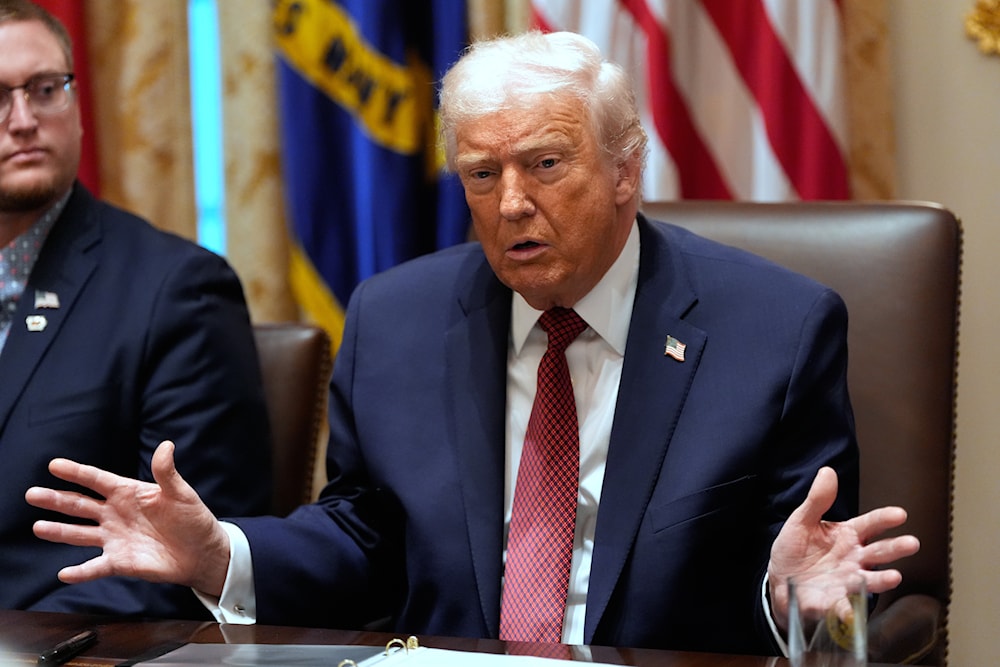
US President Donald Trump speaks during a roundtable on farm subsidies in the Cabinet Room of the White House, Monday, Dec. 8, 2025, in Washington (AP)
US President Donald Trump launched a blistering attack on Europe, describing it as a group of “decaying” countries led by “weak” figures, while hinting that Washington could walk away from Ukraine.
In an interview for POLITICO, Trump said he would back European political candidates who share his vision for the continent, while bashing current leaders, stating, "I think they’re weak, but I also think that they want to be so politically correct," emphasizing that "they don’t ... I think they don’t know what to do. Europe doesn’t know what to do."
The US president repeatedly circled back to what he portrayed as Europe’s internal problems, framing them in explicitly racial terms and labeling certain unnamed European leaders as “real stupid”.
“If it keeps going the way it’s going, Europe will not be … in my opinion … many of those countries will not be viable countries any longer. Their immigration policy is a disaster. What they’re doing with immigration is a disaster. We had a disaster coming, but I was able to stop it," he told POLITICO.
Trump signals potential exit from Ukraine deal
Trump said he had presented a new draft peace plan that, he claimed, was welcomed by some Ukrainian officials, though he said Ukrainian President Volodymyr Zelensky had not yet seen it. He stressed that European leaders talk about ending the war, but “they don’t produce, and the war just keeps going on and on.”
The president also criticized the state of Ukrainian democracy, saying, “They haven’t had an election in a long time. You know, they talk about a democracy, but it gets to a point where it’s not a democracy anymore," remarks that signal concern about governance in Kiev amid the war.
Trump urged Zelensky to accept his proposal to cede territory to Russia while asserting that Moscow still held the “upper hand” and insisting that Zelensky’s government must “play ball”.
The US president's pointed comments on Europe were paired with blunt statements on US domestic policy. He said immediate support for cutting interest rates would be a decisive test for his choice of a new chair of the Federal Reserve. He also suggested expanding anti-drug operations to include Mexico and Colombia, framing a wider regional approach to narcotics enforcement.
On the judiciary, Trump urged two conservative Supreme Court justices, Samuel Alito and Clarence Thomas, both in their seventies, to remain on the bench.
European Council warns US of meddling in internal European affairs
Recent tensions have flared after Trump’s administration released a new US national security strategy that openly criticizes the European Union, enraging European leaders who found it deeply provocative.
In response, top European officials, including António Costa, condemned the document as interference in Europe’s internal politics, warning that only European citizens should decide their governments and rejecting US pressure to back far-right or nationalist parties.
The row underscores a broader breakdown in transatlantic trust, with many in Europe now pushing for greater strategic autonomy and warning that continued US pressure could undermine European unity and democratic norms.
In detail, Costa issued a stark warning to the Trump administration against meddling in Europe’s internal affairs, as analysts said the newly released US national security strategy marked a dramatic turning point in transatlantic relations.
The strategy document, published Friday, asserts that Europe faces “civilisational erasure” due to migration and accuses the EU of “undermining political liberty and sovereignty.” Signaling not only Washington’s hostility toward the bloc but also an intent to weaken it, the paper states that the United States will “cultivate resistance” within Europe to “correct its current trajectory.”
Costa said that any indication that Washington planned to support nationalist parties across the continent was unacceptable. Speaking on Monday, he noted that Europe had long-standing disagreements with Trump on matters such as the climate crisis, but argued that the new strategy “goes beyond that.” What cannot be tolerated, he said, is “the threat to interfere in European politics.”
“Allies do not threaten to interfere in the domestic political choices of their allies,” Costa said, emphasizing that “the US cannot replace Europe’s own vision of free expression … Europe must be sovereign.”


