
US appeals court keeps Trump mail-voting restrictions blocked
 4 Min Read
A US appeals court upheld an injunction blocking key provisions of Trump’s executive order tightening mail-in voting rules in 23 states ahead of the November elections.
-
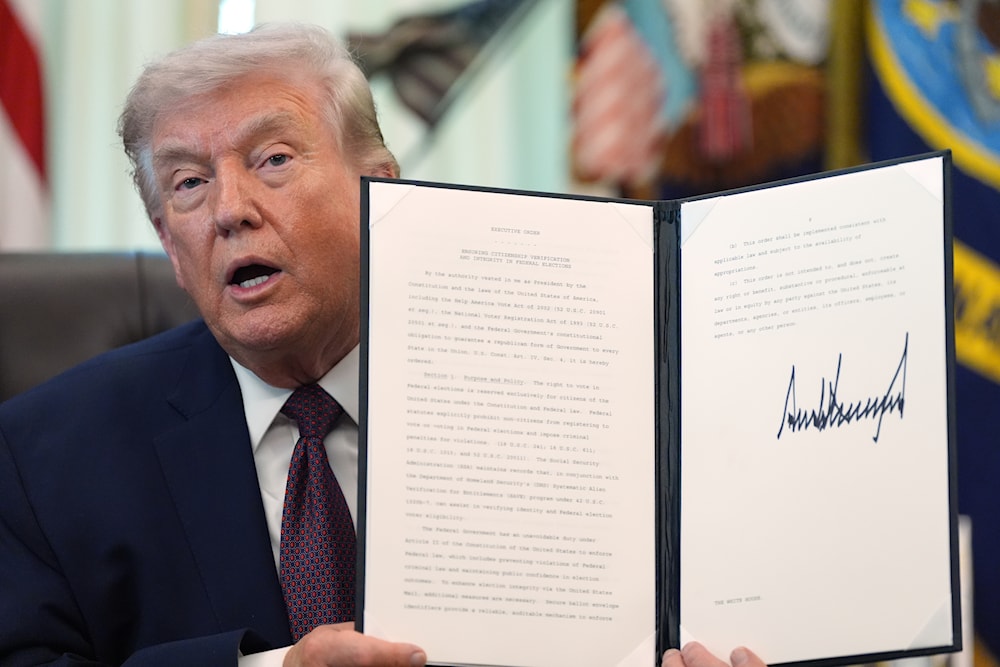
US President Donald Trump holds a signed executive order in the Oval Office of the White House Tuesday, March 31, 2026, in Washington (AP)
A US federal appeals court has refused to allow President Donald Trump’s administration to enforce key provisions of an executive order seeking to reshape mail-in voting procedures across 23 states ahead of November’s congressional elections, Reuters reported.
In a 2-1 decision issued on Saturday, the Boston-based 1st US Circuit Court of Appeals rejected a Justice Department request to suspend a lower-court injunction while the administration challenges the ruling.
The injunction was issued on June 25 by US District Judge Indira Talwani, who found that several elements of Trump’s March directive likely exceeded presidential authority and infringed on powers constitutionally reserved for states and Congress.
The case was brought by a coalition of 23 states and the District of Columbia, led by California, Massachusetts, Nevada, and Washington.
Court says states face immediate pressure
Justice Department lawyers argued that the legal challenge had been filed too early because federal agencies had not yet completed the policies needed to carry out the executive order.
The appeals court dismissed that position, finding that the approaching election timetable forced states to begin responding immediately.
“As the district court reasoned, the (executive order) lays out a clear set of rapidly approaching deadlines by which states must coordinate with federal officials and comply with new voting procedures — all while the states must also ensure that their officials and the public understand the evolving set of rules that would govern the upcoming September and November elections,” the judges wrote. “The Plaintiff States have no practical choice but to respond to the (order) now.”
The administration could now seek emergency intervention from the US Supreme Court. The Justice Department had warned that it might take that step if the appeals court declined to lift the injunction.
A federal judge in Washington had previously rejected a separate Democratic effort to block the order, ruling that the challenge was premature.
Trump seeks tighter control over mail ballots
Trump signed the executive order in March as part of a broader campaign to tighten federal election rules.
The Republican president has repeatedly attacked mail-in voting and continued to claim, without evidence, that widespread fraud caused his defeat in the 2020 presidential election.
Under the US Constitution, states hold primary responsibility for conducting federal elections, while Congress possesses authority to regulate certain aspects of the electoral process.
Trump has also pressed Congress to approve the SAVE America Act, a controversial package that would introduce additional voting restrictions.
Courts have already blocked provisions of another Trump directive that sought to require documentary proof of citizenship for voter registration and restrict the counting of mailed ballots.
Federal agencies ordered to reshape voting procedures
The March executive order instructed the Department of Homeland Security to use citizenship, naturalization, and other federal records to produce lists of confirmed US citizens eligible to vote in each state.
It also ordered the US Postal Service to deliver ballots only to voters appearing on state-approved mail-in voting lists.
USPS subsequently proposed regulations requiring states to provide the names of mail-ballot voters and the barcodes connected to their ballots.
The order further directed the Justice Department to prioritize investigations and prosecutions of state and local officials who distribute federal-election ballots to people classified as ineligible.
Talwani concluded that the president had no legal authority to compel Homeland Security to produce voter-eligibility lists for state use.
She also ruled that the Postal Service lacked statutory power to impose binding regulations governing mail-in voting.
The judge said Trump could not use the executive order “to intimidate local election officials to use the necessarily incomplete confirmed citizenship lists as a resource, lest they face criminal prosecution.”
The ruling leaves the contested provisions suspended while the administration continues its appeal, preventing them from taking effect in the plaintiff states before the November elections that will determine control of Congress.
Read more: Trump revisits election fraud claims, pushes for restrictions


