
US buried key intelligence review after Minab massacre in Iran: CNN
 8 Min Read
Months after the Minab massacre, US lawmakers are still waiting for answers as the Pentagon withholds investigative findings and restricts access to key evidence.
-
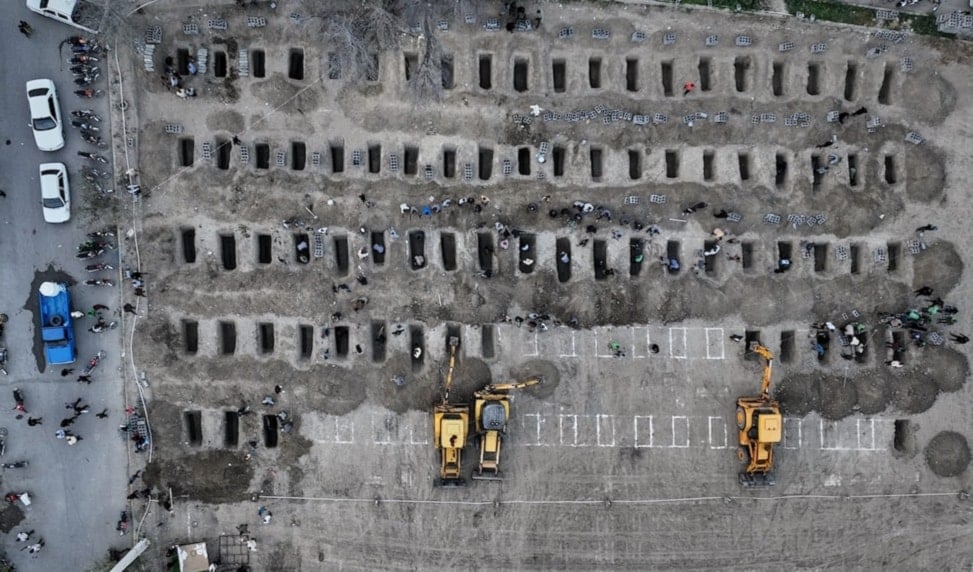
This picture shows graves being prepared for the victims, mostly children, of an Israeli-US aggression on Feb.28 at a girls' elementary school in Minab, Iran, March 2, 2026 (AP)
An investigation into a US strike that targeted a school in Iran has remained with a military command for months, while senior leaders have refrained from ordering a key, routine intelligence review intended to establish what occurred, CNN reported, citing three sources familiar with the matter.
The sources said that within a week of the attack, the first two phases of a “battle damage assessment” had been completed. Those stages focused on fundamental questions, including whether the intended target had been struck and damaged, and indicated that the United States was responsible for targeting the Shajareh Tayyebeh school in Minab.
However, the sources said a third and customary phase of the review process was never initiated. That stage typically involves analysts, often from the Defense Intelligence Agency (DIA), examining all relevant satellite imagery and other intelligence to provide a broader assessment of what happened and how the strike affected the wider mission. According to the sources, such a review is ordinarily conducted shortly after a significant strike, but it had not begun as of early July.
Access to investigation findings restricted
A separate independent investigation, announced in March, was also launched, and service members involved in the strike were interviewed.
According to the sources, information gathered during those interviews, which could help commanders conducting ongoing operations against Iran avoid similar errors, has been tightly controlled by US Central Command (CENTCOM), with access limited to a small number of officers.
“There was no detailed analysis conducted, and CENTCOM locked down the investigation/blocked anyone from looking into it,” one of the sources said.
A Defense Department official told CNN that “the investigation is ongoing.”
“We have nothing further to announce at this moment,” the official added.
The sources said the investigation is expected to determine responsibility for "the mistaken strike."
Questions over intelligence review process
The first source told CNN that the launch of the independent investigation should not have prevented the DIA from carrying out the more comprehensive third phase of the review process.
“Both could have happened at the same time if they chose to,” the source said.
The source added that while an additional DIA assessment would not independently establish fault, its findings could have served as supporting evidence.
A US official told CNN that the Pentagon’s internal investigation was designed to replace the traditional third-phase assessment. According to the official, the two processes could not proceed simultaneously because the initial review made clear that the incident warranted a comprehensive inquiry by an independent entity outside CENTCOM and separate from agencies involved in the strike.
The official added that after the independent investigation was submitted to CENTCOM in April, additional delays resulted from efforts to further examine the circumstances surrounding the incident, noting that the factors contributing to the "accidental strike dated back years and involved multiple levels of possible errors."
Outdated intelligence emerged as a factor
Iranian state media reported that 168 children and 14 adults were killed in the US aggression.
The sources said that, as of early July, the Pentagon had not requested that the DIA conduct the third and final stage of the battle damage assessment, a role the agency routinely performs. They added that the DIA had participated in the initial, more limited review.
According to the sources, the US military could have benefited from a more comprehensive assessment, particularly given the apparent reliance on outdated intelligence and broader shortcomings in the Pentagon’s targeting database that appear to have contributed directly to the incident.
CNN previously reported that senior US military commanders disregarded warnings contained in critical databases, indicating that intelligence on potential targets in Iran was significantly outdated, and proceeded with approving strikes, including the one that hit the school.
Two of the sources said the decision to overlook those warnings was made for “expediency” as officials rushed to assemble target lists during the opening phase of the war. They added that the decision directly contributed to the strike at the school.
Still, the sources said the absence of a full intelligence review following a significant strike is unprecedented.
Concerns over transparency and classification
“The Pentagon was in damage control,” the first source told CNN, adding that senior officials at both the Pentagon and CENTCOM wanted to avoid a repeat of events from roughly a year earlier, when CNN reported that a Defense Intelligence Agency assessment found that US strikes on Iranian nuclear facilities had not “obliterated” the country’s capabilities, contradicting public statements made by President Donald Trump.
That assessment, which resulted from a phase-three battle damage analysis, angered the White House and War Secretary Pete Hegseth.
A source said the DIA conducted the review of the nuclear sites without a direct request from CENTCOM, assuming it would fulfill its customary role in completing the in-depth analysis. After the findings received media attention for conflicting with Trump's characterization of the strikes, Hegseth and White House officials expressed frustration with DIA leadership, the source said.
Gen. Jeffrey Kruse, who was serving as DIA director at the time, was later removed from the position.
Pentagon officials have previously stated that the investigation into the strike on the school was assigned to a US general officer outside CENTCOM to ensure an independent review. The officer has not been publicly identified.
Lawmakers have said the official submitted an initial version of the report in April, but CENTCOM has retained it since that time.
Lawmakers demand release of findings
The delay in finalizing the investigation has prompted criticism from lawmakers on Capitol Hill, who say they have yet to receive the investigative findings despite repeated requests for the relevant materials.
“More than four months after the strike, and after the reported submission of the investigation in April, Congress and the American people still have not received the Department’s investigation and findings. There is no justification for withholding an unclassified accounting of what happened, what went wrong, and what the Department is doing to prevent recurrence,” some two dozen Democratic senators wrote in a recent letter to Hegseth and CENTCOM commander Adm. Brad Cooper, demanding information about the investigation.
A separate US official told CNN that Hegseth and Cooper have faced significant pressure from the White House to demonstrate that the war on Iran has been successful, contributing to their reluctance to share information related to the conflict with other military and intelligence agencies.
The sources said the Pentagon and CENTCOM have increasingly applied classification authorities typically reserved for highly sensitive material to limit access to information and planning details that had historically been shared broadly across military branches for operational coordination.
“I’ve never seen it used on stuff like this,” one of the sources added. “One of the reasons the US military is as effective as it is, is because we work pretty well together … When you keep siloing us away from each other, we don’t amplify each other’s strengths and cover each other’s weaknesses. And you only do that if you’re bizarrely paranoid that we won’t follow your orders, or you don’t trust us.”
Trump questions whether findings will be conclusive
Asked again this week whether he would commit to releasing the investigation's findings, Trump declined to make a commitment during an interview for Fox News.
“I’ll have to speak to the generals … I don’t think anybody is ever going to be able to say what happened there,” Trump said.
“I don’t think there can be a conclusive report,” Trump added when asked whether he would release the investigation, before repeating, “I don’t know, I’d have to ask the military people.”
Trump acknowledged that “it is possible” that outdated intelligence or "an error" by US forces during an intense period of the war contributed to the incident.
He also questioned the authenticity of publicly available evidence, suggesting, without providing evidence, that satellite images showing fragments of an American missile at the site could be “AI-generated.”


