
US free speech crackdown extends far beyond the press: The Intercept
 5 Min Read
Trump administration pressure on journalists is part of a wider US crackdown affecting Palestinians, protesters, academics and immigrants, raising deeper questions about free speech.
-
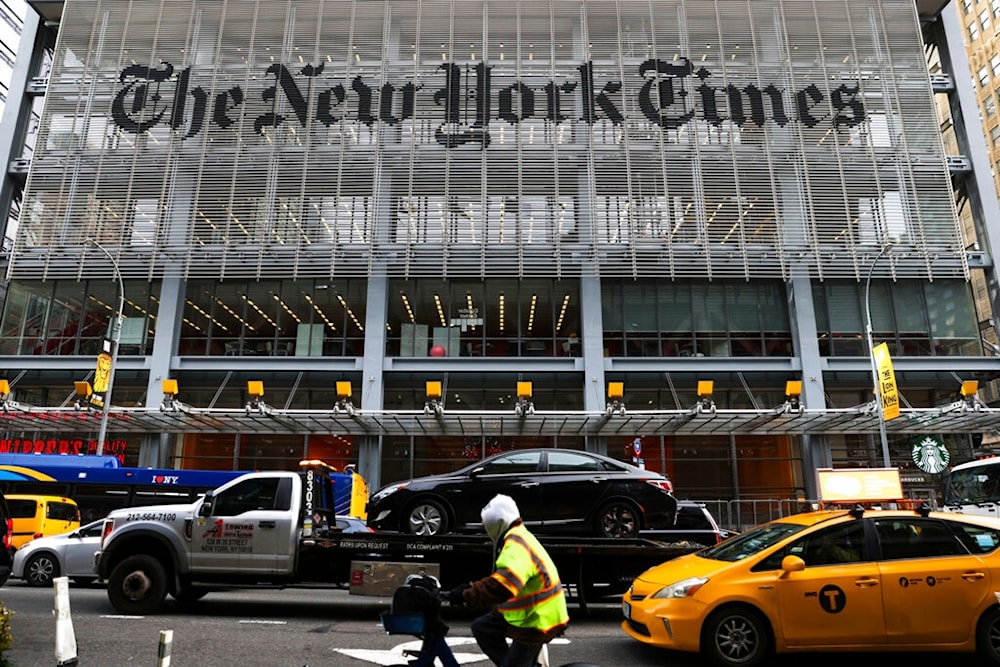
The New York Times headquarters, New York City, United States, Thursday, Dec. 8, 2022. (AP Photo/Julia Nikhinson)
The US campaign against press freedom under US President Donald Trump extends beyond journalists and news organizations, affecting Palestinians, protesters, academics, immigrants, and other groups facing government pressure, according to an analysis published by The Intercept.
The article, written by Alain Stephens, examines a recent New York Times report documenting the Trump administration’s confrontations with the American press, including subpoenas targeting journalists, restrictions on Pentagon access, lawsuits against news organizations and pressure involving federal regulators.
While acknowledging the seriousness of those measures, Stephens argues that the US media’s focus on its own institutional freedoms can obscure the broader consequences of government repression.
Read more: 2025 emerges as one of the darkest years for press freedom worldwide
The New York Times report described the administration’s actions as part of an expanding campaign targeting protected speech and the independence of the press.
Stephens does not dispute the threat posed by those measures. Instead, he argues that the debate over free speech has become too centered on journalists, editors, publishers, and their access to government institutions.
The article points to protests against Immigration and Customs Enforcement (ICE), university faculty supporting Palestine, and students facing disciplinary measures as examples of a wider struggle over political expression in the United States.
The argument is that press freedom cannot be separated from the ability of people outside the media industry to challenge government policy and expose abuses.
Gaza exposes the stakes of media freedom
The article places Palestine at the center of that argument, highlighting continued Israeli attacks and the humanitarian crisis in Gaza.
Stephens points to shortages of medical supplies and restrictions on humanitarian assistance, alongside violence against Palestinians in the occupied West Bank.
He also highlights the large number of journalists killed during the war on Gaza, arguing that the scale of the deaths demonstrates the risks faced by those attempting to document events on the ground.
Stephens specifically criticizes The New York Times over its coverage of “Israel” and Gaza, arguing that the newspaper has helped legitimize Israeli justifications for the war while placing limits on terminology used to describe the violence.
The criticism extends beyond one newspaper. The article argues that the US media’s defense of press freedom rings hollow when journalists and civilians documenting or experiencing violence outside the United States receive less attention.
Read more: Targeting truth: 'Israel’s' war on journalists
Protesters, academics and immigrants face repression
The article also examines government pressure on groups whose political activities challenge US policy.
Stephens cites immigration protests and university campaigns supporting Palestine as examples of political expression coming under increased scrutiny.
He also points to the Trump administration’s immigration enforcement campaign, citing nearly 51,000 ICE arrests in August and reports that many detainees had no criminal record.
The article references a Department of Homeland Security watchdog report concerning conditions at Florida’s former “Alligator Alcatraz” detention facility, where immigrants were reportedly held for extended periods in outdoor metal cages.
Stephens contrasts these conditions with the professional and institutional consequences faced by journalists, arguing that government coercion can carry vastly different consequences for those directly subjected to state power.
Public trust in US media continues to decline
The article connects the debate over press freedom to declining public confidence in American news organizations.
Stephens cites 2025 Gallup polling showing that only 28% of Americans trusted newspapers, television, and radio to report the news fully, accurately, and fairly, the lowest level recorded in the survey.
The decline has multiple documented explanations, including political polarization, the fragmentation of the media environment, and the weakening of local journalism.
Stephens argues that another factor is the perception that news organizations increasingly focus on defending their own institutional interests rather than amplifying the experiences of people facing state violence and deprivation.
Press freedom must serve those confronting power
The article draws on the history of journalists such as Ida B. Wells, who faced threats and the destruction of her newspaper’s offices while documenting racial violence against Black Americans.
Stephens uses Wells’ experience to argue that journalism has historically involved confronting powerful institutions rather than simply protecting journalists’ professional access or personal security.
From this perspective, press freedom is not merely a protection for media organizations. It is a means of exposing abuses of power and providing visibility to people subjected to them.
The article argues that defending free expression therefore requires attention to those outside newsrooms whose speech, political activity, and lives are directly affected by government actions.
Read more: Trump brands media outlets critical of him as 'illegal', 'corrupt'


