
US launches attacks on Iran, violating ceasefire
 4 Min Read
The United States says it struck Iranian military sites after accusing Tehran of attacking a commercial vessel in the Strait of Hormuz.
-
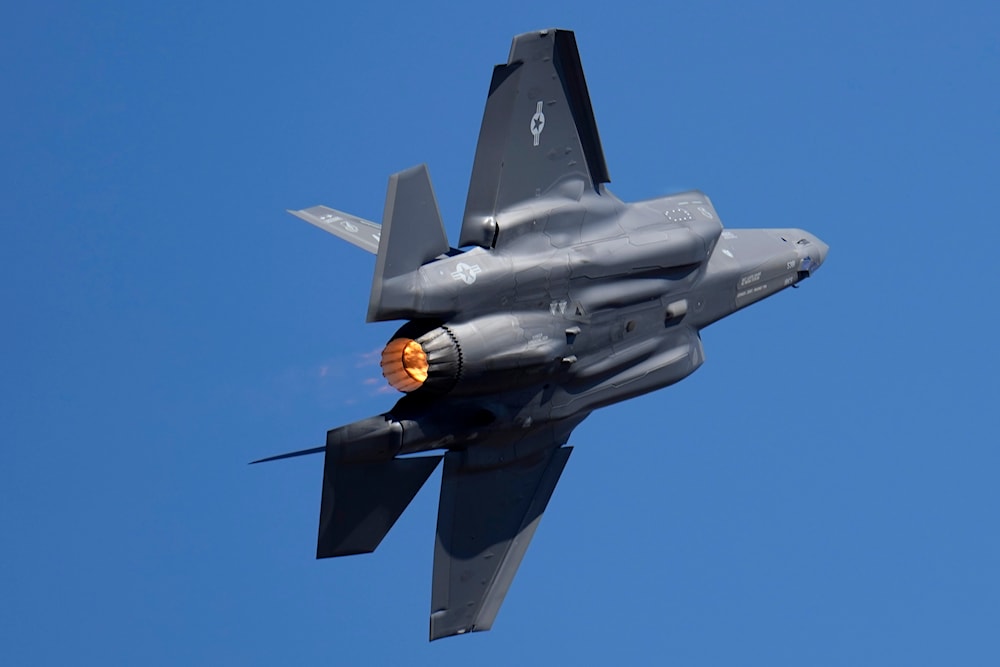
A United States Air Force fighter aircraft F-35 flies at the Aero India 2023 at Yelahanka air base in Bengaluru, India, on February 16, 2023. (AP)
The United States said that it launched attacks on Iranian military targets after accusing Tehran of attacking a commercial vessel transiting the Strait of Hormuz, while Iranian media reported explosions near the southern port city of Sirik following warning fire directed at vessels in the strategic waterway.
In a statement, US Central Command (CENTCOM) said its forces attacked Iranian missile and drone storage sites as well as coastal radar facilities. The US says that the bombing came in response to an attack on a vessel near the Strait of Hormuz, along the Omani coast.
Iran had stressed that any transit through the strait is only possible via direct coordination with Iranian authorities. The Strait of Hormuz was opened on June 18 after a memorandum of understanding was signed between Tehran and Washington.
The US military claimed that the attack on commercial shipping violated the existing ceasefire and undermined freedom of navigation through the Strait of Hormuz, one of the world's most vital maritime trade corridors.
CENTCOM said that US forces remain deployed to ensure "all aspects of the agreement with Iran are adhered to, obeyed, and in full force and effect."
The blame game does not work
Following the attacks, the head of the National Security and Foreign Policy Commission of the Iranian Parliament, Ebrahim Azizi, said the United States was violating the ceasefire, adding that the attack demonstrated that the US could not be trusted in negotiations.
"The US attacked Iran in the middle of negotiations once again. The failed U.S. President has shown he has no commitment to the principles of negotiation or a ceasefire," Azizi said.
"This reckless violation of the ceasefire will, as always, lead to retreat and regret on their part. The blame game does not work anymore," he added.
Explosions reported near Sirik
Meanwhile, Iran's state broadcaster IRIB reported that an explosion was heard at approximately 11:15 pm local time near the Taheroui pier in Sirik, located along Iran's southern coast overlooking the Strait of Hormuz.
According to an informed military source cited by IRIB, the explosions were caused by the impact of a projectile in the vicinity of the pier.
The same source stated that roughly five hours earlier, several warning shots had been fired from Sirik County toward vessels that had violated Iran's announced maritime routes in the Strait of Hormuz.
The source further said that two warning missiles were also launched from the vicinity of Karpan toward the Strait of Hormuz several hours earlier.
The reported explosions came amid heightened tensions in the strategic waterway following the latest exchange between Washington and Tehran.
IRGC-N rejects alternative Strait of Hormuz routes
Earlier on Friday, Iran's Islamic Revolution Guard Corps (IRGC) Navy warned that safe passage through the Strait of Hormuz is only possible via routes announced by Iran, rejecting newly declared navigation lanes and insisting that vessels coordinate directly with Iranian naval authorities.
Tehran said that “some authorities” had recently announced new shipping routes in the strategic waterway “without informing or coordinating with the Islamic Republic of Iran,” saying the move is “unacceptable and completely dangerous.”
The statement stressed that the only authorized passage routes through the Strait of Hormuz are those designated by Iran, warning that navigation outside these channels is “very dangerous and prohibited.”
“All vessels are warned to strictly avoid any navigation outside the notified routes,” the IRGC Navy said, adding that coordination via Channel 16 with Iranian naval forces is mandatory and that “violator vessels will be dealt with.”
Oman announces new shipping lanes
Earlier on Wednesday, Oman announced the establishment of two temporary shipping routes in the Strait of Hormuz, positioned north and south of the existing lane, in coordination with the International Maritime Organization (IMO).
Under a phased operational plan, vessels will be grouped and contacted individually with navigation instructions, including designated routes and departure timings. Oman’s maritime authorities said shipmasters remain responsible for conducting independent risk assessments, and vessels are required to keep Automatic Identification Systems active while reporting hazards to the Oman Maritime Security Centre.
Oman also confirmed that no transit tolls would be imposed on ships passing through the strait, in line with understandings reached in recent Iran-US discussions.


