
US mulls 'NATO-style' security guarantees for Ukraine: Axios
 4 Min Read
The United States is considering extending NATO-style security guarantees to Ukraine as part of ongoing negotiations aimed at ending the war without granting Kiev formal NATO membership.
-
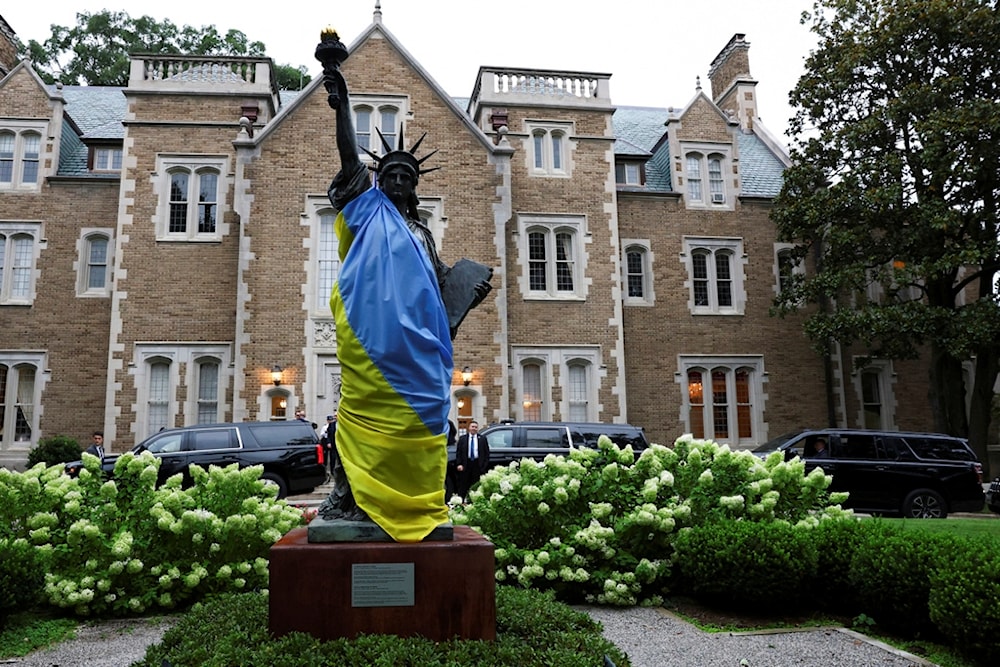
A scaled model of the Statue of Liberty stands draped in a Ukrainian flag in the gardens of the French Embassy in Washington the day French President Emmanuel Macron met with US President Donald Trump, Ukrainian President Volodymyr Zelenskiy and European leaders, amid negotiations to end the Russian war in Ukraine, at the French Embassy in Washington, DC, US, Monday, Aug. 18, 2025. (Yves Herman/Pool via AP)
The United States is considering formalizing security commitments to Ukraine by advancing a framework modeled on NATO's Article 5, according to an Axios report published Friday that cited a senior US official, a move that would mark a significant shift in Washington's approach to post-war deterrence.
Axios journalist Barak Ravid reported earlier in the day, citing a Ukrainian official, that Donald Trump is expected to meet Volodymyr Zelensky at Trump's Mar-a-Lago residence in Florida on December 28, signaling what officials describe as an effort to elevate unresolved issues to the highest political level as negotiations intensify.
Conditional Guarantees
At the center of the talks is the nature of the proposed security guarantees. US and European officials have been debating whether guarantees should be legally binding and automatic in the event of future hostilities, or structured with conditional triggers designed to deter renewed conflict without extending NATO membership.
According to Axios, the guarantees could be advanced as a treaty-level obligation requiring Senate ratification, underscoring their potential weight. US officials have stressed, however, that the framework would be "modeled" on NATO's Article 5 rather than replicate it outright, reflecting sensitivities in Washington over committing to open-ended military obligations.
Speaking Wednesday, US Ambassador to NATO Matthew Whitaker said prospects for a negotiated settlement remain viable. He stated that discussions are now focused on territorial arrangements and mechanisms to ensure compliance with a durable ceasefire, adding that the issue of security guarantees has largely been resolved in talks with Ukrainian officials.
Diverging Positions
European coordination appears to be underway, but not without internal differences. Last week, German Chancellor Friedrich Merz said the European Union and the United States had aligned on providing security guarantees for Ukraine, inspired by NATO's collective defense clause.
While several European leaders support guarantees backed by multinational enforcement and monitoring mechanisms, some governments have reportedly pushed for clearer limits on automatic military escalation, reflecting broader concerns about being drawn directly into a renewed conflict.
From Moscow's perspective, any agreement must reinforce Ukraine's neutral status. Russian Foreign Minister Sergey Lavrov said Russia and the United States had reached an understanding that Ukraine should revert to being a non-aligned, neutral, and non-nuclear state, a position Russian officials argue is incompatible with guarantees they see as NATO by other means.
Backchannel Talks
Diplomatic engagement intensified in mid-December when Berlin hosted talks on a Ukrainian settlement involving US special envoy Steve Witkoff, businessman Jared Kushner, and Zelensky. Witkoff later reported progress on a proposed 20-point settlement framework, which officials say seeks to balance territorial compromises, security assurances, and enforcement mechanisms.
Zelensky subsequently said he would be willing to abandon Ukraine's NATO membership aspirations if Kiev secured binding security guarantees from individual countries, including the United States, reflecting Kiev's prioritization of deterrence over formal alliance status.
Those discussions were followed by meetings last weekend in Miami between Witkoff, Kushner, and Kirill Dmitriev, who serves as the Russian president's special representative for investment and economic cooperation with foreign countries. Dmitriev described the talks as constructive, reinforcing indications that parallel diplomatic channels are operating alongside public negotiations as talks move toward more politically sensitive decisions.
Read more: US less committed to NATO collective defense amid rising threats: UK


