
US oil-driven kidnapping of Maduro marks imperial turn: The Guardian
 5 Min Read
A Guardian analysis argues that the US bombardment of Venezuela and the kidnapping of President Nicolas Maduro marks a dangerous return to overt US imperial aggression in Latin America.
-
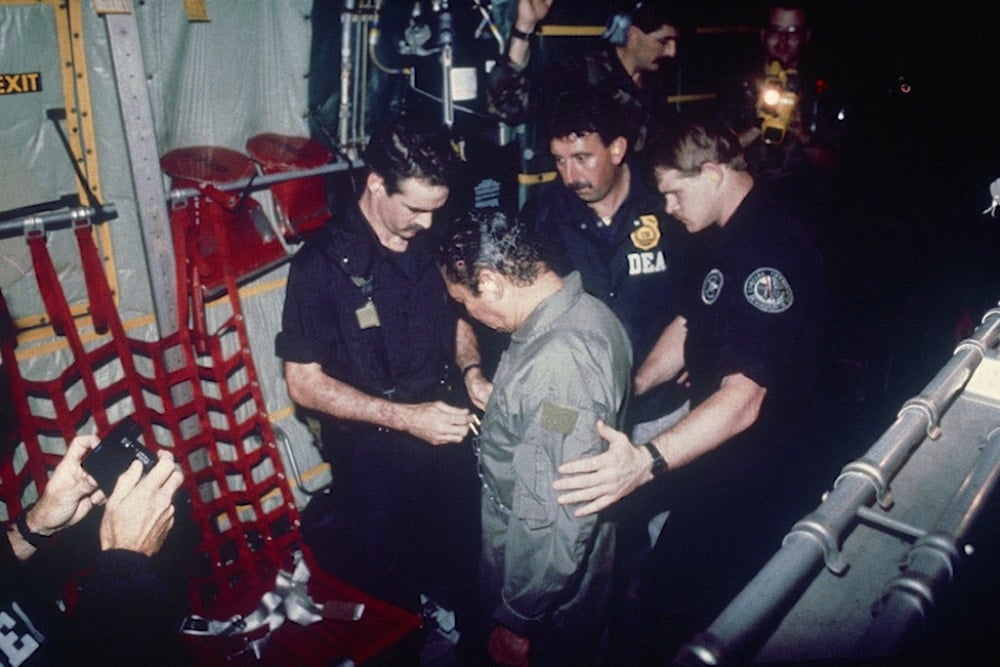
In this Jan. 4, 1990 file photo, Manuel Noriega watches as U.S. Drug Enforcement Agents place chains around his waist aboard a C-130 transport plane. (AP)
An analysis published by Tiago Rogero for The Guardian on Sunday casts the US bombardment of Venezuela and the kidnapping of President Nicolas Maduro as the clearest sign yet that Washington is reverting to open, force-based domination in Latin America, this time with Venezuela’s oil wealth plainly in the crosshairs.
Speaking after the aggression, US President Donald Trump framed the assault as a hemispheric power statement, declaring that “American dominance in the Western hemisphere will never be questioned again.”
The Guardian analysis argues that this was not rhetorical excess but a blunt reassertion of the Monroe Doctrine worldview, now updated through what the Trump administration calls a “Trump corollary” advocating an “expansion” of US military presence across the region.
Doctrinal Escalation
Rogero situates the attack on Venezuela within more than two centuries of US interventionism, tracing a record that spans territorial conquest, prolonged military occupation, and covert regime-change operations across Latin America and the Caribbean.
Mexico
The analysis recalls the US invasion of Mexico in the mid-19th century, when American forces occupied Mexico City in 1847 following a border conflict sparked by the annexation of Texas. The war ended with a treaty that forced Mexico to cede more than half of its territory, permanently reshaping the country’s geography and cementing US dominance on the continent.
Cuba
In the Caribbean, Rogero revisits Washington’s role in Cuba, where US intervention during the 1898 war against Spain allowed it to gain control of Puerto Rico, and was followed by military occupation and the imposition of arrangements that granted the US permanent control over Guantánamo Bay. Later interventions included repeated troop deployments and the CIA-backed Bay of Pigs invasion in 1961 after the Cuban Revolution, aimed at overthrowing Fidel Castro.
Haiti
The analysis also details the US occupation of Haiti, beginning in 1915, when American forces seized control of customs, the treasury, and the national bank under the pretext of restoring stability and protecting US commercial interests. Washington maintained decisive control over Haiti’s finances and security apparatus until 1934 and later intervened covertly to preserve authoritarian rule deemed useful against revolutionary movements in the region.
Brazil
In South America, Rogero stresses that US interference more often took covert form. In Brazil, Washington supported the 1964 military coup that removed President João Goulart, including contingency planning for direct intervention should resistance emerge. That coup ushered in two decades of authoritarian rule.
Chile and Argentina
Similar patterns unfolded in Chile, where the CIA backed destabilization efforts against the elected government of Salvador Allende prior to the 1973 coup, and in Argentina, where US intelligence agencies later cooperated with the military junta’s repressive apparatus.
These South American dictatorships were linked through Operation Condor, a coordinated campaign of surveillance, abduction, torture, and assassination targeting dissidents across borders, carried out with US intelligence support. Rogero notes that although these operations shaped political outcomes across the continent, they were largely hidden from public view.
This contrast, the analysis argues, is what makes Venezuela distinct: unlike earlier South American cases marked by covert manipulation, the current aggression is presented as the first overt US military attack on a South American country, breaking a long-standing geographic and tactical boundary.
Mauricio Santoro, a professor at the State University of Rio de Janeiro, said the strike “signals a major shift in foreign and defense policy, one that is made explicit in the new national security strategy published by the Trump administration a few weeks ago.”
Imperial Return Exposed
The closest historical parallel identified is the 1989 US invasion of Panama, when tens of thousands of US troops entered the country to capture Manuel Noriega, a former CIA ally later indicted in US courts. Hundreds of civilians were killed during the operation, after which Washington backed the installation of a new political leadership aligned with US interests.
Historian Alan McPherson said the Venezuela operation is “shocking because nothing like this has happened since 1989,” adding: “One might have thought that this era of naked imperialism, of the US getting the political outcomes it wants in Latin America through sheer military force, would be over in the 21st century, but clearly it is not.”
Global Condemnation
The oil motive, Rogero argues, is explicit rather than inferred. Trump has said Venezuela would be “run” by the United States until a “proper transition can take place,” and separate Guardian reporting notes that the remarks were paired with references to US oil companies moving into the country. Caracas and many international observers interpret this framing as an attempt to legitimize resource extraction through military domination.
International reaction has been swift. China called on Washington to immediately release Maduro and his wife, accusing the US of forcibly seizing them, while governments across Latin America warned that the operation violates international law and threatens regional stability.
Rogero closes with a consistent historical lesson: US interventions across Latin America and the Caribbean have rarely produced durable political settlements. As McPherson notes, it is “very rare” for such actions to be followed by “peace, tranquillity, stability and democracy,” warning that the kidnapping of Venezuela’s president may open a prolonged crisis rather than deliver the orderly transition Washington claims to seek.
Read more: Axios details US kidnapping of Venezuela's President Maduro


