
US pirates another tanker near Venezuela
 4 Min Read
The United States has illegally seized a second tanker near Venezuela as part of a growing maritime campaign that Caracas denounces as an illegal blockade aimed at weakening its economy and undermining its sovereignty.
-
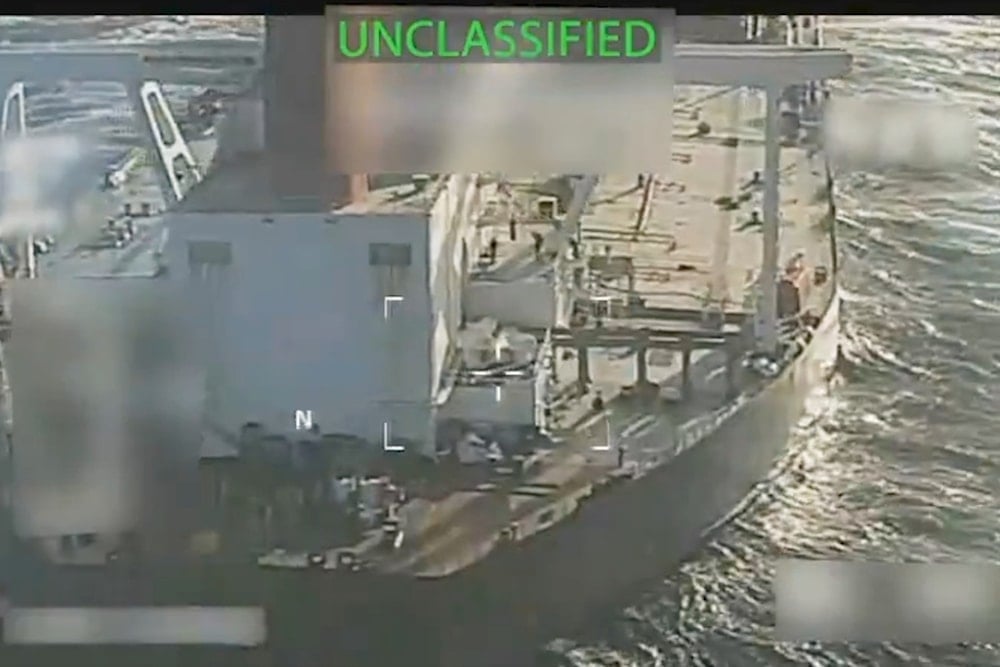
This image from video posted on Attorney General Pam Bondi's X account, and partially redacted by the source, shows an oil tanker being seized by US forces off the coast of Venezuela, Wednesday, Dec. 10, 2025. (U.S. Attorney General's Office/X via AP)
Reuters on Saturday reported that US forces have carried out another maritime vessel capture near Venezuela, seizing a vessel in international waters in what Caracas said was a direct assault on its sovereignty and a deliberate attempt to strangle the country's economy.
Three US officials confirmed the operation, which comes only days after President Donald Trump publicly ordered "A TOTAL AND COMPLETE BLOCKADE OF ALL SANCTIONED OIL TANKERS going into, and out of, Venezuela."
The White House has refused to provide coordinates of the interception, offering no transparency regarding the scope or legal grounding of the raid.
Although Washington continues to frame its actions as part of a "war on narcotics," the operations being carried out bear little resemblance to standard counter-drug missions. Instead, they align closely with a sweeping sanctions-enforcement strategy targeting Venezuela’s energy sector, the backbone of its economy and the core of its state revenue.
Venezuelan officials argue that the seizure of oil vessels has nothing to do with narcotics and everything to do with destabilizing the government of President Nicolás Maduro.
The US seizure of Venezuelan vessels in international waters constitutes a clear violation of international law and maritime norms. By intercepting ships without the consent of Venezuela or a United Nations mandate, these actions effectively amount to state-sanctioned piracy, targeting the country’s sovereign economic assets.
Such operations go beyond legitimate counter-narcotics enforcement and instead constitute illegal appropriation of property, directly undermining Venezuela’s sovereignty and threatening the legality of free navigation under international law.
Militarization Under the Guise of Narcotics
The vessel confiscation was the second of such operations in recent weeks. It comes amid a rapid expansion of US naval and air deployments under Operation Southern Spear, a mission Washington brands as anti-drug but which has increasingly targeted Venezuelan commercial infrastructure. Regional monitors have linked the campaign to more than two dozen US strikes on civilian and commercial vessels across the Caribbean and Pacific, resulting in over 100 deaths.
In the wake of the first tanker seizure, dozens of ships carrying Venezuelan crude have remained anchored inside national waters, unwilling to move for fear of interception. Analysts have documented a sharp decline in Venezuelan exports since the blockade was announced, with broader repercussions already being felt in global oil markets.
Despite this, Washington claims the deployments are necessary to combat "narco-terrorist routes," a justification experts and regional leaders dismiss as a political smokescreen.
Brazil’s President Luiz Inácio Lula da Silva warned that US intervention could be "catastrophic for South America," while Venezuelan officials say the narcotics narrative is being exploited to legitimize US military aggression.
Oil War Disguised as Counternarcotics
The US campaign now threatens a lifeline that Venezuela’s economy depends on. Venezuela’s largest oil buyer, China, continues to receive shipments but increasingly faces the risk of US interdiction. Of the more than 70 "shadow fleet" tankers in Venezuelan waters, 38 have already been blacklisted by the US Treasury. At least 15 fully loaded vessels now remain immobilized because of the threat posed by American forces.
The Maduro administration argues that Washington’s blockade amounts to piracy and represents one of the most aggressive US actions in Latin America in decades. Venezuelan Foreign Ministry officials say the United States is violating international maritime law, endangering commercial navigation, and undermining the principle of state sovereignty.
Read more: Venezuela demands $35bln in reparations from US, cites oil theft


