
US pressures unaccompanied immigrant children to return home
 5 Min Read
US officials pressure unaccompanied immigrant children to return home, even when fearing danger, under a policy critics call coercive.
-
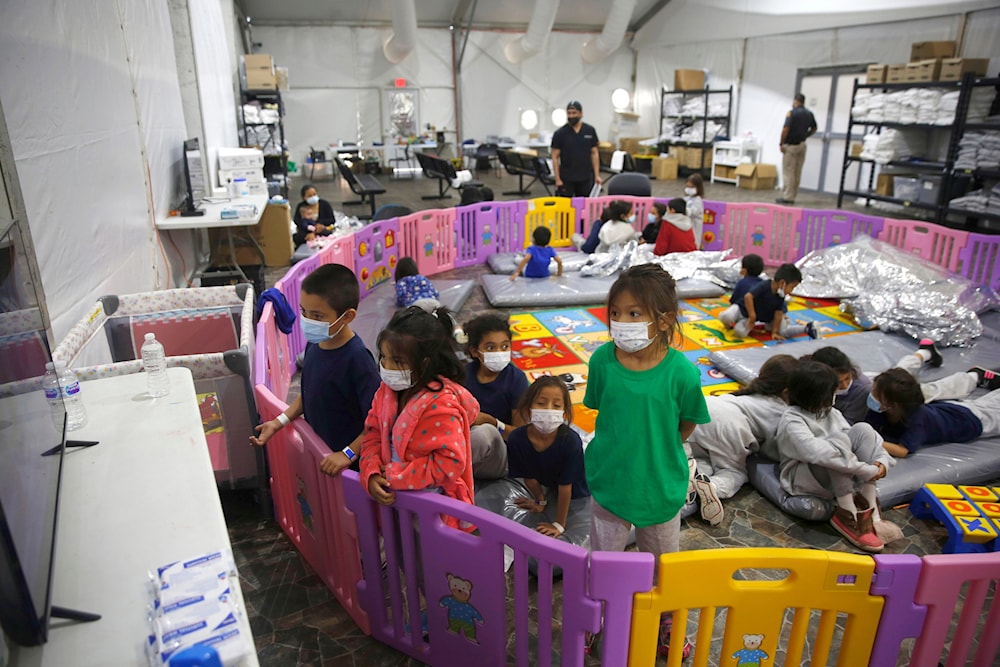
Unaccompanied migrant children watch television from inside a playpen at the US Customs and Border Protection facility, the main detention center for unaccompanied children, March 30, 2021, in Donna, Texas (AP)
Federal documents reveal that unaccompanied children arriving in the United States as undocumented immigrants are being pressured by border officials to quickly agree to return to their countries of origin, even if they express fear for their safety, or face prolonged detention and other consequences, The Guardian reported.
The documents, which emerged as attachments in a court filing by immigration attorneys, are reportedly presented to children within the first few days of their arrival while they remain in the custody of Customs and Border Protection (CBP), before they can contact relatives in the US. Termed an “advisal,” the document warns children that seeking a hearing with an immigration judge or expressing fear of returning home could result in extended detention.
It also cautions that a child’s sponsor in the US may face arrest, prosecution, or deportation, and that children who turn 18 in government custody could be handed over to Immigration and Customs Enforcement (ICE) for removal.
Senators call to abolish the policy
Senator Ron Wyden, a Democrat from Oregon and ranking member of the Senate Finance Committee, has called for the policy to be abolished, describing it as “cruel” and saying it “cynically exploits” unaccompanied children’s vulnerabilities to advance the Trump administration’s mass deportation agenda.
In a letter to CBP, shared exclusively with The Guardian, Wyden accused the agency of attempting to frighten children into abandoning their legal rights, calling the advisal “shockingly coercive” and intended to discourage them from seeking legal protections.
The document, formally titled the UAC [Unaccompanied Alien Children] Processing Pathway Advisal, was filed in court in Washington, D.C. as part of a lawsuit against the Department of Homeland Security (DHS). The case, brought by the National Immigrant Justice Center (NIJC) and other immigrant advocacy groups, challenges the immediate detention of children upon turning 18. ProPublica first reported on the advisal last month as part of a broader investigation into the treatment of immigrant children in US custody.
CBP defends its position
A CBP spokesperson defended the document, stating that it “explains options available under the Immigration and Nationality Act on their path forward” and that the agency’s duty is to “follow the law and protect children.” The spokesperson added that many unaccompanied minors are brought to the border by smugglers and face real risks of exploitation, and that providing a clear advisal ensures they understand their rights and options, with returning home sometimes being the safest path.
Senator Wyden first addressed the policy change in a letter to CBP on November 4, following media reports highlighting its implementation. After the advisal document came to light, he wrote again on 8 December, emphasizing in the latest correspondence that “unaccompanied children are a uniquely vulnerable population, arriving in this country without guardians and often fleeing threats of violence, trafficking, abuse, and neglect. CBP’s new policy and the Advisal cynically exploit these vulnerabilities to remove unaccompanied children before they can access essential protections.”
The advisal appears to offer an incentive for children to voluntarily return to their home countries, stating: “If you choose to voluntarily return to your country, there will be no administrative consequence, and you will still have the opportunity to apply for a visa, through legal means, in the future.” Legal experts, however, have dismissed this as a misleading promise.
'False carrot'
Lisa Koop, national director of legal services for the National Immigrant Justice Center (NIJC), described it as a “false carrot”, explaining that while certain visas might theoretically be available decades later, the advisal’s suggestion of a clear legal path is “misleading” and unlikely to provide any practical recourse.
The policy was implemented earlier this year and was confirmed in a letter from CBP Commissioner Rodney Scott to Senator Wyden, dated December 4, and obtained by The Guardian. Critics say the advisal is part of a broader escalation in immigration enforcement targeting unaccompanied children, including efforts to deport them, pursue criminal charges against them or their vetted sponsors, offer cash incentives for voluntary departure, and secretly attempt rapid deportations of children from countries such as Guatemala.
Upon first arriving in the US, unaccompanied children are detained by CBP for up to 72 hours before being transferred to the Office of Refugee Resettlement (ORR), part of the Department of Health and Human Services. ORR places children in shelters, foster care, or with vetted sponsors, and provides some legal support through partner organizations to help children navigate immigration and asylum processes.
The advisal came to the attention of the NIJC when an attorney representing an unaccompanied child in an ORR shelter found it among the child’s records. The minor’s identity and personal details have not been disclosed. Many children, often with limited English proficiency, appear to receive the advisement while still in CBP custody and without access to legal counsel, before their transfer to ORR.


