
US races to boost missile interceptor production amid Iran war
 4 Min Read
Bloomberg Intelligence analyst Wayne Sanders says US interceptor stocks are under strain as manufacturers face pressure to sharply increase production.
-
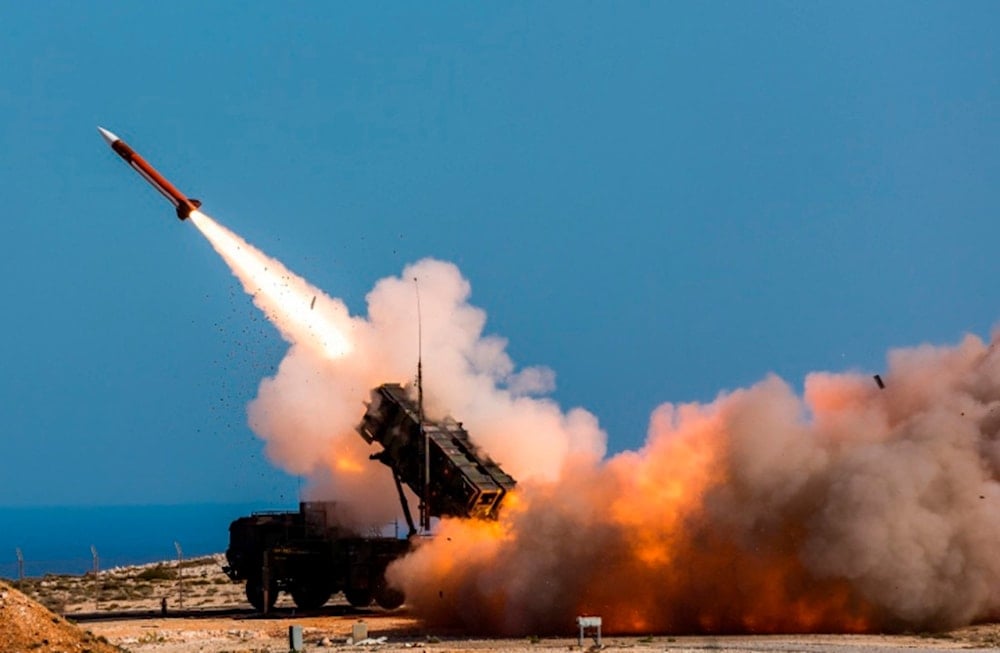
German soldiers assigned to Surface Air and Missile Defense Wing 1 fire the Patriot weapons system at the NATO Missile Firing Installation in Chania, Greece, on November 8, 2017 (AP)
The US still has significant munitions capacity for operations against Iran, but stocks of advanced interceptor missiles are under growing strain, Bloomberg Intelligence Senior Defense Analyst Col. Wayne Sanders revealed.
Speaking to Christina Ruffini and Jeff Mason on Bloomberg This Weekend, Sanders said US manufacturers are being pressed to sharply increase production of key interceptor systems, while complex supply chains and concerns about preserving advanced weapons for potential future conflicts are complicating the effort.
US interceptor stocks face growing strain
Sanders said some US interceptor capabilities have been depleted considerably, particularly systems used to defend against Iranian attacks.
“If you're looking at our interceptor capabilities, some of them have been depleted quite a bit,” Sanders said, pointing to PAC-3 interceptors for the Patriot air defense system, as well as SM-3 and SM-6 naval interceptor programs.
He said these systems have been heavily used because of the disparity between the relatively low cost of drones used in attacks against the US and the much more expensive munitions required to intercept them.
“So during that time frame, we were actually using quite a bit of it,” Sanders said.
Sanders said RTX and Lockheed Martin are facing sharply increased demand from the US Department of War to replenish PAC-3 and other interceptor stocks.
PAC-3 production targeted for major increase
The analyst stressed that rebuilding interceptor stocks will take time because of the complexity of the defense supply chain.
“It is a longer process because you're dealing with a lot of different pieces of a supply chain. It's not as simple as you just put in an order and it comes out,” he said.
A PAC-3 interceptor involves around 400 suppliers, according to Sanders. Lockheed Martin produces a large portion of the system, while L3Harris is involved in propulsion and Honeywell provides guidance and control components.
The US is seeking to increase annual PAC-3 interceptor production from about 650 currently to 2,000 by 2030.
Sanders contrasted the pressure on advanced interceptors with the availability of other US munitions, including gravity bombs and Boeing's Joint Direct Attack Munition, or JDAM, which uses GPS guidance to reach its targets.
“For an Iranian scenario, the US military has a ton of these,” he said.
Advanced weapons remain a concern for China scenario
While Sanders said the US has numerous options in its arsenal, he identified long-range precision weapons and advanced interceptors as the systems of greatest concern.
“It’s some of the exquisite ones, both on the long-range precision munitions as well as on the interceptors front that we are more concerned about for an Indo-Pacific theater engagement,” Sanders said.
He explained that a conflict elsewhere, like against China, would require more sophisticated weapons, making the ability to replenish advanced systems particularly urgent.
“That's why you're seeing the urgency of demand right now,” he added.
Patriot supplies to Ukraine add to pressure
Sanders also addressed the supply of Patriot interceptors provided to Ukraine during the Biden administration.
Three Patriot batteries were given to Ukraine, although the number of interceptors supplied alongside them remains unclear, he said.
A standard package normally includes between 72 and 96 PAC-3 interceptors, according to Sanders. Using a simplified estimate of about 300 interceptors for three batteries, he said, the transfer could represent roughly six months of US production.
“When you start looking at not only the cost, but also when you have a limited capacity to build these,” the scale of the transfers becomes significant, he added.
PAC-3 interceptors cost about $4.1 million each, according to Sanders.
He noted that some of those interceptors could otherwise have been available for an Iran scenario or a potential conflict with China, while also stressing that NATO allies have contributed PAC-3 interceptors from their own Patriot supplies.
Sanders said the transfers therefore form part of a wider geopolitical security picture involving NATO and potential conflict with Russia, alongside the US effort to maintain sufficient advanced weapons for other contingencies.


