
War on Iran decisive factor behind missile stocks depletion
 7 Min Read
The war on Iran has rapidly depleted missile inventories in West Asia, exposing unexpected supply chain constraints.
-
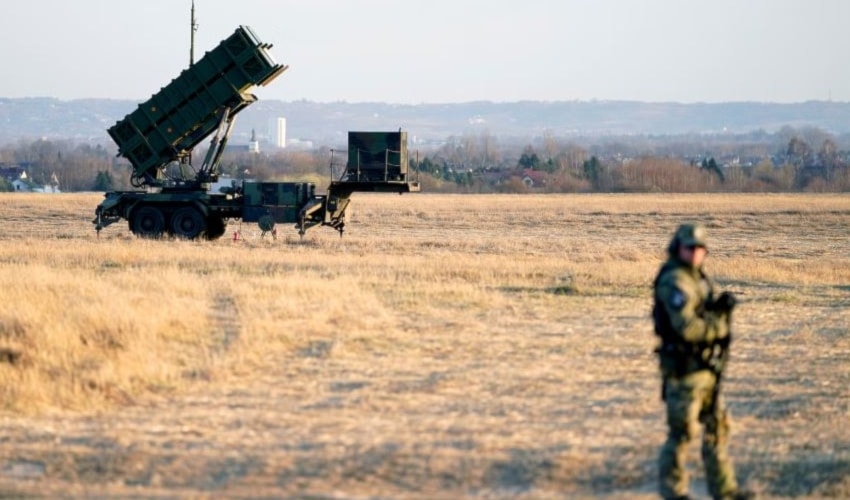
Patriot missiles are seen at the Rzeszow-Jasionka Airport, March 25, 2022, in Jasionka, Poland (AP)
The Iran war was the tipping point for shrinking inventories, The Associated Press reported, citing Ed Arnold, senior associate fellow at the Royal United Services Institute, a military think tank in London.
Arnold claimed that the deliveries to Ukraine had been anticipated and managed at a reasonable pace. By contrast, missile stocks in the Middle East, according to him, have been depleted unexpectedly and rapidly, revealing constraints in the supply chain.
US faces 'beyond critical' shortage of missiles
This comes as AP reported that the US military is facing a “beyond critical” shortage of advanced missile interceptors in Europe, largely as a result of President Donald Trump’s war on Iran.
The most serious deficit involves Patriot missile interceptors, according to AP, which cited a US defense official in Europe and a NATO official on Thursday.
The shortage has raised concerns over NATO countries’ ability to defend against what they perceive as a potential Russian attack.
War on Iran drains US missile stocks
The shortage highlights the wider consequences of Trump’s decision to launch a war against Iran, which reaches the six-month mark on Friday.
US missile stocks stationed in Europe have been shifted to the Middle East, where American and Gulf allies have fired large numbers of interceptors, including Patriots, against Iranian drones and missiles. Some of those attacks have killed and wounded US troops.
US Patriot transfers to Ukraine played role in drawdown
Though a Russian ballistic missile attack against NATO countries is not deemed imminently expected, according to AP, CIA Director John Ratcliffe went to Moscow this week to warn Russia not to attack, The Wall Street Journal reported.
Trump sought to downplay the unusual and secretive visit earlier this week, calling it “sort of semi-routine.”
Asked by reporters Thursday whether Ratcliffe had conveyed that warning to Russian President Vladimir Putin, Trump gave a roundabout answer.
“I don’t want to comment on that, but they’re not going to attack,” he said.
US Patriot stocks in Europe hit beyond critical level amid war on Iran
European and NATO officials have reportedly said Russia could be capable of attacking alliance members by 2030. Patriot inventories are expected to recover by then.
The NATO official confirmed that American and NATO forces in Europe have low inventories of Patriot interceptors, which can be used to shoot down Russia’s high-speed ballistic missiles. Both officials spoke anonymously because they were discussing sensitive military matters.
If Russia were to launch a ballistic missile attack on a military headquarters or power plant, for example, NATO could find itself in a position similar to Ukraine, which has been struggling with a shortage of Patriots and could be forced “to take punch after punch in the mouth,” the US defense official said.
The US military in Europe “definitely” lacks enough Patriots to withstand a sustained ballistic missile assault, the US official said. Its ability to counter even a single ballistic missile strike or an errant Russian missile would be “very limited,” the official added.
Patriot stocks have plunged during the war on Iran
Ukraine has received Patriots from US and European inventories since the beginning of the war in Ukraine in 2022. The United States supplied about 600 interceptors during the Biden administration, according to Mark Cancian, a retired Marine colonel and senior advisor at the Center for Strategic and International Studies, a Washington think tank.
The largest depletion, however, has occurred during the war with Iran. According to CSIS, the war has consumed 65% of the US Patriot inventory, or roughly 1,500 of the country’s 2,330 interceptors.
About 600 missiles, including those intended for Europe, are expected to be produced this year, Cancian said. Production is projected to reach 2,000 Patriot missiles annually by 2030.
The Patriot shortage is most severe in Ukraine, where officials are pressing for additional air defense systems and where earlier US transfers have also reduced available supplies.
Kiev says only US-made Patriots can intercept Russia’s advanced ballistic missiles, which are increasingly penetrating Ukrainian air defenses, including during a barrage overnight into Thursday.
The United States delivered hundreds of Patriot missiles to Ukraine during the 4 1/2-year-long conflict.
More critical shortages
The US military in Europe is also dealing with critical shortages of the Army Tactical Missile System, or ATACMS, a medium-range ballistic missile intended to strike targets behind enemy lines, the two officials said.
According to the report, the broader European munitions situation is less severe than the shortage of air defense weapons because some European militaries possess their own offensive missile systems, including the Taurus and Storm Shadow, both long-range, air-launched bunker-busting missiles.
US Army Col. Martin O’Donnell, a senior NATO military spokesperson, rejected the assessment that Patriot supplies in Europe are beyond critical, saying it is “simply not the case.”
NATO, he argued, can “block punches” and has sufficient air defense munitions both for its own defense and to provide assistance to Ukraine.
Europe has few alternatives while stocks are low
Experts say the shortage of Patriot interceptors leaves Europe with limited alternatives for countering Russia’s more advanced ballistic missiles, as per the report. Those missiles can be deployed alongside large numbers of inexpensive drones to overwhelm air defenses.
Ukraine and some of its allies already operate systems capable of destroying slower-moving drones without relying on costly interceptors.
Ballistic missiles are more difficult to stop because they descend toward their targets at more than five times the speed of sound, giving defenders little time to respond.
The Patriot system tracks an incoming missile, calculates its projected trajectory, and launches an interceptor within minutes. The system performs complex calculations to guide the interceptor toward its target. Each Patriot battery can protect only a limited area. It could, for instance, defend a small military base but not an entire city.
The possible alternative
One possible alternative is the SAMP/T NG air defense system operated by France and Italy. France has pledged to accelerate deliveries of the system, an upgraded version of the existing SAMP/T, to Ukraine. The manufacturer says the newer system has improved capabilities against ballistic threats.
However, the upgraded version has not yet been tested in combat, while the current SAMP/T has a shorter range than the Patriot.
US and European militaries also have warships capable of providing mobile air defense. But such vessels may be too far from a threatened target to offer protection and could themselves face the risk of being sunk.
'Ridiculous situation'
NATO says Germany’s first Patriot missile production facility is expected to begin operations in September, with deliveries potentially starting early next year.
The initial shipments are expected to go to countries that have already placed orders, including Germany, the Netherlands, Romania and Spain, according to the US defense official.
For now, however, some countries such as Germany have purchased costly Patriot systems but lack the ammunition needed to use them. Arnold described the situation as “ridiculous.”


