
US exhausted nearly all ATACMS, PrSM stocks in Iran war: Reuters
 8 Min Read
This fact has strained global readiness and exposed the limits of Washington’s ability to sustain prolonged aggression.
-
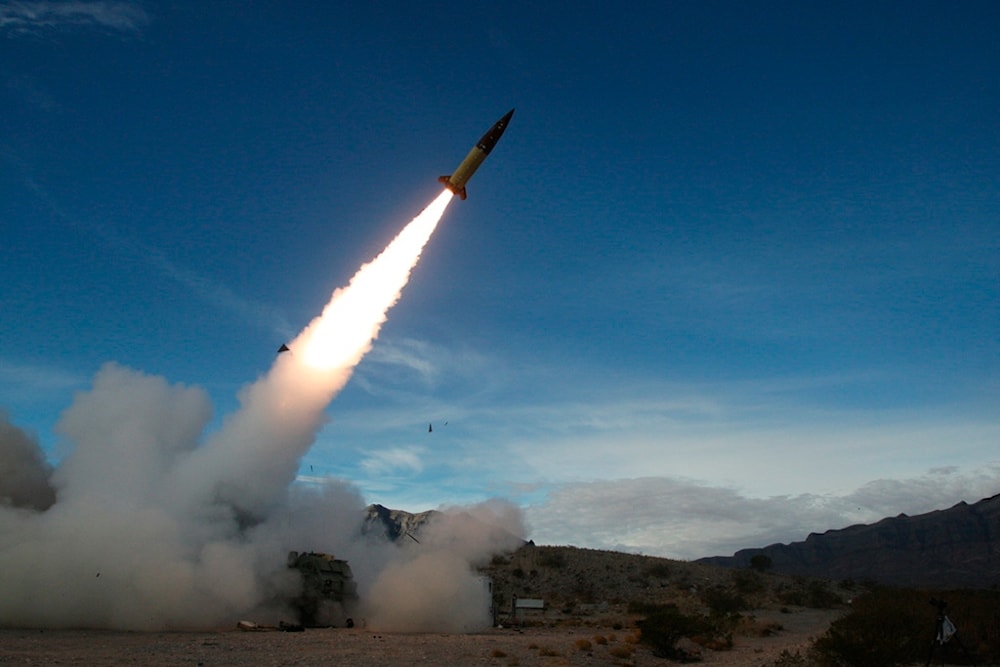
FILE - In this image provided by the US Army, soldiers from the 3rd Battalion, 321st Field Artillery Regiment of the 18th Field Artillery Brigade out of Fort Bragg, N.C., conduct live fire testing at White Sands Missile Range, N.M., on Dec. 14, 2021, of early versions of the Army Tactical Missile System (AP)
Iran’s resistance to five months of US and Israeli aggression has drawn Washington into a costly war of attrition, consuming much of its supply of advanced missiles and raising concerns over the US military’s preparedness for future wars, Reuters reported on Tuesday.
Citing three people familiar with internal stockpile data, the news agency reported that US forces had used nearly all of the Army’s available Army Tactical Missile Systems, known as ATACMS, and Precision Strike Missiles, or PrSM, during the war on Iran.
Two of the sources told Reuters that Washington had expended “virtually all” of the long-range surface-to-surface weapons, although they declined to disclose how many remained.
The extent of the depletion had not previously been reported.
The disclosure illustrates the growing strategic cost of a war that US President Donald Trump launched jointly with “Israel” in February while predicting that the campaign would be brief.
Five months later, the aggression has failed to force Iran into submission and has instead required the United States to expend scarce precision-guided weapons worth more than $1 million each.
ATACMS and PrSM enable US forces to strike distant targets without sending piloted aircraft directly into heavily defended airspace. Their extensive use reflects Washington’s preference for launching attacks from a safer distance rather than exposing its aircraft and personnel to greater risk over Iran.
The weapons would also be important in any possible US confrontation with China, according to analysts cited by Reuters. Their depletion therefore raises questions over Washington’s ability to continue its war on Iran while retaining sufficient firepower for "crises" elsewhere.
CENTCOM draws missiles from other regions
US Central Command has nearly exhausted the land-based missiles assigned to it before the war began, a fourth person familiar with the matter told Reuters.
CENTCOM, which oversees US military operations across West Asia, has been able to replenish those stocks by drawing weapons from US inventories positioned elsewhere in the world.
As the war continues, US planners face growing pressure to balance attacks on Iran against the need to preserve capabilities for potential wars involving Russia, China, or other countries.
The sources spoke on condition of anonymity because they were discussing sensitive military stockpile information.
Asked about the declining supplies, Trump dismissed concerns and claimed that the United States possessed “far more munitions than anyone in the world” and “far more than we need.”
“Our defense companies are, at this moment, making more munitions than they have ever made before, in addition to expanding their plants and equipment at record levels,” Trump said.
Record production levels may still fall far short
Analysts agree that Washington has expanded production of several types of missiles and artillery shells. However, they have warned that even record production levels may fall far short of what would be required to sustain a prolonged, high-intensity war.
Advanced missiles require sophisticated components and lengthy manufacturing processes, making it difficult for US arms producers to replenish them at the rate at which the military is consuming them.
Meanwhile, Pentagon spokesperson Sean Parnell insisted that the US military retained the weapons required to continue its operations.
“America’s military is the most powerful in the world and has everything it needs to execute at the time and place of the President’s choosing. We have executed multiple successful operations across combatant commands while ensuring the U.S. military possesses a deep arsenal of capabilities to protect our people and our interests,” Parnell said.
The assurances contrast with the concerns reportedly circulating within the US government over how long Washington can continue attacking Iran without reducing its inventories to levels that would restrict its response to "crises" elsewhere.
Iran imposes mounting costs on Washington
One source told Reuters that the rapid consumption of ATACMS and PrSM reflected the Trump administration’s decision to avoid riskier methods of striking Iranian targets, including sending piloted aircraft to drop bombs.
By preserving its defensive and retaliatory capabilities, Iran has forced Washington to rely on costly long-range weapons that allow US forces to strike from a safer distance.
The exchange shows how Tehran can impose high military costs on a much larger adversary without matching the United States weapon for weapon. Its strategy instead relies on endurance, continued retaliation, and forcing Washington to expend scarce munitions that are difficult to replace.
A March report by the Center for Strategic and International Studies said the United States already possessed relatively few PrSM missiles before the war because the system had only recently entered service.
Future deliveries provide little immediate relief
The US Army is gradually phasing out ATACMS and shifting production toward PrSM, with substantial additional orders scheduled for 2027.
Those future deliveries, however, provide little immediate relief as the military continues consuming missiles at wartime rates.
The internal supply figures reportedly circulated across the federal government over the past week during tense discussions about how much longer the United States could continue striking Iran without seriously undermining its readiness elsewhere.
Military officials have also repeatedly warned Trump that supplies of defensive weapons, particularly Patriot interceptors used against ballistic missiles, were falling sharply, two sources told Reuters.
Several media outlets reported last week that Trump decided against launching another massive offensive against Iran partly because military advisers had warned him about depleted US weapons stocks.
Pressure, not shortage delayed strikes?
A US official disputed those accounts, maintaining that Trump abandoned the proposed attack because of pressure from Gulf governments seeking to prevent further escalation.
Either explanation highlights the constraints Tehran has imposed on Washington. Iranian retaliation has consumed US defenses, heightened concerns among regional governments and increased the risks associated with any new escalation.
The war has also intensified debate inside the United States over Trump’s authority to continue military operations without congressional approval.
The administration has neither requested a declaration of war nor submitted a proposal seeking authorization for the use of military force against Iran.
Iranian strikes erode US missile defenses
The depletion extends beyond the offensive missiles used to attack Iranian territory.
CSIS estimated last week that the United States had expended approximately 65% of its Patriot interceptor inventory between February and July.
The organization also estimated that Washington’s supply of THAAD ballistic-missile interceptors was at least 38% lower than at the beginning of the war.
Two sources familiar with classified US stockpile figures told Reuters that the estimates matched internal government data.
Patriot and THAAD are among the most advanced defensive systems in the US arsenal and have been heavily used to confront Iranian ballistic-missile attacks.
Their declining inventories illustrate the broader strategic effect of Iran’s retaliation.
What to shoot down and what not
Even when US defenses successfully intercept an incoming missile, Washington must expend a costly and limited interceptor. Repeated Iranian attacks can therefore weaken the overall defensive network, force the military to redistribute its systems, and require commanders to prioritize which bases and positions receive protection.
Iran does not need every missile or drone to reach its intended target to impose such costs. Each launch can compel Washington to activate expensive defenses and consume munitions that cannot be quickly replaced.
This dynamic has allowed Tehran to transform US technological superiority into a growing logistical and industrial burden.
US consumes nearly half of Tomahawk supply
The United States has also used slightly less than half of its global Tomahawk cruise-missile inventory since the war began, one source familiar with the figures told Reuters.
The news agency said it could not independently verify that number.
Tomahawks are US Navy weapons launched from destroyers, cruisers, and submarines. They allow Washington to strike heavily defended targets from long distances without endangering pilots.
Their extensive use further demonstrates the US military’s dependence on costly stand-off weapons in its campaign against Iran.
Raytheon, a subsidiary of RTX, has reached a preliminary multiyear agreement with the Pentagon to increase Tomahawk production as Washington attempts to rebuild depleted inventories.
However, production agreements and future orders cannot immediately replace the missiles consumed during months of warfare.
The reported decline in ATACMS, PrSM, Patriot, THAAD, and Tomahawk supplies shows that Iran has succeeded in turning the confrontation into a wider test of US military endurance.
Washington retains immense destructive capabilities, but Tehran’s refusal to capitulate has exposed the limits of relying on firepower to secure a rapid political victory.
Read more: US went after Iran 'nukes', met with ‘more powerful weapon': Newsweek


