Collapsing Empire: The Resistance Disarms 'Israel'
-
 Kit Klarenberg
- 31 Mar 2026 23:48
- 9 Shares
 10 Min Read
The US and "Israel" are near munitions exhaustion after 2 months of war with Iran, while Tehran sustains production, exposing a strategically ruinous cost-exchange ratio the West cannot endure.
-

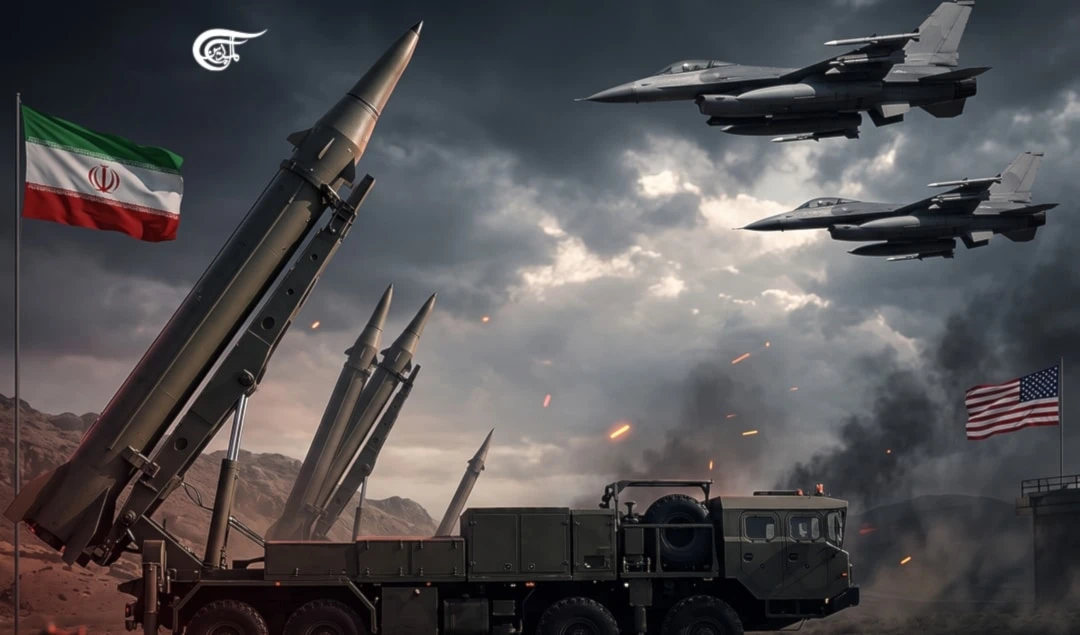
Iran has not only overwhelmed and disarmed the Zionist entity and imperial targets throughout West Asia via systematic, staggered blitzes of drones and missiles (Illustrated by Ali al-Hadi Chmeiss to Al Mayadeen English)
As the criminal Zionist-American war on Iran enters its second month, the conflict has proven so ruinous for the aggressors that dire alarm is being widely sounded. Embarrassing failure to subdue the Islamic Republic from the air has raised the prospect of a US ground operation of some kind, widely perceived as a suicide mission. Washington has also burned through over 850 Tomahawk missiles and 1,000 air-defense interceptors, at a rate the Pentagon finds “alarming”. In the process, "Israel" is rapidly approaching total disarmament.
On March 24th, elite British state-connected ‘think tank’ RUSI published a withering post mortem of the war’s first 16 days. An in-house “ledger tool” tracking the “intense consumption of advanced munitions” by the US and Zionist entity calculates 11,294 fires over this period, which cost a total of approximately $26 billion to produce. Resultantly, US - and thus Israeli - inventories of long-range interceptions and precision strike weapons “are nearing exhaustion.” And it will perhaps cost double that staggering amount to replenish what has been lost.
The Resistance shows no signs of slowing its onslaught, with every indication Tehran’s munitions production continues apace in wartime. Even the Western media has acknowledged Iran’s drone and missile arsenal costs a fraction to produce of the past and future outlay involved in shooting them down. Per RUSI, the war on Iran has exposed a “critical vulnerability” at the core of the Empire’s warfighting capabilities: a “strategically ruinous cost-exchange ratio that the West’s industrial capacity is not prepared to sustain.”
Over a dozen different munitions were fired by the US and "Israel" over the conflict’s first 16 days, “at a rate that appears to be unsustainable.” Now, Tehran’s relentless barrage “continues to drain the coalition’s most critical assets” - RUSI calculates missile and drone attacks have averaged 33 and 94 strikes daily, on average. By contrast, the organisation’s analysis shows “the magazine abyss” for Washington and Tel Aviv is “coming soon”. Moreover, Rheinmetall’s CEO has cautioned the Empire’s global munitions stockpiles are “empty or nearly empty.”
The Zionist-American war on Iran has thus become “a contest of endurance,” in which “the decisive advantage shifts to the actor that can sustain its defensive economy and replenish its most critical assets.” Based on current battle trends, the Islamic Republic firmly holds that advantage, and will continue to do so. The US could be mere weeks away from running out of ground-attack missiles - including much-vaunted ATACMS - and THAAD interceptors. RUSI similarly forecasts "Israel’s" Arrow interceptors will “likely” be “completely expended” come April.
On top of enormous expense, even at pre-war production levels, it would take years to replace what was spent in just over two weeks against Iran. As this journalist documented on March 24th, Tehran’s closure of the Strait of Hormuz has thrown the Empire’s already shattered defence industrial base into total disarray. Commodities and components central to constructing and maintaining digital and electronic systems, and precision-guided munitions, which hitherto transited the Strait daily in abundance, are now scarcer and ever-rising in cost.
‘Constant Alert’
Iran has not only overwhelmed and disarmed the Zionist entity and imperial targets throughout West Asia via systematic, staggered blitzes of drones and missiles. Crippling at least 12 US and allied radars and satellite terminals throughout the region has dented interception rates far further, while increasing the number of munitions necessary to shoot down the latest barrage blasted from Tehran - often unsuccessfully. Up to 11 Patriot interceptors can be fired at an Iranian missile, and up to eight at a single drone.
As a March 26th report by highly influential Zionist ‘think tank’ JINSA observes, “Iran’s attacks have imposed mounting costs on every component of the defensive architecture.” The Islamic Republic entered the conflict “with a deliberate plan to degrade US and [allied] capabilities by attacking each element of their air defense architectures.” In the process, “some of the most capable and expensive sensors” in Washington’s global inventory have been destroyed, with little chance of near-term repair.

These sensors in many cases explicitly provide the Zionist entity with an “early warning” system, tearing a gaping and ever-widening hole in Tel Aviv’s detection and warning network. As such, Iranian drone swarms - “frequently drawing on Russian tactical innovations from the Ukraine war” - are routinely proving “far harder to detect and defeat” than missiles, hitting twice the number of targets with pinpoint accuracy. Some US sensor systems simply cannot detect low-altitude Shahed volleys - including those specifically designed to counter drones.
It is not just Shaheds that have wreaked havoc. The entire Resistance is increasingly deploying fiber-optic guided drones “immune to electronic warfare jamming,” and first-person-view drones “for precision strikes against point targets,” JINSA reports. Other Iranian drones are equipped with jet engines, making them significantly faster than Shaheds, and interception even more problematic. As the conflict evolves too, Tehran has increasingly relied on ballistic missiles carrying cluster warheads, which release up to 80 submunitions at high altitude that scatter across areas spanning several miles.
JINSA assesses over half of the total Iranian missiles fired during this conflict to date carried cluster warheads, compared with three known uses during the calamitous 12 Day War. “Even a successful intercept does not guarantee the bomblets are stopped” - if interceptors fail to strike these missiles before they reenter the Earth’s atmosphere, they still disperse submunitions in the air, or release them upon impact. These attacks don’t deliberately target Israeli civilians, but nonetheless make daily life miserable for the settler colony’s population:
“Smaller, more frequent Iranian salvos keep civilian populations under constant alert…[This] shortens the time between attacks while reducing overall lethality, trading mass effect for persistence to wear down daily life. Warheads with cluster munitions amplify these disruptions by increasing the chance that submunitions or debris fall in populated areas…"Israel’s" decision not to fire against all incoming ballistic missiles carrying cluster munitions also suggests a need to ration interceptors.”
‘Highly Capable’
However, the Resistance is predominantly concerned with fulfilling its “deliberate plan to degrade” US and Israeli defensive capabilities, to drive the former out of West Asia permanently and make the region safe for Palestine’s final liberation. On this score, JINSA notes the “devastating effects” of Iran’s drones and missile barrages on previously invulnerable targets. For example, the Pentagon estimates a single Resistance strike on the US Navy Fifth Fleet headquarters in Bahrain cost approximately $200 million.
It’s one of over a dozen US bases in the Gulf to sustain “significant damage.” Fighter jets have been destroyed, American soldiers injured and killed in sizeable numbers, and survivors sent scurrying to local hotels. Iran has resolved to target these makeshift, remote bases. Local air defense batteries are thoroughly preoccupied with “sufficiently defending” devastated US military installations, “to create the conditions for additional assets and repair teams to flow into theater.”
When they will arrive, how long they will take to restore what has been lost, and whether doing so will be remotely safe, remains to be seen. Meanwhile, “Iranian fire against shipping in the Gulf has proven even harder to stop than attacks on land targets.” Over half of known Resistance projectiles fired at vessels in the Gulf and Strait of Hormuz have hit their targets. With Gulf governments having depleted almost their entire interceptor stocks since February 28th, what comes next could be catastrophic:
“Most Gulf bases, ports, and cities sit only a short distance from Iranian launch areas, which reduces the time defenders have to detect, track, and engage incoming threats. Iranian ballistic mis- siles launched toward Kuwait, Bahrain, Qatar, or the UAE can reach their targets within three to 10 minutes, a fraction of the already short 12 - 15 minutes that ballistic missiles take to reach Israel.”
To say the least, from the Empire’s perspective, none of this should be happening. The Zionist-American war on Iran was intended to be a one-sided aerial gangbeating lasting only a few days, which would culminate with the Islamic Republic’s collapse, or at least total capitulation. There was seemingly no sense in Washington, Tel Aviv, or other imperial centres of power that Tehran could fight back at all, let alone bring America’s military machine to its knees.
Yet, the inevitable upshot of kickstarting a major conflict with the Resistance was entirely predictable, and indeed widely predicted. None other than JINSA released an assessment in September 2024 warning how Iran had developed a “large and highly capable missile and drone force,” designed to render US bases in West Asia “unuseable” and “overwhelm” air defences. JINSA acknowledged this capacity posed a dire threat to the Zionist entity - but argued "Israel" simply required enhanced missile interceptors to counter the menace.
That appraisal was authored by former CENTCOM commander Frank McKenzie, who oversaw the Empire’s disastrous retreat from Afghanistan. On March 20th, he openly boasted how the war on Iran was unfolding according to a strategy drawn up by CENTCOM over “many years”, and “my fingerprints are on this war plan.” McKenzie’s failure to take known threats seriously, and delusional belief in the ultimate invincibility - and inexhaustibility - of US and Israeli air defences, surely accounts for the conflict rebounding so spectacularly against the aggressors.
JINSA’s latest report is likewise rife with fantastical optimism. It argues Iran can be defeated by the Empire pressuring its vassals to move their US-supplied air defences to the Gulf, forming a coalition with “partners” in Europe and West Asia “to escort shipping through the Strait of Hormuz,” and other hallucinatory plots. In a bitter irony, on March 5th, the report’s author cheered how “Iran’s missile firepower has almost run out.” Will the Zionist entity’s very real disarmament even be noticed by imperial strategists?