
US war on Iran eating into US stockpiles, faster than it can replenish
 5 Min Read
US weapons stockpiles are coming under pressure as the war on Iran consumes air-defense interceptors and precision weapons, raising concerns over Indo-Pacific readiness.
-
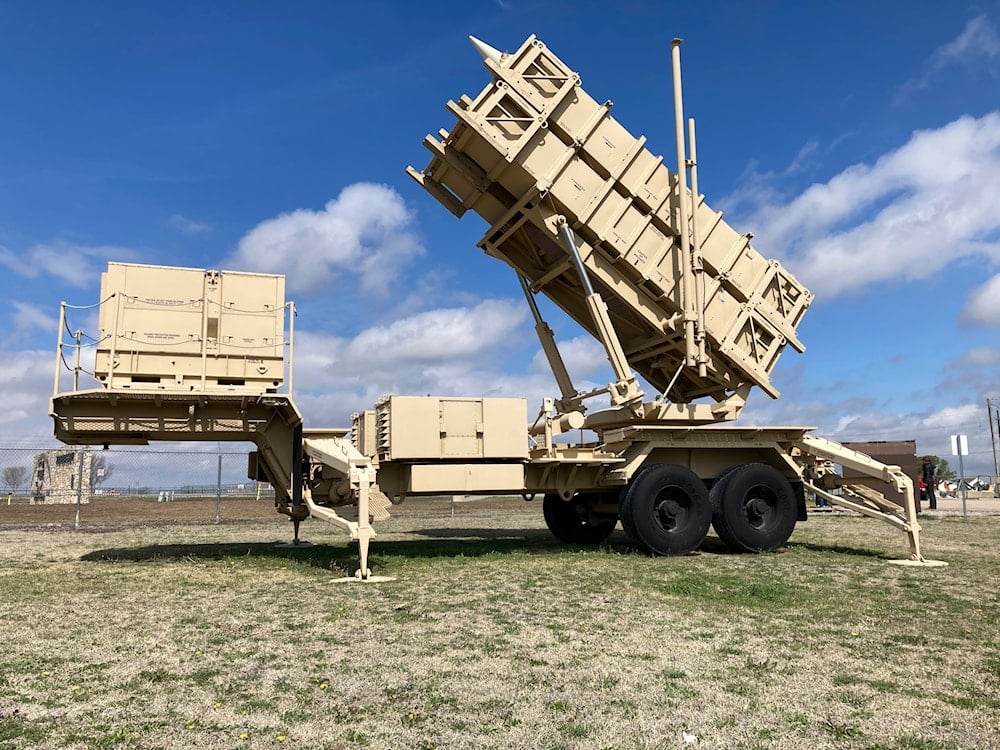
A Patriot missile mobile launcher is displayed outside the Fort Sill Army Post near Lawton, Okla., on March 21, 2023 (AP)
The rapid pace at which the US is expending advanced air-defense interceptors and precision-guided weapons in its war on Iran is a point of great tension inside the Trump administration as President Trump's war on Iran ratchets up again, CBS News reported, citing US military and intelligence officials familiar with internal assessments. The drawdown is raising broader concerns about America's readiness for a potential conflict in the Indo-Pacific.
The dwindling stockpiles of defensive interceptors and long-range missiles have become a pressure point for top military and civilian leaders who are weighing the demands of the war with Iran against maintaining readiness to deter other adversaries, including China.
The US officials, who spoke to CBS News on condition of anonymity given the sensitivity of the topic, said the US cannot sustain the rate at which it expended precision munitions early in the campaign against Iran.
Defense industry not equipped to catch up with interceptor expenditure
According to the officials, the defense industrial base is not equipped to produce missiles rapidly enough to replenish munitions that have been fired or transferred to US Central Command, which is overseeing the conflict, leaving inventories under mounting pressure even as military operations continue. Interceptors are in heavy use to defend US interests in the Gulf states, which house US troops and are being targeted by Iranian drones and missiles.
One partner country told CBS News there is a need for a pause in fighting, particularly given the intensity of Iranian strikes that have been battering Kuwait and Bahrain.
In an interview last month on "Face the Nation with Margaret Brennan," War Secretary Pete Hegseth denied that there was any crisis with the stockpiles. He conceded that some munitions may take more time to produce than others, but he told Brennan, "We've got lots of them, we're building more than ever before." Hegseth added, "Our stockpiles are strong, and they will only get stronger in the future."
The costly calculus of firepower
US commanders have increasingly been shifting toward using more GPS-guided bombs fitted with Joint Direct Attack Munitions, or JDAM, guidance kits, along with Small Diameter Bombs, which are precision-glide weapons that can attack fixed targets at shorter ranges and can also be used in lieu of long-range standoff weapons.
Earlier in the war, US forces frequently employed long-range cruise missiles such as the Joint Air-to-Surface Standoff Missile, known as JASSM, and the Tomahawk Land Attack Missile. Those weapons remain in the arsenal, officials said, but are being used more sparingly.
In April, Adm. Samuel Paparo, the head of US Indo-Pacific Command, told lawmakers on Capitol Hill that scaling up output of high-end systems such as the Tomahawk cruise missile or JASSM could take years, as defense companies work on expanding production lines.
"I think it will take one to two years for them to scale," said Paparo, whose responsibilities include preparing for any potential conflict in the Pacific region, including with China. "It won't be soon enough. There are finite limits to the magazine, and I have all the faith in the world that they're being employed judiciously."
After the US reneged on the ceasefire deal earlier this month, attacks have focused on targets closer to Iran's coastline, reducing the need for aircraft to penetrate deeper into Iranian territory, where they would face denser air-defense networks and a greater threat from surface-to-air missiles. The US officials told CBS News there are limited inventories of the Army Tactical Missile System, or ATACMS, the long-range missiles fired from the High Mobility Artillery Rocket System, known as HIMARS, a truck-mounted launcher capable of firing precision rockets and missiles.
Stockpile strains deepen as interceptor supplies dwindle
Concerns over munition inventories are not new, with the Biden administration having delayed giving ATACMS to Ukraine over readiness fears, CBS News previously reported. The US has healthier supplies of shorter-range GMLRS, officials said. The most pressing concern involves air-defense interceptors. The US has expended large numbers of Patriot and THAAD interceptors, consuming inventories faster than industry can replace them.
To support the war on Iran, the Pentagon has shifted interceptor stocks from the Indo-Pacific. Those transfers have left other commands with thinner margins than planners consider ideal. Asked for comment, Pentagon spokesman Sean Parnell told CBS News, "America's military is the most powerful in the world," adding that the US possesses "a deep arsenal of capabilities."
In 2022, Elbridge Colby, now undersecretary for policy, wrote: "A missile used in Europe can't be used in Asia." He was commenting on Ukraine, but the war on Iran has brought the same dilemma into focus. Colby later argued that weapons useful against China should be reserved for that purpose. US officials' concerns involve some of those same weapons.
A CSIS report during the ceasefire said over 1,000 Tomahawks and 1,100 JASSMs had been used, with replacement timelines approaching four years. It said air-defense interceptors are under greater strain, as the US burns through prewar inventories of THAAD, SM-3, and Patriots. Those weapons face production timelines of up to five years. The numbers suggest the problem is not simply cost but time.
Many of the weapons being fired in weeks cannot be replaced for years.


