
Trump's 'deep state' purge leaves intelligence office half-sized
 5 Min Read
Jay Clayton is set to inherit a significantly reduced intelligence apparatus as recent firings and reassignments further reshape the agency responsible for coordinating US spy services.
-
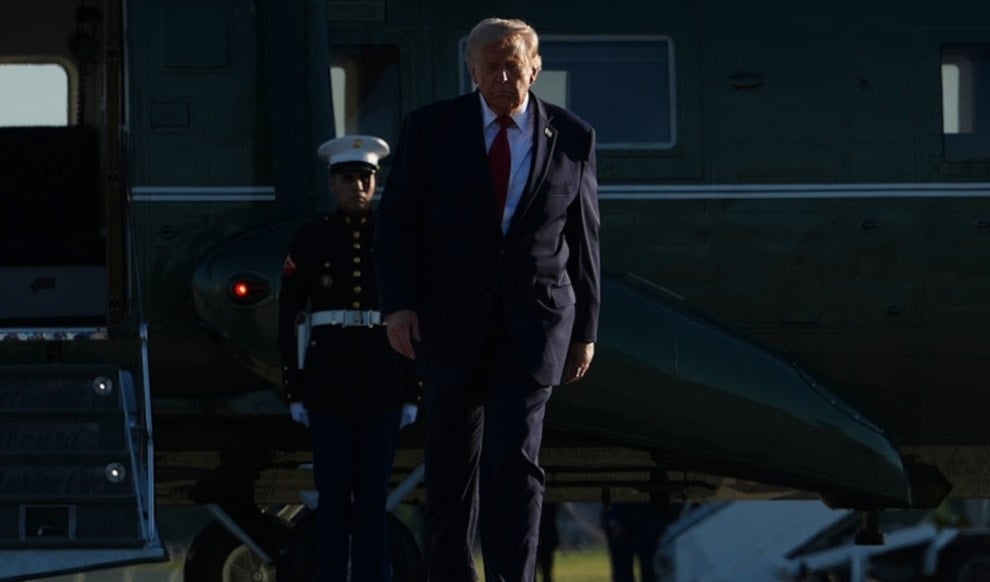
US President Donald Trump at Geneva Airport following the G7 summit, June 17, 2026, Switzerland (AP)
The Office of the Director of National Intelligence has lost roughly 200 employees through dismissals and reassignments since June 1, The Washington Post reported, citing information the Trump administration provided to Congress this week.
The latest reductions add to a series of cuts affecting ODNI, the agency established to coordinate and oversee the nation’s intelligence services. US President Donald Trump and many congressional Republicans have long criticized the office, claiming that it has grown well beyond its original mandate since its creation two decades ago.
Some former intelligence officials have reportedly echoed those concerns. ODNI employed about 2,000 people at the beginning of Trump’s second term but now operates with just over half that number, according to congressional aides.
Clayton set to inherit smaller agency
The personnel reductions mean that Jay Clayton, Trump’s nominee to lead the US intelligence community, is expected to take charge of a significantly smaller organization if confirmed by the Senate. The agency has undergone sustained upheaval over the past year and a half.
In early June, Trump appointed Bill Pulte, the federal mortgage regulator and a political ally with no previous national security background, as acting director of national intelligence. At the time, Trump said he wanted Pulte to “start the process” of eliminating some workers.
Trump’s longstanding criticism of intelligence agencies
Trump has frequently expressed distrust of intelligence agencies and career intelligence officials, asserting that they sought to undermine his first administration. He has pointed in particular to intelligence reports "examining Russia’s efforts to influence the 2016 presidential election in support of his campaign."
The president has also rejected intelligence assessments on several major issues, including the DPRK’s nuclear strategy and Iran’s expected response to the US and Israeli aggression launched in February.
Neither Pulte nor the White House has publicly outlined the recent reductions at ODNI, which includes the National Counterterrorism Center and was created after the Sept. 11, 2001, attacks to address failures in intelligence-sharing among US agencies.
Details of the latest personnel cuts
A congressional staff member and another individual familiar with the matter confirmed the most recent workforce reductions, as per the report. Both spoke on condition of anonymity to The Washington Post because the information has not been made public.
ODNI reportedly did not respond to requests for comment.
According to the person familiar with the matter, the reductions include some firings, while a larger number of intelligence officers were directed to return to their parent agencies. A substantial portion of ODNI’s staff is made up of personnel assigned from the CIA and other intelligence organizations.
Officials have said the National Counterterrorism Center has largely avoided significant reductions. However, the National Intelligence Council has undergone extensive cuts. The council, an analytical body, produces intelligence assessments across the intelligence community on subjects including the origins of COVID-19 and foreign interference in US elections.
The Washington Post previously reported that around 20 council employees either departed or were removed, including senior officials responsible for analysis concerning Russia, China, and Europe. The senior official overseeing the council was also placed on administrative leave.
Former official warns of declining morale
Julia Curlee, who served as a director for intelligence programs in Trump’s White House until last year and recently left the CIA after two decades as an analyst, said neither Clayton nor the administration has clearly explained its vision for ODNI.
“Other than it should be smaller,” Curlee said. “It seems like DNI was just a fat target to punish the ‘deep state.’”
“Morale is pretty terrible, as you would imagine,” Curlee stressed.
Uncertainty over timing and scope of reductions
It reportedly remains unclear how many of the approximately 200 personnel cuts occurred after Pulte assumed the acting DNI role on June 19 and how many took place under his predecessor, Tulsi Gabbard, who left the administration following her husband’s illness.
The administration and its congressional allies have not publicly disclosed the full scale of the downsizing, as per the report.
“US National Intelligence is operating more efficiently and effectively than ever before, and today, we started a third round of reducing redundant, or noncritical, personnel,” Pulte wrote on X on July 10, without providing additional details.
Senate Intelligence Committee Chairman Tom Cotton (R-Ark.) said shortly after Pulte’s appointment that the acting DNI informed him that “a small handful of front-office personnel” were departing. Cotton also said that “Around 45 or 50 career officers” were being reassigned to their home agencies.
Confirmation vote advances Clayton’s nomination
The exact number of personnel employed by ODNI and other intelligence agencies remains classified. By the time Gabbard left the administration in mid-June, ODNI’s workforce had declined from approximately 2,000 employees in January 2025 to about 1,300.
During his Senate Intelligence Committee confirmation hearing, Clayton faced sharp criticism from Democratic lawmakers, who argued that he failed to clearly acknowledge Joe Biden’s victory in the 2020 presidential election, a result Trump continues to dispute.
On Tuesday, the Republican-controlled committee approved Clayton’s nomination in a 9-8 vote. A vote by the full Senate is expected next week.


