
Iran rejects unguaranteed US ceasefire proposal delivered by Iraqi PM
 4 Min Read
Tehran rejects a temporary truce, warning that Washington’s proposals offer no protection against renewed aggression or further escalation.
-
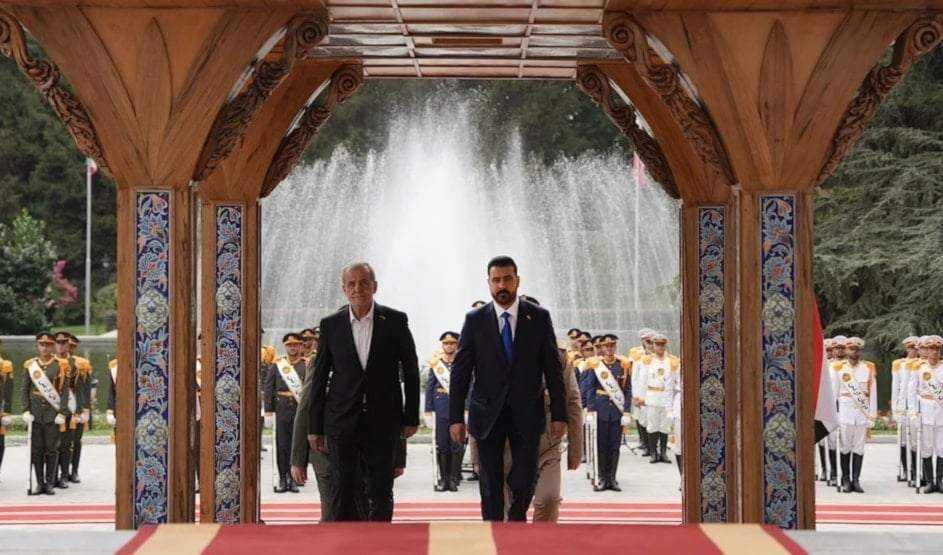
Iraqi Prime Minister Ali al-Zaidi walks alongside Iranian President Masoud Pezeshkian during the welcoming ceremony for the Iraqi PM, in Tehran, July 23, 2026 (X/ @IraqiPMO)
Iran rejected on Thursday a ceasefire proposal conveyed by Iraq’s prime minister on behalf of US President Donald Trump, The New York Times reported, citing Iranian and Iraqi officials, with Tehran unwilling to accept a temporary arrangement that offered no guarantees against further US aggression.
The development came as Trump continued to threaten an escalation of the US aggression, including potential strikes on critical Iranian infrastructure.
The officials, speaking to NYT on condition of anonymity because of the sensitivity of the national security discussions, said Prime Minister Ali al-Zaidi’s visit to Iran followed his recent meeting with Trump at the White House.
Iranian officials said the details of the ceasefire proposal were not immediately known. However, they described it as the only proposal currently under consideration and said Tehran was unwilling to accept a temporary arrangement that left unresolved the issue of control over the Strait of Hormuz.
In fact, Iran argues that repeated US actions have demonstrated a pattern of reneging on agreements and using negotiations as a tactical tool rather than a basis for lasting commitments. Iranian officials frequently cite Washington's 2018 withdrawal from the Joint Comprehensive Plan of Action (JCPOA), despite Iran's compliance being verified at the time by international inspectors, as evidence that US commitments can be reversed by political change.
It also contends that sanctions relief has often been delayed, limited, or replaced with new restrictions, reinforcing a "double-cross" strategy in which diplomatic engagement is paired with continued economic and military pressure. From Tehran's perspective, accepting new US proposals without concrete, enforceable guarantees risks repeating past experiences in which concessions were made but promised reciprocal benefits failed to materialize. As a result, Iranian leaders maintain that trust must be earned through verifiable actions rather than diplomatic assurances alone.
Iraqi delegation holds talks with senior Iranian officials
Al-Zaidi reportedly arrived in Tehran with a delegation of senior Iraqi officials and held meetings with Iranian President Masoud Pezeshkian, Iran’s chief negotiator Brig. Gen. Mohammad Bagher Ghalibaf, and Foreign Minister Abbas Araghchi.
Speaking to state television, Araghchi said Iran and Iraq shared extensive economic, political, and security interests, as well as close bilateral relations, adding that the visit carried particular importance given current regional developments.
Araghchi says dispute goes beyond message exchanges
Araghchi said al-Zaidi had conveyed his “views and impressions” from his discussions in Washington, but stressed that communication channels between Tehran and Washington were not the central issue.
“The problem is not passing messages,” he stressed. “The problem is America’s outlook, which is illogical, greedy, and controlling.”
Tensions between Iran and the United States have continued to rise in recent weeks, with US forces carrying out aggression on Iranian infrastructure including railways, airports, bridges, and seaports. Iran, in turn, has launched retaliatory ballistic missile and drone strikes against American military targets across West Asia.
It is worth noting that Iran has repeatedly said that US military bases and economic assets in the Gulf region have been used to launch acts of aggression against Iran, including strikes that have resulted in civilian casualties. In this framing, Iran frames any action against such facilities as retaliation against hostile military activity originating from or enabled by those bases.
Iran warns of wider regional war if Trump escalates aggression
Two Iranian officials told The New York Times that Iran’s armed forces are preparing for the possibility of a wider war should President Donald Trump carry out threats to target Tehran and the country’s critical infrastructure.
The officials said that any such US aggression would prompt Iran to expand its response across the region, including by targeting Tel Aviv and coordinating with its Yemeni allies to close the Bab al-Mandab Strait, a key maritime corridor linking the Red Sea to global shipping routes.
Meanwhile, highlighting the unity and steadfastness of the Iranian people in the face of US aggression, supporters gathered in Tehran’s Azadi Square on Thursday to demonstrate their backing for the country’s leadership and armed forces, as a military vehicle carrying Iranian-made ballistic missiles was displayed during the gathering.


