
US Senate blocks war powers resolution on Iran for fourth time
 3 Min Read
US Senate votes down a war powers resolution on Iran, backing President Donald Trump’s military onslaught.
-
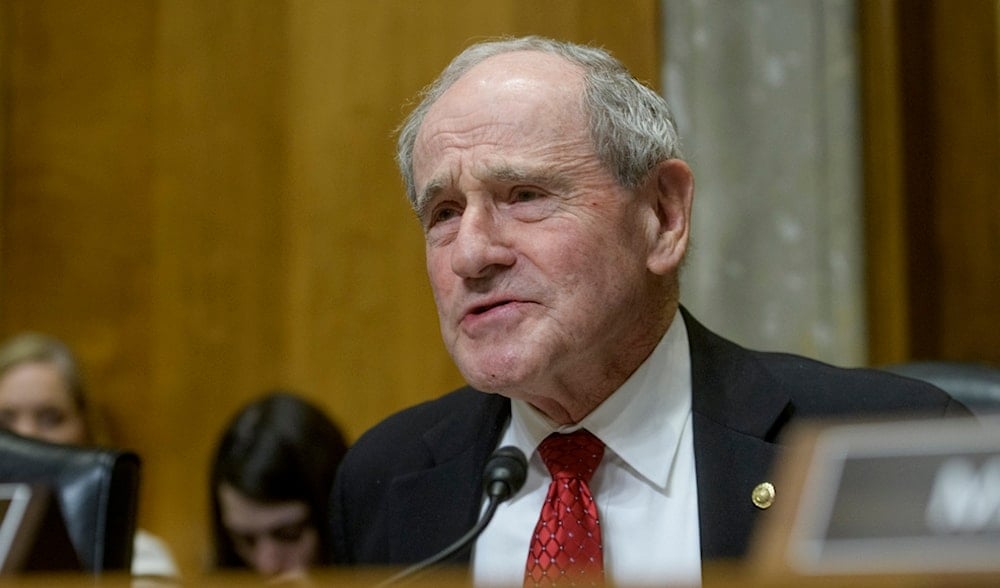
Senate Committee on Foreign Relations Chairman Jim Risch, R-Idaho, questions Rep. Elise Stefanik, R-N.Y. as she testifies during a Senate Committee on Foreign Relations hearing for her pending confirmation on Capitol Hill, Jan. 21, 2025. (AP)
A majority of the US Senate voted on Wednesday to block a war powers resolution aimed at halting US President Donald Trump's aggression against Iran, underscoring continued support for his administration's war.
Lawmakers voted 52-47 against advancing the Democratic-led measure, which sought to prevent further military action without congressional authorization. The resolution was the latest attempt by Democrats to reassert Congress’s constitutional authority to declare war, a power that has increasingly been contested in modern US offensives.
Fourth fail as Republicans back warmongering
The vote reflected strong Republican backing for Trump’s approach, more than six weeks after the US and "Israel" launched joint attacks on Iran despite diplomatic engagement between Washington and Tehran.
It was the fourth time Democrats forced a Senate vote on a war powers measure since the aggression began. All previous efforts have failed, facing near-unanimous opposition from Republican lawmakers.
Senator Rand Paul was the only Republican to support the resolution, consistent with his long-standing stance against extensive military intervention and in favor of strict constitutional limits on executive power.
On the Democratic side, Senator John Fetterman was the only member of his party to vote against the measure, while Senator Jim Justice abstained.
Read more: Growing divide in US Congress over 'Israel' funding: Axios
Lawmakers clash
Senator Jim Risch, chairman of the Foreign Relations Committee, criticized supporters of the resolution during debate.
"Nobody is coming to help you, Iran, except for the 47 people over here," he said, referring to senators backing the measure.
Democrats, however, warned that continued military engagement without congressional approval risks escalating into a prolonged war. "I urge my colleagues ... to choose the path of peace before President Trump's war becomes irreversible," Senator Jack Reed said.
Concerns grow among republicans, but not enough
While the failure of the resolution does not come as a surprise, Republicans have recently expressed growing unease with the US war on Iran, particularly in light of the economic strain facing American society, The Wall Street Journal reported.
Republican Sen. Susan Collins previously warned she would oppose continued military action if it exceeds the 60-day limit set under the War Powers framework or escalates further without congressional approval, signaling early unease over the trajectory of the war.
That unease now appears to be expanding, driven in part by rising economic costs at home. Lawmakers are increasingly facing pressure from constituents impacted by surging fuel and fertilizer prices, as the crisis enters its seventh week with no clear resolution in sight.
“The military operation needs to be brief and successful,” said Sen. Jon Husted (R., Ohio), who will face voters in November. “The president said it would take weeks and not months, and he should stick to that goal," Husted said.
Concerns are also growing over public perception, as the prolonged war becomes harder to justify domestically. "Every day that it drags on it makes it more and more and more difficult for people to understand why we're there," warned Sen. Jim Justice (R., W.Va.).
Read more: US-Iran ceasefire set for extension as negotiations expected soon


