
US struggles to 'protect' Kuwait after 'liberating' it: WSJ
 13 Min Read
The war on Iran has exposed how the US military presence in Kuwait, long portrayed as a security guarantee, has instead made the country more vulnerable to retaliation and regional instability.
-
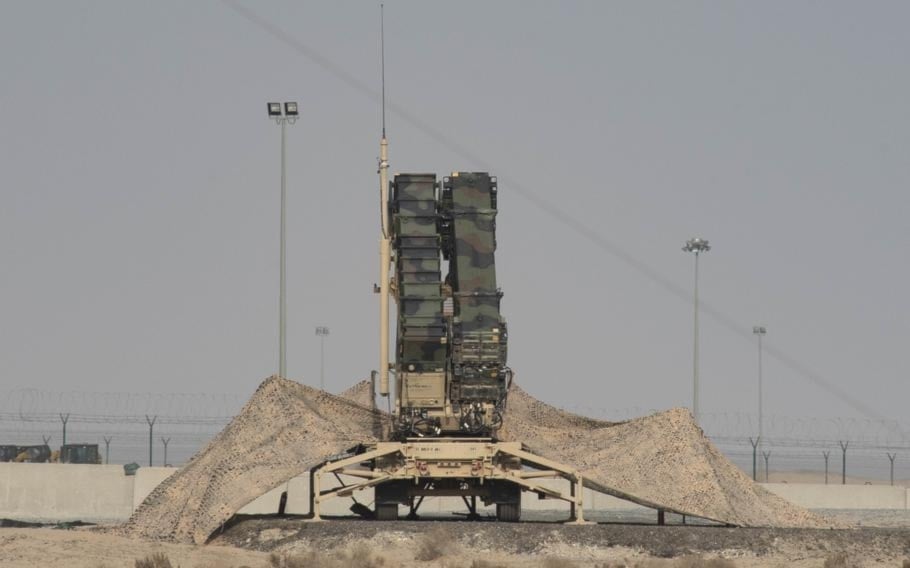
In this 2020 file photo, a Patriot missile launcher stands ready to destroy any incoming threats at Ali Al Salem Air Base, Kuwait. (US Air Force)
In an analysis published by writers David S. Cloud, Shelby Holliday and Anika Arora Seth for the Wall Street Journal (WSJ), the authors examined how the war on Iran has unsettled the security partnership between Kuwait and the United States, as Washington questions whether its extensive military deployment in the emirate remains sustainable.
The report presents Kuwait as caught between its continued dependence on American military protection and the danger created by hosting some of the largest US bases and logistics facilities in West Asia.
However, the experience of the war raises a more fundamental question than whether Washington should reduce or reorganize its forces. It challenges the premise that the foreign military presence has provided Kuwait with lasting security at all.
Rather than insulating the emirate from conflict, US bases, equipment depots and operational facilities have incorporated Kuwaiti territory into Washington’s regional war infrastructure, leaving the country exposed to retaliation when the United States launched attacks on Iran.
US security guarantee faces its central contradiction
Kuwait became a major American military center after the US-led coalition expelled Iraqi forces from the country in 1991.
The deployment expanded further following the 2003 US invasion and occupation of Iraq, when Kuwait served as a staging ground for American forces and a transit point for troops, weapons and equipment moving into and out of Iraqi territory.
In subsequent years, the United States stored Abrams tanks, armored vehicles, artillery, fuel and ammunition in Kuwait while using Camp Arifjan, Ali al Salem Air Base and other installations to support operations across the region.
As many as 13,500 American troops have been stationed in the emirate in recent years, placing Kuwait behind only Germany, Japan and South Korea among the largest locations for permanent US deployments abroad.
The Wall Street Journal described this presence as a source of reassurance following Iraq’s invasion. Yet the war on Iran has exposed the contradiction at the heart of that arrangement: military facilities promoted as a deterrent have also made Kuwait part of the operational geography of an American war.
Iran has launched repeated missile and drone attacks toward US-linked sites in Kuwait during the conflict. The strikes have affected military facilities as well as the country’s airports, electricity network and desalination infrastructure, according to the report.
Washington says American-made air-defense systems intercepted most of the Iranian projectiles and prevented a higher death toll. Nevertheless, the scale of the attacks demonstrates that the US military presence neither deterred Iran nor fully protected Kuwait’s essential facilities.
“The attacks have made people in Kuwait think of the U.S. presence as a liability, but also as absolutely necessary to defend Kuwait,” said Douglas Silliman, president of the Arab Gulf States Institute and a former US ambassador to Kuwait.
“I think they are trying to figure out what the best way forward on defense is.”
Silliman’s assessment captures the dilemma confronting Kuwait. Still, it also reflects the circular logic surrounding Washington’s military presence: US bases contribute to making Kuwait a target, while the resulting attacks are then cited as proof that Kuwait requires continued US protection.
Western framing overlooks origins of Kuwait’s exposure
The WSJ largely framed the issue as a question of whether the United States can protect Kuwait from Iran's retaliatory strikes.
That interpretation places Tehran’s retaliation at the center of the crisis while giving less weight to the decision by the United States and “Israel” to launch the war and use a network of regional bases to sustain military operations against Iran.
For Iran, Kuwait was not attacked merely for maintaining relations with Washington. Iranian officials have argued that retaliation was directed against military bases, assets and facilities used to facilitate US aggression.
Following renewed American aggression, Iran’s Foreign Ministry called on neighboring states to prevent Washington from using their territory, territorial waters or airspace to strike Iranian soil.
The ministry said Iran had no hostility toward neighboring countries and maintained that lasting security could only be achieved through regional cooperation free from US military intervention. It described its operations against facilities used in attacks on Iran as lawful self-defense under Article 51 of the United Nations Charter. Foreign Ministry spokesperson Esmaeil Baqaei had previously warned regional governments against relying on “borrowed security,” saying, “The US military presence in the region is the sole source of insecurity and endangers the countries hosting American bases.”
“The US military presence in the region is an extra burden and brings nothing but insecurity,” he added. This directly challenges the Journal’s underlying assumption that the principal problem is insufficient American protection.
Critics instead hold that the danger originates in allowing foreign forces to turn regional states into forward operating platforms for wars against their neighbors.
Under that reading, deploying more US weapons would not resolve Kuwait’s security crisis; it would deepen the same military dependence that placed the country on the front line.
Iranian strikes force Pentagon reassessment
The Pentagon had reportedly begun considering a reduction of its military presence in Kuwait before the latest phase of the war.
Iranian attacks have since increased the pressure on US officials to disperse personnel and equipment, particularly after a strike in March killed six US service members.
US officials cited by the Journal said the Pentagon had already reduced the number of personnel in Kuwait to minimize the risk of further casualties.
“The question really is, if the Iran war continues, whether that large of a US presence still makes sense,” said Elizabeth Dent, a fellow at the Washington Institute for Near East Policy and a former Pentagon official focused on the Persian Gulf.
The Journal presented a possible drawdown largely as a difficult strategic calculation for Washington and a potential source of anxiety for Kuwait.
For regional observers, however, a reduction would represent more than an administrative adjustment. It would indicate that Iran’s missile and drone capabilities have made large, concentrated US bases increasingly difficult to defend.
Iranian attacks have already caused more damage to US military installations across the region than Washington initially disclosed. A separate Journal investigation found extensive damage at the US Navy’s headquarters in Bahrain, where command buildings and satellite communications infrastructure were struck, and most personnel were evacuated.
Strategic vulnerability applies to Kuwait. Fixed installations containing large concentrations of troops, ammunition, aircraft and armored vehicles provide Washington with logistical reach, but also offer Iran identifiable targets during an open war.
A Pentagon decision to shrink or disperse its deployment could therefore be understood as an acknowledgment that Washington can no longer operate from Persian Gulf states with the degree of impunity it previously enjoyed.
Kuwait pays economic and civilian costs
The consequences of the war have extended far beyond military installations.
The closure of the Strait of Hormuz halted nearly two million barrels per day of Kuwaiti oil exports for months, cutting off the country’s principal source of state income and removing around 2% of global daily oil supplies from the market.
Iranian strikes have also placed Kuwait’s electricity and water systems under severe pressure.
More than 90% of the country’s drinking water is produced through desalination, with many desalination facilities integrated into electricity-generating plants. Damage to these sites therefore threatens two essential services simultaneously.
A power and desalination complex reportedly sustained serious damage and caught fire following strikes this month. Kuwait has so far maintained supplies through reserve capacity, emergency work and repairs, but a longer campaign could further strain those systems.
Satellite imagery from July 18 showed smoke over the al-Ahmadi port area, while subsequent images reportedly revealed damage near a northern pier belonging to the state-owned company overseeing Kuwait’s oil and gas sector.
The damage to civilian and dual-use infrastructure remains one of the most serious issues raised by Iran’s campaign. Tehran argues that it is striking assets used to support American military operations, but attacks affecting airports, electricity, water and energy facilities create substantial risks for the Kuwaiti population.
At the same time, presenting those consequences solely as the result of Iranian aggression leaves Washington’s role largely unexamined. The United States began a war from a regional military network that included facilities in countries whose governments and populations would predictably bear the consequences of Iranian retaliation.
Kuwaiti officials were reportedly disturbed that US President Donald Trump launched the war without extensive consultation with regional governments, despite exposing their territories, economies and infrastructure to attack.
Their frustration has intensified as the conflict has continued and Kuwait’s oil exports have remained restricted.
Disputed claims over Kuwait’s military role
After Iranian missiles struck Kuwait International Airport in June, Iranian Foreign Minister Abbas Araghchi described the attack as "self-defense", saying the Pentagon had used the airport as a staging point for operations against Iran.
US forces have operated from the airport in the past, but the WSJ said it could not determine whether the facility was still being used for military operations when it was struck.
The newspaper previously reported that Kuwait had conducted airstrikes against Iran, citing people familiar with the matter. Kuwait’s ambassador to the US denied the allegation.
That denial is significant because Kuwaiti participation in attacks would alter the nature of the confrontation, transforming the country from a state hosting US forces into a direct belligerent.
Without independent confirmation, the allegation cannot be treated as fact. However, it illustrates the risks created by the opacity surrounding American operations conducted from regional countries.
When civilian airports, ports or other facilities are used partly for military purposes, they become vulnerable to being treated as dual-use targets, placing civilian infrastructure and populations in greater danger.
More US weapons would deepen the same dependency
Kuwait is not believed to be preparing a fundamental break with Washington and may instead request additional Patriot systems and other air-defense equipment from the United States and foreign suppliers.
“The recent attacks have highlighted the increasingly complex security environment in our region and the evolving nature of modern threats, including missiles, drones and asymmetric capabilities,” a spokesperson for Kuwait’s US Embassy said.
The spokesperson added that Kuwait “remains committed to working closely with the United States.”
Kuwait has also signed a defense agreement with Pakistan, which has participated in diplomatic efforts aimed at ending the war.
Diversifying military partnerships may reduce Kuwait’s exclusive dependence on Washington, but obtaining additional foreign weapons would not in itself address the political source of its vulnerability.
The Journal’s analysis largely confines Kuwait’s options to maintaining a substantial US presence, securing a stronger US commitment or purchasing more advanced interception systems.
It gives less consideration to an alternative repeatedly advocated by Iran: a regional security arrangement based on agreements among Persian Gulf states and the removal of foreign military bases.
Such an arrangement would require guarantees that no regional country would allow its territory, airspace or waters to be used for attacks against another. It would also require Iran and its neighbors to establish mechanisms capable of preventing disputes from escalating into attacks on military or civilian infrastructure.
“Whether the Americans are there or not, these threats from the Iranian side will continue,” said Bader al-Saif, a history professor at Kuwait University.
“Where the Americans helped us in the ’90s when conventional warfare was the thing, that’s not the case today. So I think it was a wake-up call.”
Yet the lesson drawn by the Resistance would differ from al-Saif’s suggestion that the Iranian threat exists independently of the American presence.
Iran’s publicly stated position is that regional countries become targets when their facilities are used to support attacks on Iranian territory. Removing or restricting that foreign military role would therefore be central, rather than incidental, to reducing the danger.
US presence fails its own security test
Kuwait “is caught in a difficult place right now,” Dent said. “They want the war to be over, but they also want to end any threat from Iran.”
The Journal depicts this as a struggle to preserve Kuwait’s longstanding American security guarantee while adapting it to missile, drone and asymmetric warfare.
The events described in the report, however, support a more critical conclusion.
Washington used Kuwait for decades as a military warehouse, troop hub and launchpad for operations across West Asia. When the United States opened a direct war against Iran, that infrastructure exposed Kuwait to retaliation, while American air defenses proved unable to prevent substantial disruption and damage.
The conflict has therefore not merely weakened an otherwise successful defense arrangement. It has exposed the limits of a security model based on permanent foreign bases and dependence on a power capable of initiating regional wars without meaningful consultation with the countries expected to host its forces.
For Kuwait, the strategic choice is not simply between more or fewer American troops. It is between continuing to function as part of Washington’s military architecture and pursuing a regional security policy that prevents its territory from being used in wars against neighboring states.
Read more: KSA, Kuwait grant US military access to bases, airspace for war: WSJ


