
US threats, interference delaying Iran-Oman Hormuz deal: Sepah
 4 Min Read
Regional mediators continue working on a temporary navigation framework.
-
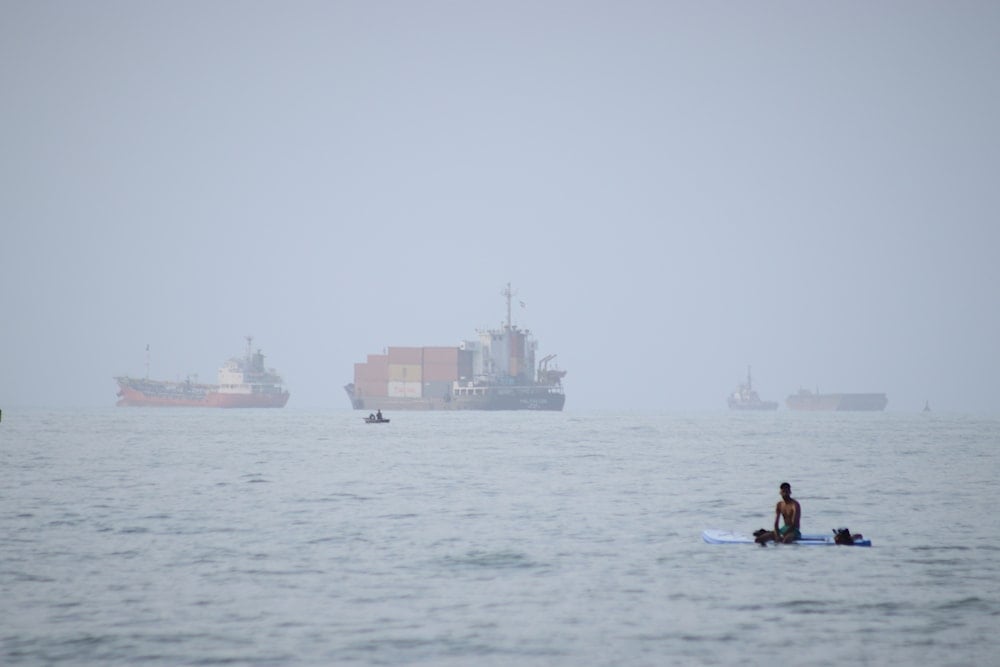
A man sits on a surfboard as a container ship and other commercial vessels appear anchored in the Strait of Hormuz off Bandar Abbas, Iran, Monday, July 27, 2026. (ISNA via AP, File)
US interference and continued threats of military action against Iran are obstructing efforts to finalize an agreement with the Sultanate of Oman on navigation through the Strait of Hormuz, an informed Iranian official said on Wednesday.
The source told Sepah News, the official news outlet of Iran’s Islamic Revolution Guard Corps, that Washington’s interventions were the primary reason for the delay.
Continued threats of an attack would further complicate the negotiations, the source warned, stressing that “Iran will not conclude any agreement under threat.”
Trump threatens Iran as reports suggest deal is near
The remarks followed a new threat by US President Donald Trump, who said on Tuesday that Iran would be “hit very hard” unless the strategic waterway was reopened “very soon".
“The strait is going to be open very soon, or they’re going to get hit very hard — and then the strait’s going to be open,” Trump told Fox News during a visit to California.
Trump claimed that “very good discussions” were underway and said he believed an arrangement could be reached on Wednesday or Thursday. He provided no details about the negotiating process or the parties involved.
Axios subsequently reported, citing unnamed US and regional officials, that Washington, Tehran and Muscat were nearing an interim arrangement to restore navigation through the strait, which the United States hoped could be announced on Wednesday.
According to the report, the proposed arrangement would remain in effect for 60 days and could later be extended. Inbound vessels would reportedly use a northern shipping lane, while outbound traffic would travel through a southern lane passing through Omani territorial waters. The proposal would not include the payment of tolls.
Iranian sources, however, have rejected claims that Tehran is negotiating directly with Washington over Hormuz, maintaining that the only active talks concerning the waterway are taking place between Iran and Oman.
The differing accounts suggest that Washington is seeking to shape the emerging arrangement through regional intermediaries while presenting itself as part of a negotiating process that Tehran says is limited to Iran and Oman.
Press TV also cited an informed source as saying that an agreement between Tehran and Muscat remained within reach, provided that interference by the United States and other regional parties ceased.
Pakistani, Qatari mediators draft new document
Alongside the Iran-Oman negotiations, Pakistani and Qatari mediators are preparing a separate document intended to clarify the broader regional framework governing commercial navigation through the Strait of Hormuz.
Sources told Al Mayadeen’s correspondent in Islamabad that the new document would focus exclusively on the strategic waterway.
Preparations are underway for a second memorandum of understanding that would serve as an annex to the original Islamabad Memorandum of Understanding and establish specific arrangements for commercial vessel traffic between the Gulf and the Gulf of Oman.
Pakistan and Qatar are among several regional parties involved in efforts to mediate between the sides and prevent a renewed military escalation over the waterway.
Disagreement over control of shipping lanes
Clause 5 of the Islamabad Memorandum of Understanding requires Iran to make the necessary arrangements for a safe commercial shipping corridor between the Gulf and the Gulf of Oman for 60 days.
Under the memorandum, vessel traffic would be organized in coordination with Oman and the countries bordering the Gulf.
Separate reports indicate that the emerging Iran-Oman proposal could grant Tehran responsibility for inbound traffic while Oman supervises vessels leaving the Persian Gulf.
The parties have yet to publicly confirm the final terms, and reports differ over whether service fees would be collected from passing ships.
Iranian sources have accused Washington of disrupting the proposed framework by establishing a separate route south of the Strait of Hormuz, near the Omani coastline, and encouraging commercial vessels to use it outside the navigation arrangements coordinated with Tehran.
Read more: Iran says Hormuz talks are only with Oman, not US


