
US war on Iran testing depleted Justice Department, FBI: WaPo
 5 Min Read
Mass dismissals within US security agencies raise concerns over weakened expertise as escalations with Iran intensify.
-
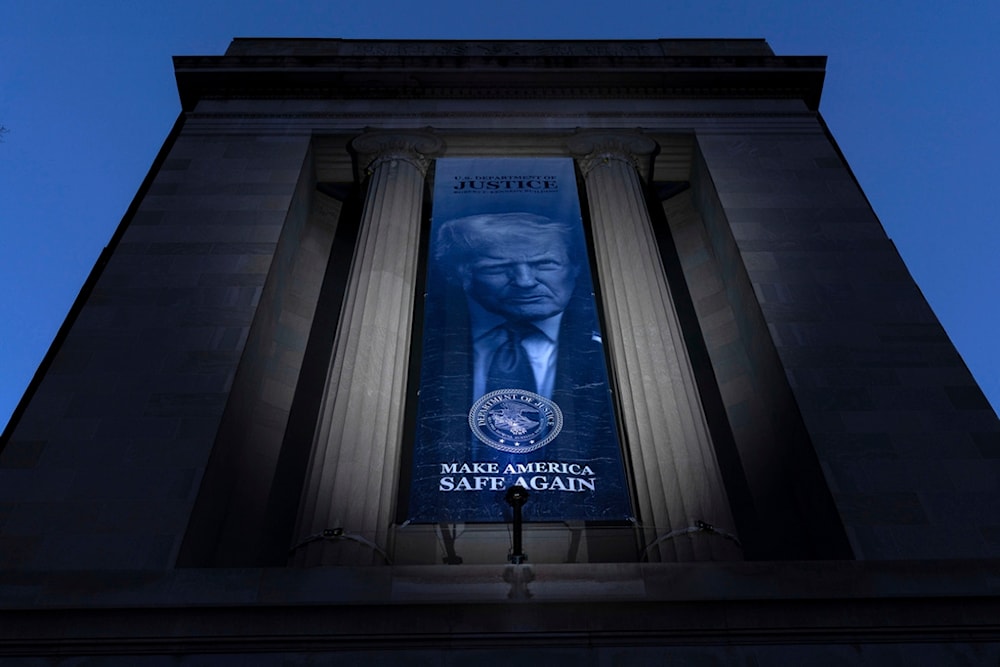
A banner with a portrait of President Donald Trump is hung from the Department of Justice, Saturday, March 7, 2026, in Washington (AP)
Mass firings and departures across the United States’ national security institutions have significantly reduced experienced personnel within the FBI and Justice Department, according to US media reports.
The staffing losses come as Washington intensifies its aggression on Iran, raising concerns among former officials that the country’s domestic security apparatus is operating with reduced expertise during a period of heightened geopolitical tensions.
Over the past year, the Trump administration has overseen widespread dismissals, reassignments, and resignations across federal law enforcement agencies, removing decades of institutional knowledge from key national security positions.
Agents with Iran expertise among those dismissed
Last week, FBI Director Kash Patel dismissed roughly a dozen agents and staff members who previously had ties to investigations involving US President Donald Trump.
Among those removed were agents specializing in monitoring threats linked to Iran and groups aligned with Tehran. The dismissals reportedly took place just days before the United States launched an aggression on Iran.
Current and former officials say the loss of experienced personnel has weakened the bureau’s ability to track potential threats during overseas conflicts, when domestic security agencies typically increase surveillance and threat monitoring.
Security operations stretched by staffing losses
FBI agents responsible for national security cases are tasked with evaluating large volumes of potential threats, determining which incidents require investigation and which may be linked to extremist groups or foreign actors.
In serious cases, agents coordinate with Justice Department prosecutors to obtain warrants and carry out arrests before suspected attacks can occur. Former prosecutors say the loss of experienced agents complicates such efforts, particularly when investigations require continuous surveillance of suspects.
Reports indicate that at one point last year, roughly 25% of FBI agents were reassigned to immigration enforcement duties, further stretching the bureau’s operational capacity.
Officials also note that when experienced agents leave, the intelligence networks and community contacts they built over years of work are often lost, making it harder for investigators to monitor threats effectively.
Leadership departures across the Justice Department
The staffing reductions have also affected leadership roles within the Justice Department. Several veteran officials responsible for national security and counterintelligence operations have been dismissed or forced out during the administration’s restructuring of federal law enforcement agencies.
Among those removed were senior figures overseeing international criminal affairs, cyber investigations, and national security operations within the FBI. In some cases, replacements have been promoted earlier than expected, while other posts remain difficult to fill due to the shortage of experienced candidates.
Reports also indicate that much of the leadership of the Justice Department’s Civil Rights Division criminal section has departed in recent months, reducing the number of prosecutors experienced in handling cases involving planned attacks or hate crimes.
Political tensions surrounding FBI leadership
The leadership changes follow years of political tensions surrounding federal investigations into Trump and his associates. During the previous administration, federal prosecutors investigating Trump’s handling of classified documents reportedly subpoenaed phone records belonging to Kash Patel and other figures linked to the president.
After Patel assumed leadership of the FBI in 2025, several officials connected to earlier investigations were dismissed or reassigned, contributing to the broader restructuring of the bureau. Critics argue the moves have weakened institutional expertise, while supporters claim they were necessary to address alleged misconduct within the agency.
Concerns over long-term security impact
Security analysts warn that rebuilding expertise within national security agencies can take years, as agents develop intelligence sources and operational experience over long careers.
The loss of veteran personnel may affect Washington’s ability to detect and prevent potential attacks, particularly during periods of international conflict when domestic threats often increase.
The staffing reductions also come as US military defenses face mounting pressure from Iran’s expanding missile and drone capabilities. Reports indicate that waves of low-cost Iranian attack drones have repeatedly challenged US and allied air defense systems across West Asia.
Analyses cited by US media say systems such as the Patriot and THAAD interceptors, which cost millions of dollars to deploy, are being used to counter inexpensive Iranian Shahed drones that can cost only tens of thousands of dollars each. Pentagon officials have warned that existing defenses cannot intercept every incoming drone.
Former officials say the combination of strained military resources abroad and reduced expertise within domestic security agencies could complicate Washington’s ability to respond to emerging threats. They argue that the United States may now have fewer resources to monitor risks and coordinate investigations as tensions with Iran continue to escalate.
Read More: The Hill: Mass-produced Iranian drones strain US defenses


