
Venezuelan military backs Delcy Rodríguez as acting president
 4 Min Read
Venezuela’s armed forces endorse a court ruling naming Delcy Rodríguez acting president and announce full operational readiness amid what they call foreign aggression.
-
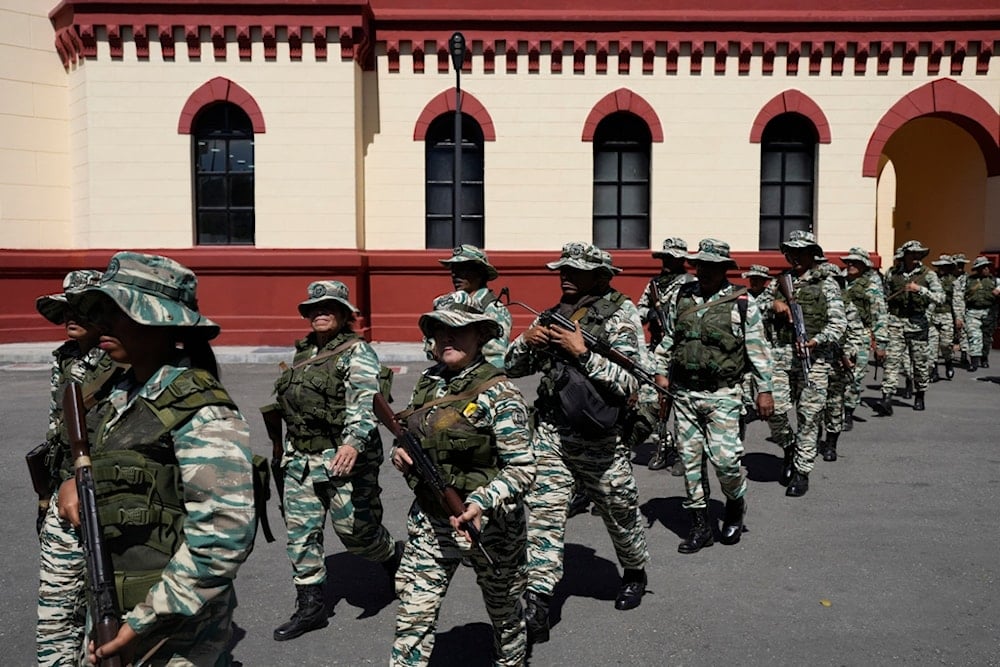
Bolivarian Militia members leave the 4F Military Museum for a gathering of security forces at Miraflores presidential palace in Caracas, Venezuela, Tuesday, January 7, 2025 (AP)
Venezuela’s armed forces said they fully support a Supreme Court decision ordering Executive Vice President Delcy Rodríguez to assume, in an acting capacity, all presidential powers, duties, and responsibilities, according to a statement issued on Saturday.
The communiqué from the Bolivarian National Armed Forces said the move follows a January 3, 2026, ruling by the Constitutional Chamber of the Supreme Tribunal of Justice, which cited the need to guarantee continuity of government and national defense.
The statement opened by condemning what it described as the “cowardly abduction” of Venezuela’s constitutional president, Nicolás Maduro, and first lady Cilia Flores, alleging that members of Maduro’s security detail, soldiers, and civilians were killed during the operation.
Military condemns Maduro’s abduction
The communiqué was read in a nationwide broadcast by Defense and Sovereignty Vice President Vladimir Padrino López, who said the armed forces unanimously back the judiciary’s decision, which he said is grounded in the Venezuelan constitution and organic laws governing states of exception and national security.
The armed forces also expressed full support for a decree declaring a State of External Disturbance across the national territory. According to the statement, the military will guarantee governability and employ all available capabilities to ensure national defense, maintain internal order, and preserve peace.
Ahead of reading the communiqué, Padrino López urged Venezuelans to resume their work and educational activities in the coming days, saying the country must continue along its constitutional path.
Assembly installation and full readiness
Padrino López said the armed forces will attend the constitutional installation of the National Assembly of Venezuela on Monday, January 5, marking the start of a new legislative term.
To meet what it described as the current security challenge, the military high command announced the activation of a state of “Full Operational Readiness” across Venezuela. The measure aims to integrate all branches of national power to confront what the statement called “imperial aggression” and to form “a single combat bloc” to defend independence and sovereignty.
The communiqué concluded with government slogans including “Independence and Socialist Homeland” and “The Sun of Venezuela rises in the Essequibo.”
Rodriguez ordered to lead Venezuela
Venezuela’s Supreme Court on Saturday ordered Executive Vice President Delcy Rodríguez to assume and exercise, in an acting capacity, all powers and duties of the presidency to ensure administrative continuity and the comprehensive defense of the nation.
The ruling was issued by the Constitutional Chamber of the Supreme Tribunal of Justice following what the court described as a foreign military attack on January 3, 2026, which it said resulted in the abduction of Venezuela’s constitutional president, Nicolás Maduro.
Reading the decision, Constitutional Chamber president Tania D’Amelio Cardiet outlined the legal and factual grounds behind the ruling, stating that the president’s forced absence constituted a situation of material and temporary impossibility to carry out his constitutional duties.
She said the court was compelled to act in light of what it described as an exceptional and unprecedented scenario not explicitly foreseen in the Venezuelan constitution, one that posed a direct threat to state stability, national security, and the effective functioning of the legal order.
Interpretation of constitutional provisions
D’Amelio said the chamber exercised its interpretative authority under Article 335 of the Constitution to conduct a systematic and teleological interpretation of Articles 234 and 239, in order to determine the appropriate legal framework to safeguard state continuity and national defense.
According to the ruling, Article 234 broadly contemplates situations of presidential impossibility, while Article 239 assigns the executive vice president the responsibility of assuming presidential functions in cases of temporary absence.
The court emphasized that its decision was adopted as an urgent, precautionary, and preventive measure aimed at ensuring the uninterrupted operation of the executive branch amid what it described as a “manifest state of urgency” and a “certain threat” stemming from foreign aggression.


