
Venezuelan youth mobilize to demand Maduro's release
 3 Min Read
Thousands of Venezuelan youths marched in Caracas, insisting that the “dreams of a people who decided to be free" not be shattered.
-
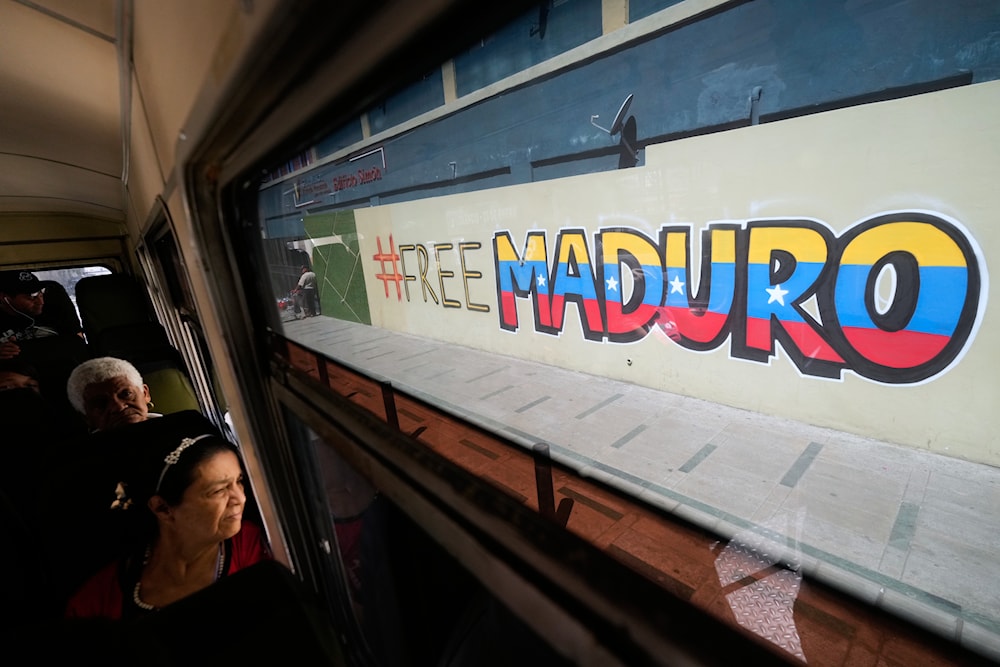
Commuters ride a bus past a mural calling for the release of former Venezuelan President Nicolas Maduro, who was kidnapped by US forces, in Caracas, Venezuela, Thursday, Jan. 8, 2026 (AP)
Thousands of Venezuelan youths marched through the streets of the capital on Thursday to demand the immediate release of President Nicolas Maduro and First Lady Cilia Flores, who were abducted by US forces on Jan. 3 in a dramatic military operation.
Organized by student groups, grassroots movements, and the Great Mission Venezuela Youth, the mobilization began near the student residences facing Venezuela Square. Demonstrators formed a unified bloc that advanced toward downtown Caracas, chanting slogans defending national sovereignty and denouncing what they called a violation of international law.
“The golden generation’s voice will be heard before the world,” said Nahum Fernandez, mobilization secretary of the United Socialist Party of Venezuela (PSUV), adding that foreign interests should not “shatter the dreams of a people who decided to be free.” Fernandez also invoked the legacy of the late Commander Hugo Chavez.
Youth to remain 'in permanent struggle' until Maduro's return
PSUV youth representatives said they would remain in the streets “in permanent struggle” until Maduro and Flores return to Venezuelan soil, pledging unwavering support for the embattled leaders.
The youth protests come amid nationwide outrage following the US aggression that kidnapped Maduro and flew him and Flores to the United States to face federal court charges, including alleged drug‑trafficking and narco‑terrorism counts. Maduro has pleaded not guilty and has insisted in court that he remains the legitimate president of Venezuela.
Socialist organizers have framed the US action as an affront to Venezuelan self‑determination. Their march also served, they say, to highlight what they view as an illegal military incursion and weaponization of international law.
Women’s groups joined the protests in Caracas and other Venezuelan cities, with activists taking to the streets to defend national sovereignty and call for peace. At one demonstration, Caracas Mayor Carmen Meléndez sent a message of support to Acting President Delcy Rodríguez, affirming that Venezuelan women will play a key role in public service and civic engagement.
PSUV Secretary Diosdado Cabello also praised Venezuelan women’s role in resisting external aggression, describing their contribution as rooted in “courage, bravery, dedication, and struggle.”
Popular demonstrations continue in Venezuela
Demonstrations continued across the streets of Venezuela’s capital on January 7, as citizens rallied in solidarity with President Nicolas Maduro and First Lady Cilia Flores following their abduction.
According to Al Mayadeen’s chief of bureau in Caracas, the march marked the largest public mobilization since Maduro was seized, with tens of thousands participating despite heavy rainfall, highlighting sustained public support in the capital.
Venezuela’s Attorney General, Tarek Saab, condemned the incident, calling it a grave attack on national sovereignty. In a televised statement, Saab described the operation as a “terrorist military attack” and asserted that it was the sole illegal act in the situation, warning that such an event could threaten the sovereignty of any nation.
Linking the crisis to broader regional and international tensions, Saab said, “After the genocide in Gaza, matters escalated to a US military attack against our country.” He emphasized that Venezuelan institutions remain the cornerstone of stability and stated that authorities are relying on constitutional bodies to address the crisis.


