
War remnants continue to threaten lives across Syria: AFP
 6 Min Read
More than 2,375 people have been killed or injured by explosive ordnance since December 2024, including over 850 children, according to UN-led monitoring.
-
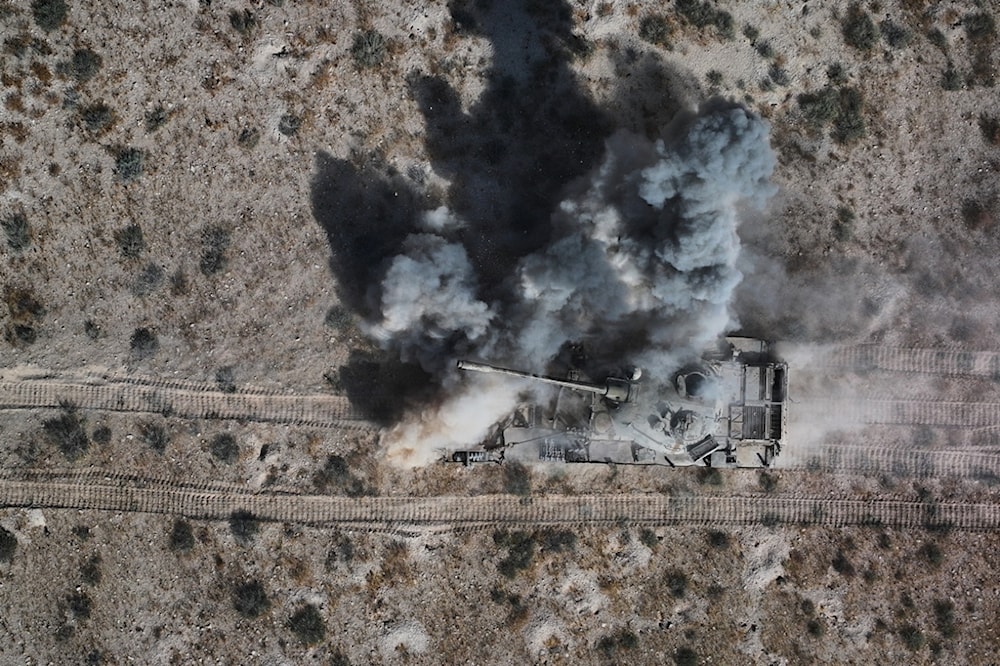
A Syrian army mine-clearing vehicle detonates anti-personnel mines as it drives through a minefield during an operation to clear mines left behind during the war in Qara, in the Damascus countryside, Syria, Friday, Aug. 7, 2026. (AP/Ghaith Alsayed)
More than 13 years after the outbreak of war, Syria is still facing a deadly threat buried beneath its roads, farmland and residential areas, with landmines and unexploded ordnance now claiming or injuring a person approximately every six hours.
The scale of the danger has become increasingly apparent as displaced Syrians return to areas devastated by years of fighting, only to encounter explosive remnants left behind by the conflict. Since the fall of the previous government on December 8, 2024, a Syria-specific coordination mechanism involving international and non-governmental organizations and led by the United Nations Mine Action Service has recorded 1,337 explosive ordnance incidents.
At least 2,375 people have been killed or injured in those incidents, including more than 850 children. The actual toll is believed to be higher. For Malaka Barbour, the consequences of the hidden danger became devastatingly personal when an object collected by her children exploded inside their home.
About eight months ago, her children had gone out to collect plastic and combustible materials for heating. “They did not know that among what they had collected was an object left over from the war,” the grieving mother told AFP.
The explosion injured 10-year-old Haidar and his seven-year-old brother Ghaith. Their 17-year-old brother Ahmad was hit by shrapnel that caused severe bleeding and ultimately killed him. “His death shattered us and broke our hearts,” Barbour, a farmer in her 40s, said as she held a photograph of her son.
A threat that continues long after the fighting
Ahmad's death illustrates the wider danger posed by the remnants of Syria's long conflict. Multiple parties planted mines across different parts of the country during more than 13 years of war, leaving behind a contamination problem that is now complicating efforts to restore normal life.
For Barbour's family, the loss has transformed everyday life into a source of anxiety. “Life no longer has any taste since we lost him,” she said. “I feel afraid every time one of my children leaves the house (..) as if my heart is burning.”
Syria's wider casualty figures reflect the severity of the problem. An initial report issued by the Landmine and Cluster Munition Monitor in June found that Syria recorded the highest number of casualties worldwide from landmines and war remnants last year, with 1,600 people killed or injured.
The situation has remained critical this year. The HALO Trust, the world's largest international humanitarian organization specializing in unexploded ordnance clearance, has documented nearly 700 people killed or injured by mines and war remnants since the beginning of 2026. Around one-third of those casualties were fatalities, while children made up roughly one-third of the victims.
Simon Jackson, the HALO Trust's Syria program director, told AFP that explosive remnants were causing "approximately one death or injury every six hours" on average.
The rise in incidents has coincided with the return of displaced Syrians to their former homes. Jackson said the number of incidents increased sharply at the beginning of 2025, with more than 60% taking place in agricultural or grazing areas.
Specialist clearance teams, including those from the HALO Trust, are working across several parts of Syria alongside the country's authorities, but the scale of contamination means the danger is unlikely to disappear quickly.
Explosive remnants threaten reconstruction
Beyond the immediate loss of life, unexploded ordnance is creating another barrier to economic and social recovery.
Jackson said the presence of unexploded ordnance prevents people from “rebuilding their homes and businesses. It also prevents farmers from planting their crops,” describing the threat as “an obstacle to the recovery of communities and the recovery of Syria.”
The scale of the clearance operation means that rebuilding will require a sustained effort over many years. "Even if we doubled the pace of work, we would need at least 10 years,” Jackson said. “We are talking about 20 or 30 years to solve this problem, and until the Syrian government is able to take responsibility for the remaining risks posed by the remnants that are found".
The difficulty of the task is evident in Jobar, on the outskirts of Damascus, where some of the war's fiercest battles took place. Clearance teams have spent months working through collapsed structures, rubble and twisted metal in an effort to identify dangerous remnants.
Hussein Qazahli, the HALO Trust's operations officer for southern Syria, said teams had cleared only around 200,000 square meters of roads during approximately eight months of work in the area. Large quantities of rubble, metal and shrapnel make detection more difficult, while limited resources, shortages of trained personnel and a lack of advanced equipment further restrict the pace of operations.
Syria faces a vast and poorly mapped contamination problem
In Qara, in the Damascus countryside, military engineering teams are using a mine-clearance machine to work through barren land, with controlled explosions sending clouds of dust and smoke into the air.
Personnel in protective suits inspect mines and other munitions before collecting and destroying them, as authorities attempt to tackle contamination according to a phased clearance plan.
A source in the Defense Ministry's engineering units told AFP that populated areas, roads and agricultural land are being prioritized. But the operation faces significant obstacles, including “the absence of maps of some minefields and the vast areas of contaminated land,” as well as the dangers posed by certain types of ordnance.
Teams rely on existing maps, reports from residents and field surveys to identify contaminated locations. Anti-personnel and anti-vehicle mines are among the devices most frequently encountered.
The threat has also claimed the lives of members of the armed forces. Since the fall of the previous government, 47 army personnel have been killed and more than 90 injured by mines and war remnants, according to the Defense Ministry source.
Yet the full scale of the contamination remains unclear. The ministry does not have an accurate estimate of the total area of land contaminated by mines and unexploded ordnance, leaving Syria facing a potentially decades-long effort to make its territory safe.


