
Washington defeated, failed to reap any gains in its war: IRGC
 3 Min Read
IRGC spokesperson Mohebbi affirms that sustained, relentless resistance and the defeat of the enemy remain Iran's fixed strategy.
-
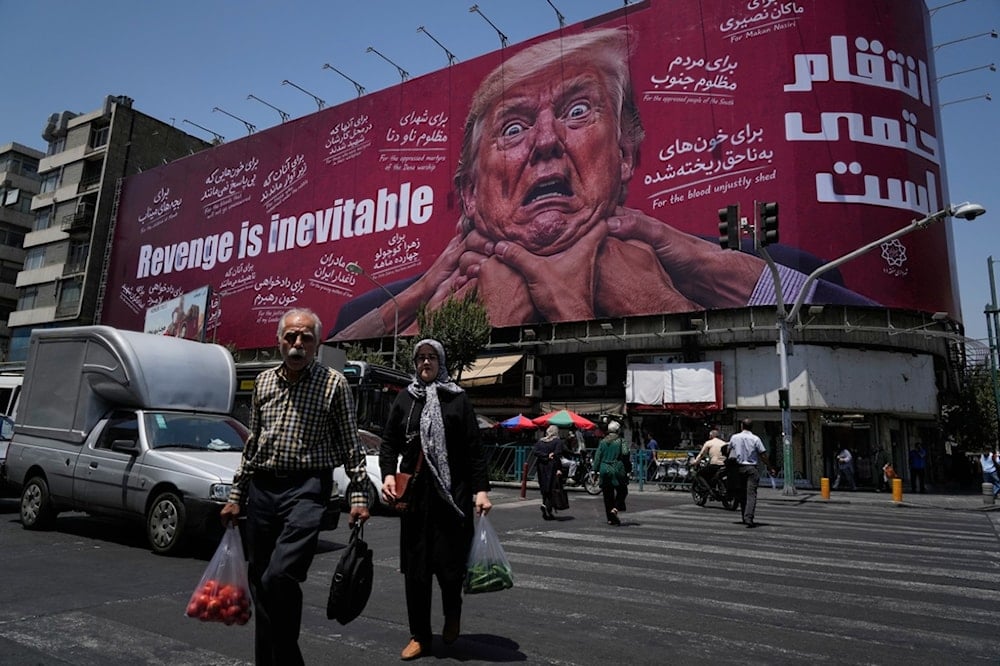
Pedestrians walk past a billboard depicting US President Donald Trump being grabbed by the neck alongside the message "Revenge is inevitable" in English and Farsi, in Tehran, Iran, on July 27, 2026. (AP Photo/Vahid Salemi)
Islamic Revolution Guard Corps (IRGC) spokesperson Brigadier General Hossein Mohebbi said on Sunday that the US war on Iran was the only war in which Washington has acknowledged defeat without achieving any gains.
Mohebbi stressed that "sustained and relentless resistance and the defeat of the enemy are our unchangeable, fixed strategy".
He added that Iran had forced the enemy to swiftly abandon all its objectives and seek the reopening of the Strait of Hormuz. Mohebbi emphasized that Hormuz is a geographic battleground, not merely a waterway, noting that Iran's current strategy is to maintain control over the strait until the enemy accepts all of its conditions.
Mohebbi had said on Saturday that Iran will only reopen the Strait of Hormuz once the United States fully accepts its terms and abandons its interventionist approach in the region. He added that the strait's reopening is completely independent of the ongoing talks between Tehran and Oman, and instead hinges entirely on Iran's own legal and defensive mechanisms.
'Iranian-imposed order is irreversible'
In a related statement on Saturday, Iranian Army spokesperson Brigadier General Mohammad Akraminia said the Iranian-imposed order currently governing the Strait of Hormuz is irreversible. He stated that the United States has no choice but to accept the status quo in the strait, warning that otherwise it would incur costs far greater than those it has already sustained.
Similarly, the Wall Street Journal reported on Saturday that regional officials are increasingly treating Iran’s effective control over the Strait of Hormuz as a reality that must be accommodated, with ongoing negotiations reportedly shifting away from ending that control toward determining how maritime traffic can operate under the new circumstances.
Per the report, Gulf officials acknowledged that a proposed agreement to reopen the Strait of Hormuz would give Tehran control over the strategic waterway, potentially permanently. They said, however, that the arrangement currently represents the best option available to them.
The officials said the IRGC has demonstrated its readiness to escalate and impose the highest possible costs on Washington’s regional allies. Gulf states have consequently begun examining ways to bypass the strait by expanding pipelines leading to the Red Sea and the Gulf of Oman and increasing investment in oil storage facilities outside the region.


