
We will defend our country's sovereignty: Venezuelan MP to Al Mayadeen
 4 Min Read
Venezuelan lawmaker Juan Romero condemns US aggression after Maduro's kidnapping, as Delcy Rodríguez is sworn in as interim president with China’s support.
-
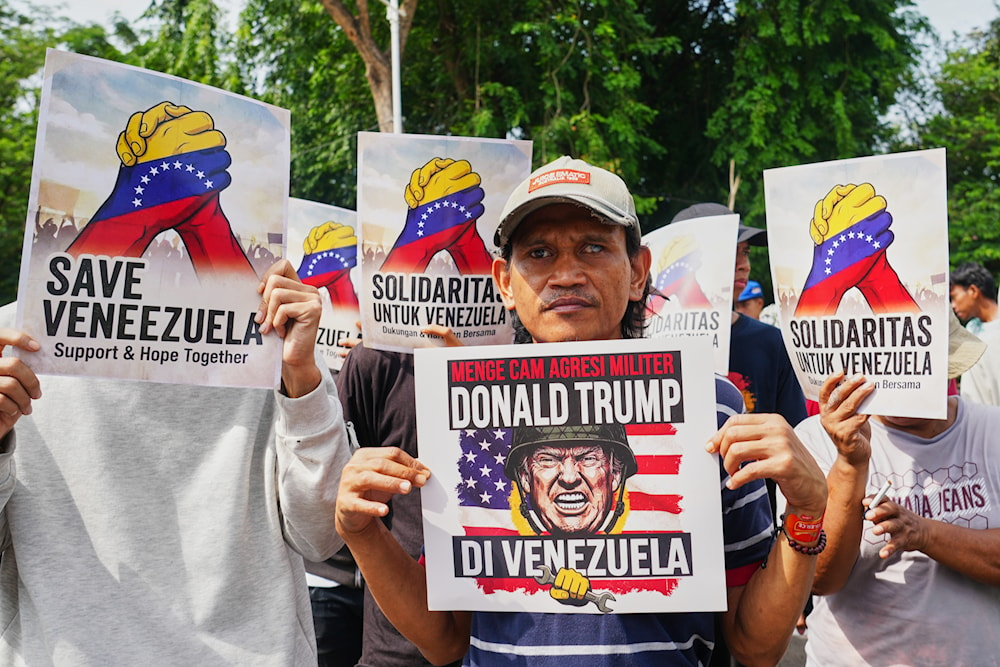
A protester holds a placard during a rally outside the US Embassy in Jakarta, Indonesia, denouncing the US kidnapping of Venezuelan President Nicolas Maduro, Tuesday, Jan. 6, 2026 (AP)
A member of Venezuela’s National Assembly, lawmaker Juan Romero, has described recent US actions as a “blatant act of aggression," stressing that the Venezuelan people are fully prepared to defend their sovereignty against any external threat.
In an interview for Al Mayadeen, Romero said Venezuela was on the highest level of alert and ready to reaffirm its historical stance in confronting foreign aggression, particularly in the aftermath of the US attack on January 3.
Romero invoked the legacy of Venezuela’s liberator, Simón Bolívar, emphasizing that free peoples have historically succeeded in breaking the dominance of major empires and affirming that Venezuelan society would remain united and resilient in the face of any potential challenges.
He also compared the abduction of President Nicolás Maduro to the abduction of former Haitian president Jean-Bertrand Aristide, describing such actions as part of the interventionist mechanisms employed by major powers.
Romero told Al Mayadeen that these practices constitute a flagrant violation of the principle of sovereign equality enshrined by the United Nations and amount to an unjustified and illegal act of aggression against a sovereign state.
Concluding his remarks, he recalled President Maduro’s previous statements that, in the event of an attack on the country, Venezuela would resort to a strategy of prolonged popular war involving all segments of society, stressing that the country remains ready to confront any threat and safeguard its independence by all available means.
China signals support for Rodriguez
Meanwhile, China on Tuesday signaled its support for Delcy Rodríguez, who assumed office as Venezuela’s interim leader following a US military intervention in Caracas that resulted in the abduction of President Nicolas Maduro and First Lady Cilia Flores.
“China respects Venezuela's sovereignty and independence, and respects the arrangements made by the Venezuelan government in accordance with its own constitution and laws,” Chinese Foreign Ministry spokeswoman Mao Ning told reporters in Beijing, responding to questions about whether China recognizes the interim government led by Rodríguez.
Asked whether Beijing would seek sanctions against Washington over the military operation, Mao said the United States, as a permanent member of the UN Security Council, had “disregarded the serious concerns of the international community and wantonly trampled on Venezuela's sovereignty, security, and legitimate rights and interests.”
“China firmly opposes this. We support the Security Council in fulfilling its primary responsibility to maintain international peace and security,” she added.
Mao also condemned Washington’s mishandling of President Maduro, saying, “The United States has disregarded Venezuelan President Nicolás Maduro's status as head of state by openly prosecuting and conducting a so-called ‘trial’ in its domestic court, severely violating Venezuela's national sovereignty and undermining the stability of international relations.” She concluded, “No country can place its own rules above international law.”
Who is Delcy Rodriguez?
Delcy Eloína Rodríguez Gómez is a Venezuelan lawyer and veteran politician who has held several senior posts under former president Hugo Chavez and President Nicolas Maduro. She has served as vice president since June 14, 2018, after previously holding positions including foreign minister and oil minister.
As vice president, Rodríguez emerged as one of Maduro’s closest allies, wielding significant influence within the executive branch and maintaining strong ties with the ruling United Socialist Party and key state institutions. She was widely viewed as a central figure in the continuity of the Maduro-led political project.
Following the US military aggression on Caracas on January 3, 2026, which resulted in the kidnapping of President Nicolas Maduro, Venezuela’s Supreme Court announced that Rodríguez would assume the presidency on an interim basis to ensure constitutional continuity and state stability.
Rodríguez was formally sworn in as interim president on January 5, 2026, with backing from the National Assembly and senior military leadership, positioning her as the country’s acting head of state amid an escalating political and security crisis.


