
Western states prepare measures against firms linked to E1 settlement
 5 Min Read
Several Western countries are preparing measures targeting companies involved in "Israel's" E1 settlement project in the occupied West Bank.
-
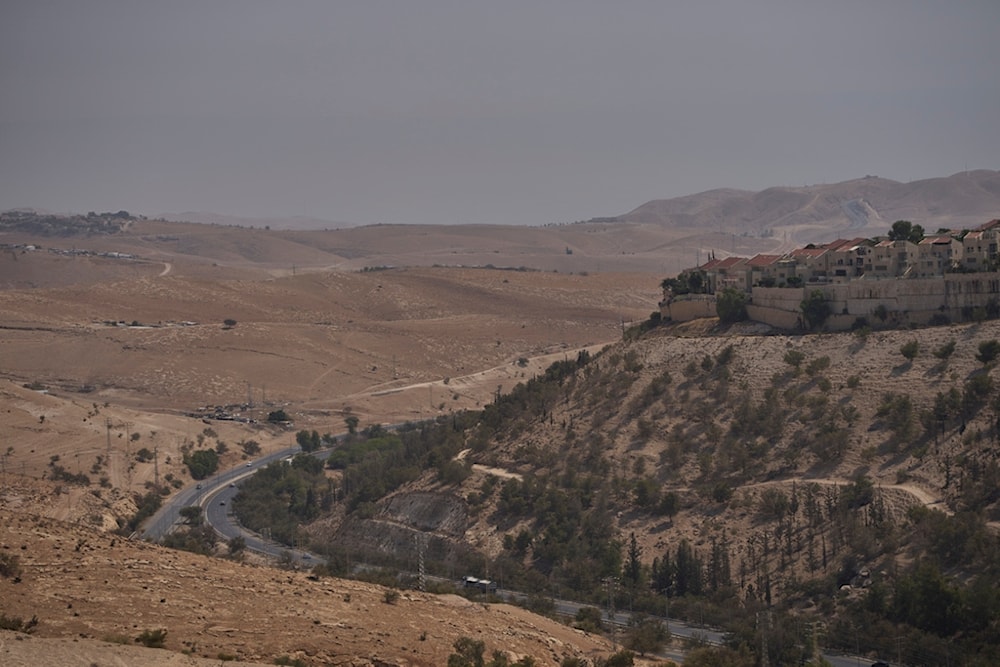
View of an area near Ma'ale Adumim in the Israeli-occupied West Bank, where Israeli Finance Minister Bezalel Smotrich says housing units will be built as part of the E1 settlement project, Thursday, Aug. 14, 2025 (AP)
A group of Western countries is expected to announce new measures this week aimed at discouraging corporate involvement in "Israel's" planned E1 settlement expansion in the occupied West Bank, The Guardian reported.
The anticipated package, expected to include action by the United Kingdom alongside partners such as France and Australia, comes as "Israel" advances plans for thousands of new settlement units in the E1 corridor between occupied al-Quds and the settlement of Ma'ale Adumim.
Earlier this month, tenders were opened for more than 3,000 settlement units in the area. Critics argue that construction in E1 would divide the occupied West Bank into northern and southern sections, making a contiguous Palestinian state increasingly difficult to establish.
Pressure mounts in Britain
The expected measures come as pressure grows within Britain's ruling Labour Party for stronger action against Israeli settlement expansion.
A group of 137 Labour MPs has urged Foreign Secretary Yvette Cooper to take urgent action in response to escalating Israeli violations against Palestinians in the occupied West Bank and eastern al-Quds, including ending trade with Israeli settlements.
Among the signatories was former Health Secretary Wes Streeting, who recently said he felt he was "hitting up against a brick wall" when attempting to raise concerns about Gaza within the government.
Melanie Ward, the Labour MP who organized the letter, argued that economic measures are necessary.
"Banning settlement trade would send the clearest possible message to Israel that settlements can have no viable economic future and are rejected by the world. This is needed now more than ever," she said.
The lawmakers said conditions in the occupied Palestinian territories have deteriorated despite previous commitments by the British government to confront threats of displacement and "annexation".
"The situation has worsened considerably and the government has taken no further action. This is unacceptable," the letter stated.
Khan al-Ahmar at the center of concerns
The debate surrounding E1 has intensified following renewed concerns over the Palestinian Bedouin community of Khan al-Ahmar.
Last week, a United Nations committee condemned an order signed by Israeli Finance Minister Bezalel Smotrich aimed at advancing the displacement of residents from the village.
The committee warned that the move would "heighten the risk of forced transfer of the civilian population" and described such actions as illegal and constituting a war crime.
Labour MPs linked the fate of Khan al-Ahmar directly to the broader E1 project, describing the community as being engaged in "a gruelling struggle against erasure, displacement and state-backed settler violence as part of Israel's E1 plan."
According to the letter, the project seeks to divide the occupied West Bank and would "make the two-state solution that we all want to see an impossibility."
Businesses warned against participation
On May 22, nine Western countries issued a joint warning regarding the settlement project.
"The E1 settlement development would divide the West Bank in two and mark a serious breach of international law. Businesses should not bid for construction tenders for E1 or other settlement developments. They should be aware of legal and reputational consequences of participating in settlement construction including the risk of involving themselves in serious breaches of international law," the statement said.
The forthcoming British package is expected to clarify potential penalties for UK firms involved in the project and may also expand sanctions targeting individuals and organizations linked to settler violence.
French Foreign Minister Jean-Noël Barrot has likewise called for broader action against those supporting extremist settlers.
"I have pushed for sanctions to be imposed not only on those responsible for this violence but also on the entities, companies and organisations in Israel that are providing these extremist settlers with the means to drive Palestinians from their land, burn their crops and destroy their public buildings," Barrot said.
Settlement expansion draws international opposition
The E1 plan has long been viewed by Palestinians and much of the international community as one of the most controversial settlement projects in the occupied West Bank.
Smotrich has openly championed the project, stating that the settlement would bury the prospect of Palestinian statehood. He described it as "Zionism as its best – building, settling and strengthening our sovereignty in the land of Israel."
The developments come as European governments increasingly consider measures targeting Israeli settlements, with Spain already moving to enforce restrictions on products originating from settlements in the occupied Palestinian territory, while Ireland, Belgium, and the Netherlands are considering similar legislation.
Meanwhile, diplomatic efforts continue in Cairo to address the situation in Gaza, where mediators from Egypt, Qatar, and Turkey are engaged in talks with Hamas amid ongoing Israeli attacks and threats of further military expansion in the besieged enclave.
Read more: Spain's PM Sanchez attends pro-Palestine Primavera Sound festival


