
WH official says US 'in charge' of Venezuela, sets terms, conditions
 3 Min Read
A US official says Washington is running Venezuela, citing sanctions, military pressure, and full control over the country’s oil and trade.
-
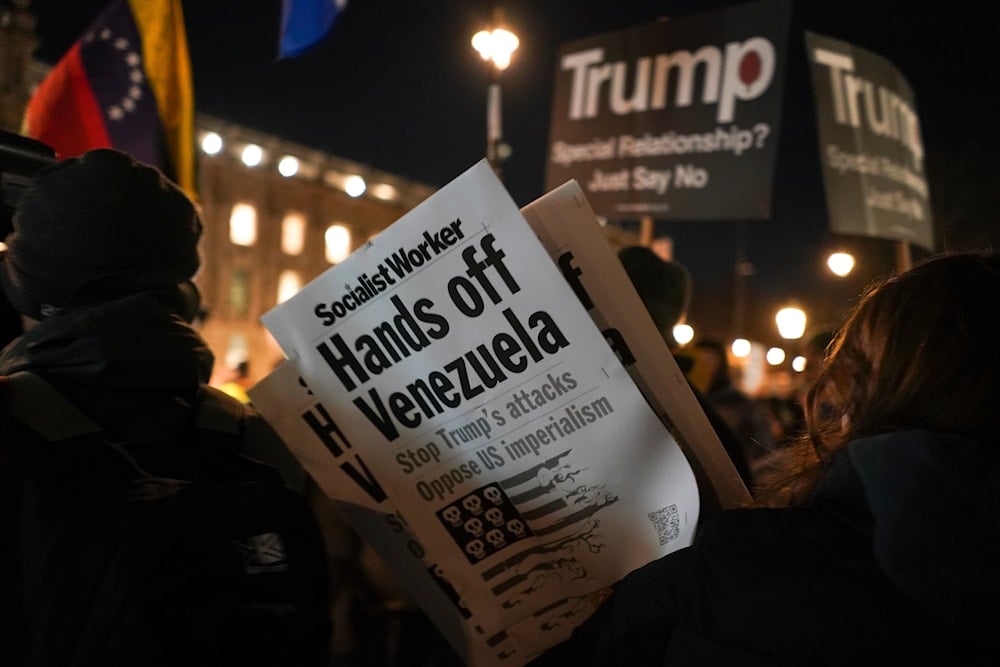
People demonstrate in London, Monday, Jan. 5, 2026, against the weekend abduction of Venezuelan President Nicolas Maduro by US forces (AP)
The United States is effectively running Venezuela during what was described as a transitional phase, underscoring Washington’s use of power and economic pressure to shape developments in the country, a senior White House official claimed on Tuesday.
Speaking to CNN, Stephen Miller, the deputy White House chief of staff and a top aide to President Donald Trump, said the United States was “managing Venezuela at this stage," calling the situation “self-evident.” Miller added that Washington does not operate “in a world of slogans or international niceties,” but rather “in the real world.”
Miller argued that global affairs are governed by force and authority, saying these were “the hard rules that run the world,” and insisted that the United States sets the terms and conditions. He claimed that Washington is currently "in charge" of Venezuela because the US military is positioned outside the country.
He further pointed to sweeping economic measures, saying there is a “total ban” on Venezuelan oil and on the country’s ability to trade. Any economic activity, he said, requires US approval, reinforcing Washington’s leverage over Caracas.
Trump has previously made similar assertions following the abduction of Venezuelan President Nicolas Maduro, stating that the United States was now overseeing Venezuelan affairs while engaging with what he described as the new leadership in Caracas.
Trump tries to impose his will on interim Venezuela adminstration
Trump has also issued a veiled warning to Venezuela’s vice president, Delcy Rodríguez, who was appointed interim president. In a phone interview for The Atlantic, Trump was quoted as saying that if Rodríguez failed to “do the right thing,” she would face consequences “far greater” than those imposed on Maduro.
On January 6, the Trump administration is reported to have presented a series of conditions to Venezuela’s acting president, Delcy Rodriguez, demanding significant policy changes that her predecessor, President Nicolas Maduro, consistently rebuffed, according to POLITICO.
According to US officials cited by POLITICO, Washington expects Rodríguez to:
- Crack down on drug flows allegedly linked to Venezuela;
- Expel Iranian, Cuban, and other "foreign operatives" the US deems hostile to its interests;
- Halt oil sales to states that the US labels as adversaries.
US officials have indicated that they are seeking for Acting President Delcy Rodríguez to enable free elections and eventually relinquish power, while also acknowledging that no specific electoral timeline has been established. The Trump administration claimed that the restoration of “law and order” must come first, effectively positioning Venezuela’s sovereignty under the influence of the United States.
President Trump and his Secretary of War, Pete Hegseth, have acknowledged that the United States aims to control Venezuela due to its valuable resources and oil wealth. In response, Venezuelan authorities have declared the full mobilization of the nation’s armed forces and, through a recently issued decree, implemented a temporary military administration over the oil sector and other critical industries considered essential for national stability.


