
Xi Jinping, Taiwan opposition leader meet in Beijing
 4 Min Read
Xi Jinping met Taiwan opposition leader Cheng Li-wun in Beijing, emphasizing unity and dialogue as political divisions and regional tensions continue to shape cross-strait relations.
-
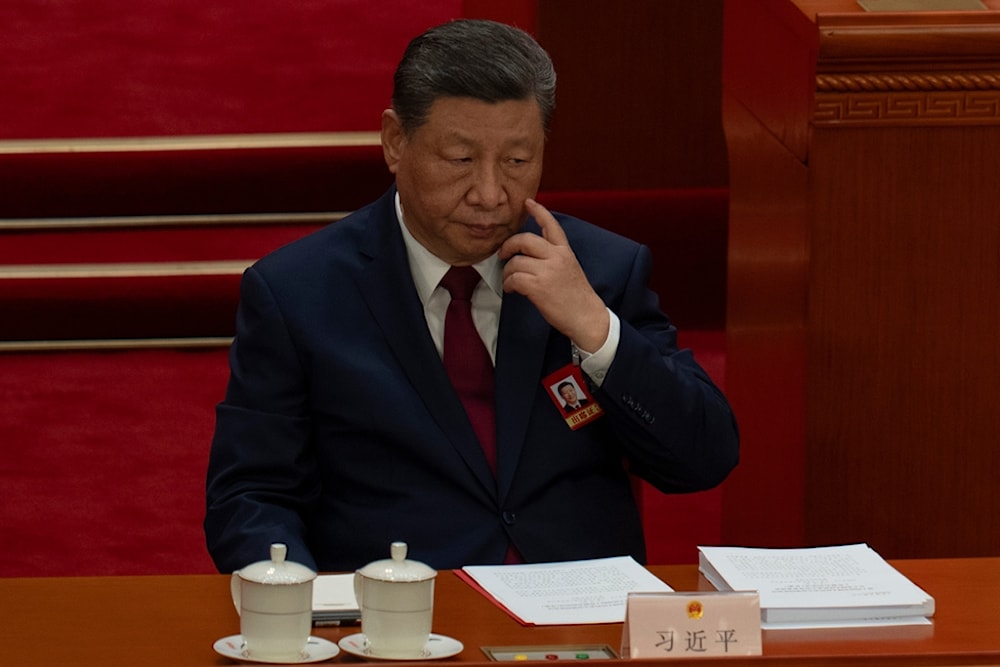
Chinese President Xi Jinping reacts during the closing session of the National People's Congress (NPC) at the Great Hall of the People in Beijing, Thursday, March 12, 2026. (AP)
Chinese President Xi Jinping stressed that people on both sides of the Taiwan Strait are part of one nation, during a high-level meeting with Taiwanese opposition figure Cheng Li-wun in the Chinese capital.
Cheng, head of Taiwan’s main opposition party, the Kuomintang (KMT), is visiting China on what she called a “peace mission” aimed at reducing tensions amid rising military pressure around the island.
Speaking at the Great Hall of the People, Xi said that “compatriots on both sides of the strait are all Chinese,” framing cross-strait relations as a matter of shared identity and collective future.
He stressed that peace, development, and cooperation represent the “common voice” of the Chinese people, adding that dialogue between political forces is essential to safeguarding stability and advancing long-term prosperity.
Xi also reiterated Beijing’s willingness to engage with various political groups in Taiwan, provided they adhere to the principle of opposing independence, emphasizing that the future of cross-strait relations should remain “in the hands of the Chinese people.”
Opposition seeks de-escalation
Cheng highlighted the need for mutually beneficial relations, stating that people on both sides of the strait seek stability and continued exchange.
She expressed hope that the Taiwan Strait would no longer serve as a flashpoint for conflict, warning against turning the region into a “chessboard for outside forces,” in an apparent reference to US involvement.
Cheng also called for the development of more structured and sustainable mechanisms for dialogue and cooperation between the two sides, stressing the importance of reciprocal engagement.
Rising tensions and political divide
The visit comes as Taiwan’s current leader, Lai Ching-te, continues to up his rhetoric against mainland China and militarize the island through arms deals with the US. Taipei has urged the opposition delegation to press China to halt its military pressure, while maintaining that any dialogue should take place with the island’s elected government.
The United States remains Taiwan’s primary international backer and arms supplier, despite the absence of formal diplomatic relations, in violation of its commitments toward Beijing.
The meeting underscores deep divisions within Taiwan’s political landscape over how to manage relations with China, alongside broader geopolitical tensions surrounding the island. With tensions persisting and external powers increasingly involved, Beijing continues to frame the issue as an internal matter, insisting that the future of cross-strait relations must ultimately be decided by the Chinese people themselves.
Dialogue, not militarization
Cheng accused President Lai months ago of steering Taiwan toward a dangerous confrontation with the People's Republic of China (PRC).
“If cross-strait relations are peaceful and stable, we don’t need a pointless arms race,” Cheng said in November, arguing that renewed dialogue with Beijing was the best path to peace.
China-Taiwan relations cannot be addressed without considering the One China Principle, which recognizes that there is only one China, encompassing both mainland China and Taiwan. Countries, such as the United States, that formally recognize the People’s Republic of China (PRC) do not maintain official diplomatic relations with Taiwan (Republic of China, ROC).
After the Chinese Civil War, which lasted from 1945 to 1949, the PRC was established on the mainland, while the KMT-led ROC government retreated to Taiwan. Most countries, including the US, recognize the PRC as the sole government of China.
Read More: Taiwan opposition leader visits mainland China, expected to meet Xi


